Thursday, April 08, 2010
A Thanks to KVPR and the future of libraries
As I was listening and speaking on the show, one of the things that kept surfacing in my mind was- how do we get our services to people? How do we connect the information that we have to them? iPads and ebooks are all the rage, and are certainly a great innovative step into our future. However, for the here-and-now, it's a question of, "how do I get this print book or this DVD to the person who wants it?"
Here in the San Joaquin Valley, there isn't sufficient broadband to provide e-content consistently and the population typically isn't affluent enough to have e-book readers or the bandwidth to download an audiobook online to their mp3 player. We need to provide the content that we currently have, most of which is non-digital. That's why I continue to be impressed with our library consortium. The San Joaquin Valley Library System includes 13 different jurisdictions, making 2 million books and other items available. If you live anywhere in the area, whether it is the biggest city such as Fresno, or the smallest community, which might be Alpaugh, you can still have access to a variety of material, from critical information to the latest bestsellers. It's all moved around by hand and delivered to your local library.
It's truly amazing what we can do by pooling our resources, responding to the community needs right now, and getting them the services they want. It's looking to the future as well, and being able to plan for future needs. However, it's the right now that needs to be figured out. How do we do that?
Tuesday, December 01, 2009
Success is determined locally
HAPLR (Hennen's American Public Library Ratings) has ranked public libraries based on several factors for many years. Attempting to compare libraries, apples to apples, by counting books checked out, walk-in business, program attendance, computer usage, and budget allocation among many other factors. Library Journal has also gotten in the game and provided their own ranking system. My interpretation of the intent is to reward libraries for doing a good job and to encourage other libraries to emulate their success.
Every year, libraries across the country must report to their state library. This data is then sent to the Federal Government and posted at the National Center for Education Statistics (http://nces.ed.gov/surveys/libraries/)
A problem with the numbers
A major problem with this statistical measure is the reporting. Every library in the United States must report on a number of indicators every year to their state government. Sometimes these numbers determine funding from the state, sometimes it doesn't. The survey system isn't very clear in what it is asking and information collected locally doesn't always mesh with what is being asked. Some of the questions are dated and do not reflect how current libraries operate. Number of internet terminals and number of computer users are only very recent additions. "Reference questions asked" has not changed either even though many librarians are answering much more than that, particularly with technology, yet the federal government does not want that tracked.
Antiquated and confusing questions can result in numbers being way too high, way too low, or not reported. As demonstrated in the Library Journal controversy, it wasn't logical that a library had 16 million computer users in a 12 month period. There is quite a bit of data that may seem illogical, but since this information isn't attached to anything financially and libraries don't benefit from this scoring system there is no incentive to take this report seriously. Why then is everyone ranking libraries based on this data?
Statistics or Success
With Hennen and now Library Journal began ranking libraries, it seems to push an agenda, focusing on excellence based on statistics rather than on factors that actually lead to success. Success based on statistics cannot be emulated. Furthermore, placing stars for these libraries doesn't help their budgets or success locally nor does it reflect why they are successful. The information used in the scoring system is also very dated. Information available to Hennen and Library Journal are typically two or even three years behind. So the scoring for the library doesn't reflect what the library is doing currently, but what it was doing years ago.
It was one thing for a marker such as HAPLR to record the scores, it's another thing to star the libraries. It makes libraries focus on the wrong things, statistical markers. It also does something else. I remember when this information was first distributed and one library colleague commented:
Is it really stating that libraries aren't doing their jobs well? That they aren't successful? I enjoyed the discussion on PUB-LIB with my favorite coming from James Casey:
"Susan's gut instinct to look behind the statistics is most assuredly useful for any of us pondering the HAPLR and LJ rating results. That is clearly evident when HAPLR gives bouquets of praise to libraries serving upscale, suburban communities such as Cuyahoga County (Suburban Cleveland) earning a rating of 893 and Baltimore County at 794 while those excellent public libraries serving large and often underprivileged urban populations draw abysmal scores like 293 for Detroit Public Library, 285 for Chicago Public Library and 385 for Baltimore's Enoch Pratt Public Library. One has to look behind the statistics to get at reality.
If one were to examine only statistical and output measures in rating the performance of Presidents of the United States (for example), Lincoln would have to be considered one of the most inept and unsuccessful of our Presidents instead of being one of the greatest. The thousands of deaths, enormous destruction of property, military blunders, idiot generals hired, civil liberties curtailed, etc. have to be considered within the context of the overwhelming difficulties and challenges he had to overcome just to save the Union and bring Slavery to an end. --- The work of urban libraries in struggling against ignorance, crime, shrinking property tax bases, crumbling schools, ward politics, etc. is just as heroic and certainly not fairly represented by such dismal scores as 285 and 293. "
Some libraries will never be ranked at the top. In fact, in the last ten years, the top ten libraries have been trading spaces, but few have gone off the list and few new libraries have gotten onto the list. What are the real factors behind this? Statistics can never demonstrate that. There are many factors to this success, many however, may not have anything to do with the library's performance. It might be the affluency of the community, the percentage of college educated patrons, or simply the local culture of the area. The library's success can be tied to the community's success and that is very difficult to measure.
Libraries make a difference in their communities/
Librarians are rock stars
I would agree with this statement. I think when librarians or library administration are noticed prominently in the community and respected that it is a true sign of library success. When the local rotary or Kiwanis group calls several times wanting your library director to speak at their next function, when they are chomping at the bit to provide funding for the library, that organizations and businesses want to be included and fund your projects because it makes them look good, and when the youth librarians get mobbed by little kids Beatles-style when they are out and about in the community- those are signs of success and of librarians being rock stars.
Tuesday, August 11, 2009
TV Appearance Great Day Fox 26
Saturday, May 16, 2009
Library Legislative Day
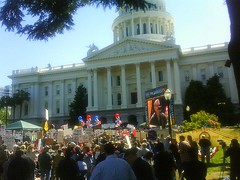
The California Library Association hosted Library Legislative Day on April 15th. (There was a press conference included, which was a bit overshadowed by coverage of Anti-Tax protesters.)
We were able to speak with our local State representatives and provide support to other libraries on several issues:
- ACA 9 which reduces the requirement for bond to a simple majority from a super majority (66%).
- Lobbied to fully fund the Public Library Fund, which allows libraries to share resources and allow reciprocal borrowing.
- We also lobbied for Recovery Act funds to be set aside just for libraries.
When it comes to lobbying and advocacy, the best stories are human stories. This story came from a library's Friends board member who attended:
"A high school student comes into the library weekly to use the computers to finish her homework online. She not only completes her own homework, but does her mother's as well. Now, the first thought is, 'Hey she is doing her Mom's homework!' In reality, she prints out the homework assignment afterward and then tutors her mom at home. Her mom can't make it to the library during its open hours. If the library were to close just one hour earlier from budget cuts, both of them would fail through lack of resources."
We can talk about how efficient we are and our great services, but the human stories often make the most compelling argument.
Friday, July 25, 2008
From Awareness to Funding Part III (how to get support)
Super Supporters

Super Supporters are avid readers with a long-standing relationship with the library.
Although they use the library only a little more than average, their relationship with
the library is strong because their emotional connection to the library transcends the
library’s practical functions. More than any other segment, Super Supporters see the
library as a place where they can better themselves and become the people they always wanted to be. They hold the librarian in high regard and recognize the value that librarians bring to the research process.p 116
Super Supporters use the library to feed their voracious
reading habits and to recommend children’s books p 118
This group supporters the library, ranking it second highest (only behind the Fire Department) for priority support. However, they support EVERYONE very highly. They are big community supporters, are influential (even powerful) figures in the community.
I always think it is interesting when libraries think organizations, groups, or individuals may not fund a library initiative because the particular entity funds another heavily. It seems to me those who fund, fund EVERYTHING well. I have never seen an either or situation. These are the "rah rah" community supporters.
Super Supporters recognize the library’s contribution to a successful community p 123
Super Supporters believe the library helps bring a community together p 124
Chronic Non-Voters
The Chronic Non Voters segment of the Library Supporter Segmentation Pyramid
represents 26.6% of the U.S. population ages 18–69 in communities with
populations of less than 200,000. Chronic Non Voters are the group least likely
to improve funding support for libraries. Chronic Non Voters are not registered to
vote, or they are registered to vote but report a track record of not voting in primary
elections, presidential elections or local elections. Chronic Non Voters are unlikely to
be motivated to vote in the future. This segment represents 0% of respondents who
said they would definitely vote yes in a library referendum. p.128
I can hear it now when I write this. "Boo hiss boooooo!" These people apparently don't care about anything. They are not involved in anything. Their lack of support isn't just for libraries, it's for everything. They have basically dropped out of democracy and don't support their local community. The more disconnected the population feels, the more the support wanes. I would go so far to say that if the general public has a tendency to distrust government, particularly the local government, support for everything wanes. Even if it isn't a problem with library performance, dissatisfaction for local government or for the local community translates to a problem with the library.
Elected Officials (Chapter 3 goes into Elected Officials perspective)
Elected officials have views about the library similar to those of the Probable
Supporters. They appreciate the added value librarians offer and see librarians as
important figures in rallying community support. Elected officials are knowledgeable
about libraries and their value, but they often do not see the library as a necessity
for the community. The library is seen as a community ‘amenity’ rather than a
‘must have.’ p132
This seems to be a balance of non-usage. Most City Councilmen don't need the library, they understand the big value in the community, but if it hasn't touched their life (they don't use it, their family and friends don't use it) that is where the "isn't necessary" comes in. In my opinion, this really goes back to a complaint issue. People will complain if they don't have adequate service and if the library provides good enough service so that people don't complain, than they are doing their job.
The Library consistently ranks below, Police, Fire, Schools, and Streets in that order. (Reality check, more people complain about the lack of these things. If there is a crime, and the cops show up really late, or there is nothing done about the crime, people get angry. If the Fire response is too slow and it is a life or death situation, that's serious. If the schools are failing, everyone takes notice and wants to know what is being done about it. If the streets are in disarray, that will also cause a trip to City Council to complain. Even though the library is used more often than two of the four services (more people visit a library in their community than need to call police for a crime or fire for a medical/fire emergency, but they do send their kids to school every day and drive them there on city streets), they aren't supported more.
Local elected officials (68%) are more likely than voters (59%) to have lived in their community for more than 10 years. Elected officials are more likely to be members of a variety of local organizations, including Friends of the Library groups. Forty percent (40%) of elected officials surveyed were members of Friends of the Library, compared to 9% of voters and 11% of Probable Supporters. p 137
Elected officials are more likely than voters to recognize library financial needs; yet 73% believe the library has sufficient operating funds p 140
I think this goes back to the complaint issue. If people are not complaining about the lack of service, then it is fine.
Advice from elected officials:
- Stress the library’s return on investment (ROI) to the community
- Build strategic partnerships
- Be proactive
- Engage voters in the campaign
- Stress the broad appeal of the library
Elected officials on library funding campaigns
Elected officials cited a number of important components required of a successful
library funding campaign:
- Messaging that focuses on the broader value of the library to the community,specifically a community gathering place, access to technology and programs for teenagers and other groups
- A passionate, committed and active champion(s) who can rally support among the elected officials and community influences
- Civic engagement, including a commitment to speak with every relevant group in the community to encourage grassroots support
- A willingness to partner with other public services in a joint effort where strategically advantageous
- The ability to ask for the right support at the right time:
- Voter turnout is greater for general elections than local elections
- It is often easier to campaign for a new building than for operating funds.
The next part focuses on how people vote and awareness. Many people who say they would vote for a bond issue, may not do so.
Furthermore, it states that while the breakdown of support is 37% definitely yes, 37% probably yes, and 26% no the probably part should concern libraries.
Familiarity with the full range of library services was not a determinant of library funding support for the library’s top funding supporters. p 148
Neither was usage
Frequency of library visitation is not a determinant of funding support. p 149
A definite need, the "passionate librarian"
These five attributes can be combined to describe the ‘passionate librarian’:p152
- True advocate for lifelong learning
- Passionate about making the library relevant again
- Knowledgeable about every aspect of the library
- Well-educated
- Knowledgeable about the community.
The library is perceived as a service that provides ‘information with a purpose.’ As the framework illustrates, this perceptual territory, ‘information with a purpose,’ is a very crowded space. There are many other information and learning services located in the same quadrant including Wikipedia.com, online bookstores like Amazon.com, search engines and bookstores.
These brands and services are redefining the role and definition of information.
Belief that the library is a transformational force in people’s lives is directly related to their level of funding support.p 156
Rewards Framework:
- Helps create who you are
- Makes you feel good about yourself
- Allows you to appreciate the beauty in life
- You come away feeling like you really learned something
- Fills you with hope and optimism
- Empowers you
- Helps you seek truth
- Serves a serious purpose

The library needs to be transformative. Libraries that are perceived the same as "watching a documentary" is a snoozer. Libraries perceived as taking a class for fun, going to a religious service, or getting a college degree are better. How can I change myself? How can I improve myself? What can I learn today? Rather than functional like reading the newspaper.
Increasing support for libraries may not necessarily mean a trade-off of financial support for other public services. p158
The public library receives just under 1% of the total local operating budget. p 158
A side-by-side comparison of the willingness of a voter segment to increase taxes to
fund local public services, including the public library, shows that a willingness to
fund one service is often similar to their willingness to support other local services. p 158
Elected officials are supportive of the library—but not fully committed to increasing funding. Engaging Super Supporters and Probable Supporters to help elevate library funding needs is required. p160
DING DING DING. Don't go after Mayor and Council, go after the people who have influence over mayor and council. Who are those people? Who do Mayor and Council listen to? Those are the people you need to talk to.
Best Factors for motivation
Early memories, the library as a transformative force (your storytime kids will ensure funding in the future )
Current perceptions are important. The idea of what the library can do and what it represents
a lot of other cultures and things out there that a small town of
4,000 doesn’t provide access to. The library is literally
a window on the world.”
(Super Supporter, McPherson, Kansas) p 169
During the course of discussion it surfaced that, even for the most passionate lovers of the library, the library is becoming less relevant. Access to information from other sources, often the Internet, is changing the relative importance of the library. Many assumed that usage of the public library is down as ‘other’ people are increasingly turning to the Internet for information. p 171
Brain Drain. You’ll close off the mental capabilities of the people.”
(Super Supporter, McPherson, Kansas) p 172
I felt the presentation to the population was a bit extreme. You either have libraries or you don't Yes that shows what the impact is, but it doesn't address an unfunded library. I think the extremes here are troubling and unhelpful. No we don't want it to close, but will we allow the library to be underfunded? And what is underfunded in the average community member's mind. What is underfunded? What is the community member willing to accept?
Library's Relevance is questioned
- Information: The library is one of many sources of information. It could potentially be replaced by a combination of bookstores, schools, coffee shops and the Internet.
- Institution: The library is an institution sometimes associated with an out-of-date building, aged materials and limited accessibility. (The library has limited hours, the Internet is available 24/7.)
- Nice to have: Availability of so many other options for information and learning make the library a ‘nice to have’ service, rather than a necessity.
- Past: The library is an important part of supporters’ lives, but they question whether it is still relevant for their children and grandchildren.
- Altruism for others: The library is less important to them, but it is important for ‘other people’ in the community.

Why people vote no
Even though the libraries in that town were closed at the time of the focus group research, the Probable Supporters were planning to vote ‘no’ at a pending library levy to raise the operational funds that would allow the library to open. This was not because they were against the library,
“Feeling good doesn’t equate to voting ‘yes’ for a library referendum.” but they saw it as a personal statement against the local city council who they felt had mishandled funds that had previously been raised for the library and then placed into the general fund. Even in that situation, the residents believed that ultimately the funding situation would be resolved and the libraries would reopen. p 179
I remember the City of Mesa in Mesa, Arizona when their property tax initiative failed. It was perceived by the public that the city had mishandled funds and that this was a bailout. Some other failed initiatives have the same theme, "We feel you mishandled our funds.", "We feel you are not going to use these funds what you say you will." Track record of previous projects will crop up. Does the library appear to be using its funds adequately? If there are detractors, what are they saying, is it being addressed. If you have a bond or referendum election during an off election year, the no vote becomes that much stronger. If you have that same election during a Presidential or Congressional election cycle, you will have a better chance at success. I wonder if OCLC actually looked at the stats on that?
Probable Supporters and Super Supporters felt that support for libraries
can be improved by increasing the public’s attention to four essential community benefits that the public library uniquely delivers:
- Equal access: “No kid should have an excuse for not having a book or knowing how to do research. If you don’t have a computer at home, you can go to the public library.” (Probable Supporter, Huntsville, Alabama)
- Shared community values (or teaches values) “It’s one of the few things that truly can provide a sense of community. It doesn’t belong to anyone but to all of us. It’s a good lesson in respect, being quiet, signing up for Internet time, returning books on time. It’s kind of a good building block in respect.”
- A sacred place “It’s a gathering place where lots of different people can listen to someone else’s ideas, whether spoken or written.” (Super Supporter, Medford, Oregon)
- Community stature. “It represents a commitment by the community to cultural and intellectual activities.” (Probable Supporter, Pittsburgh, Pennsylvania)
Some objectives
Make the library relevant for the 21st century.
Instill a sense of urgency by putting the library in the consideration set
for local funding with other public services, like police, parks and fire.
Activate a conversation about how the library is a vital part of the
community’s infrastructure and future.
General conclusion. This is the same research you can find on getting any bond election passed. They are the same issues for the community as for the library.
The city wants to pass a bond, the perceptions must be the same. You must also time this during a big election with already high turnout. Any negative campaigning can be drown out.
If there has been some scandal in finances or if this is perceived as a bail-out, expect a no vote.
If you have tried a levy, etc, and it failed, and you are going again and haven't changed the package, you will continue to fail.
Most U.S. residents are aware of the traditional ‘informational’ library services, such
as books, newspapers, magazines and Internet access. Far fewer know about the
many value-added and ‘transformational’ services provided by their libraries, such as
teen programs, computer training and ‘English as a second language’ (ESL) classes.p195
The transformative nature. Let's look at activity based costing. The most expensive program is the tutoring program. It is the most transformative, but most costly. These people will be supporters and the people who understand that need will support us supporting them. The person must see the need.
Today’s support comes from those who believe libraries transform lives. I would also state that a library that is perceived to do this, even from people who have not participated in the library, would show support for a library that does this. In fact, the person who sees that the library is doing this will support the library more than the person who is actually using the service for that need. This is generally why libraries that are more successful are action based (strategic plan) versus stats based (your stats went up, so what?). They can also change the perception of the library. If the library is perceived to be old, run-down, and mis-managed, you won't get funding even if you need it. If the library is perceived as modern with modern conveniences, even if the library doesn't need the funding, they could get it if they asked. Is it just a perception issue that libraries can work on with a focus on how the library transforms people rather than provides access to things? There is a great deal to ponder here.
Sunday, July 20, 2008
From Awareness to Funding Part II (The Probable Supporters)
The next section covers the Probable Supporters. The Strong Supporters section, briefly mentioned, spoke of community members who strongly supported the library, but did not necessarily use the library extensively (it comes later). They understand the value of the library and the benefit to the community.
However, the Probable Supporters support the library because they use the library. The Four categories of probably supporters are:
Just for Fun
Kid Driven
Library as Office
Look to Librarians
Greater Good
JUST FOR FUN
"The Just for Fun respondents are the heaviest users of the library, reporting an average of 36 visits per year."p 71
"While the Just for Fun voters are the heaviest users of the library, they are the least likely of all Probable Supporters to vote in favor of an increase in library funding. p 71"
That matches the Financially Strapped as two categories of heavy library users that are the least likely in their categories to fund library initiatives. This group obviously favors the library and would support it in an election, but I wonder where the line is crossed for this group to go from supporter to non-supporter (the bad economy affects this). Furthermore, one identifies it as a need, but can't afford more, whereas the Just For Fun don't identify the library as a need, but a want.
"They see the library as a place to relax, hang out and socialize with others and recognize the library’s role as a community gathering place. However, they are not as emotionally connected to the library as other segments on the Probable Supporters tier and are less likely to support it financially. p 71"
Does that mean they like it, but consider it frivolous?

I have to say, I find it odd whenever respondents state the top thing they check-out are non-fiction titles when my circulation data states otherwise. (you'll see this pattern throughout)
In my library's master plan study, the results here were similar. The majority of people stated they checked-out non-fiction and used reference the most of any other service.
My stats say Fiction/Bestsellers and DVDs.
"The Just for Fun segment represents almost a quarter of all library visits (23.9%).p75"
This part was interesting:
"The Just for Fun segment has a greater awareness of what is available at the local public library than average for all voters. In particular, its members see the library’s Internet access as a big draw and they love to read. They have the same positive associations with the library that are common across all Probable Supporters segments but have less of an emotional connection than other segments on this tier. Compared to other Probable Supporters, Just for Fun respondents are less likely to see the library as a place that helps them improve intellectually, creatively or personally. The library is a place to hang out and socialize, and Just for Fun respondents value the library’s role as a community gathering place and social hub.p 76"
Does this mean library initiatives for making the library a community space creates high usage, but doesn't create any more support?
This seems to explain the the phenomenon I remarked on in the first part of this post. We have high usage, but funding comes a bit more slowly.
Is the community hub a bad idea if it doesn't translate into community support?
"The library is seen less by Just for Fun respondents as a place to better themselves intellectually, creatively or personally. p. 79"
Just for Fun respondents have a tendency to be uninvolved in the community, but make a point of voting in local elections. Their their voting habits tend to be liberal and respondents are the least likely Probable Supporters to definitely vote yes for a library referendum
KID DRIVEN
"Kid Driven respondents visit the library more than average with 19 visits reported annually. They are typically accompanied by at least one child. They regularly check out materials for children and participate in the children’s programming. Kid Driven respondents are willing to support the library financially because of the role it plays in educating and inspiring their children to be the best that they can be. p 80"

"The Kid Driven voters are emotionally connected to the library, seeing it as offering an
exciting and diverse experience that inspires them and helped shape their identity.
They hope the library will do the same for their children. p. 85"
Back to the emotional connection discussion. They understand the power of the library to transform. The value their children's education and library's potential to help. Parents are some of the best advocates of the library. They can physically see the advantages demonstrated in their child's advancement.
LIBRARY AS OFFICE
The library as office segment takes advantage of the library's technology and resources. It "fulfills a practical function and is more about knowledge than a personal connection".
"Library as Office respondents are more likely than other segments to operate businesses or work in the same towns where they live. They have a tendency to live in smaller, rural towns across the Midwest. p89"
18 visits annually

"The Library as Office voters feel that they always leave the library having learned something new. Their connection to the library is practical rather than emotional and their ideal library would offer services tailored to the business user. p 93"
Library as office segment see the library as a resource; it has the tools they need. They are very knowledgeable and are aware of library tools with little or no assistance. They use the Internet because of limited access at home and like library environment. They like the learning environment. It's all practical, it's about information, but there is no personal connection.
There is no transformational connection.
Library as Office wants more business support. I liked this part, very detailed. This is a careful line to cross for libraries. If you are dedicated to small business support, the office resources provided to the public are critical, but are very time consuming and costly. In this case, the library duplicates some of the resources you can find at a local Office Max.
"The Ideal library: A resource for small businesses: Provides all of the resources a small business would need, including free temporary office space, computers with Internet access, phone, copier, scanner and fax machine. It would also provide access to online databases like ABI/Inform as well as other business-related resources like books about finances, marketing, etc. Resource for tax preparation: Provides tax forms, access to tax preparation resources and step-by-step guidance during tax season Workforce training center: Provides instructor-led classes on entrepreneurship, presentation skills, computer skills, sales generation, financial planning, marketing and other business-related topics in order to improve the workplace skills and marketability of community members" p 95
They are more likely to be Friends of the Library. (That explains the Friends support for me. Lot's of business buy tables, donate money, but may not come to dinner or library.)
LOOK TO LIBRARIANS
"Look to Librarians voters have the foundation of a strong emotional relationship with the library and they see the library as a place where they can better themselves intellectually and feel like they belong. They also see the library as a place to escape from everyday life. p 97"
"...this is the only segment to rank public libraries as the number-one priority for an increase in taxes across all seven public services surveyed, outranking the police and fire departments and public schools. p 97

"Look to Librarians voters volunteer in their community and at the library and are active participants in local organizations. They have a long-standing and ongoing relationship with the library. This relationship has led to a strong emotional connection and a sense of belonging. p. 102"
GREATER GOOD
Although this group uses the library infrequently with only 4.5 visits a year, its members believe that the library plays an important role in serving the needs of the community and can be a great source of pride.p. 107

The Greater Good respondents see the library as a noble and necessary institution, a source of pride in a community and a place that brings people together. They believe that the library turns people into thinkers and achievers instead of passive participants in life. p 112
This covers up to page 112. Part III will cover the rest and summarize.
Thursday, July 17, 2008
From Awareness to Funding Part I
Some of the points in the document provide keen insight to why referendums and levy votes fail. Some of the points I don't agree with as I see them as points very difficult to convey, such as explaining where the library gets its money. Some financial analysts cannot clearly decipher and explain the complexities of the local taxing system. It is difficult to do that without appearing too obfuscate. The density of the annual report is enough to scare anyone away.
Some highlights for now:
(Introduction: Funding the mission)"While successful in raising demand, the majority of library campaigns have been aimed at promoting library services and driving library use,not increasing library funding."
YES!!! This is where my library is right now. We have huge increase in demand, but we are very slow to catch up to it.
"Our hypothesis:U.S. public libraries are facing marketing and advocacy challenges that have been faced by other ‘super brands.’ Lessons learned and successes achieved can be applied to increase library funding. Utilizing marketing and advocacy techniques targeted to the right community segments with the right messages and community programs, we can improve the state of public library funding."
There were eight important findings derived from the quantitative research:
1. Most people claim they would support the library at the ballot box—fewer are firmly committed to it.
2. There is a lot that people don’t know about their public library.
3. Library support is only marginally related to visitation. Advocating for library support to library users focuses effort and energy on the wrong target group.
4. Perceptions of the librarian are highly related to support. ‘Passionate librarians’who are involved in the community make a difference.
5. The library occupies a very clear position in people’s minds as a provider of practical answers and information. This is a very crowded space, and to remain relevant in today’s information landscape, repositioning will be required.
6. Belief that the library is a transformational force in people’s lives is directly related to their level of funding support.
7. Increasing support for libraries may not necessarily mean a trade-off of financial support for other public services.
8. Elected officials are supportive of the library—but not fully committed to increasing funding. Engaging Probable Supporters and Super Supporters to help elevate library funding needs is required.p 24
"Respondents who have the strongest beliefs that the library is a source of transformation are those who are most passionate about the need to protect, support and fund the library." (p 25)
"Instead, the research indicated a need to appeal to both the heart and mind of the potential voter, positioning the library as an important part of the community’s infrastructure that plays a key role in providing equal access to resources vital for thriving in today’s digital world. (p25 "
Overall, I have marketed the library and advocated for the library. We are embedded in the community, people see our value.The friends group makes $25,000 that goes right into library projects. We passed a bond by 66%. However, the traffic exceeds the funding right now. It always will in government. I wonder what the breaking point is.
I liked the breakdown in this pyramid for library support:
FINANCIALLY STRAPPED
"The Financially Strapped generally believe that the public library already has sufficient funding. The Financially Strapped segment is more than twice as likely(53%) as the average for all voting respondents (23%) to believe the library should be able to operate on its current budget. This segment is not willing to increase taxes for library funding." p 48
Generally, the Financially Strapped won't pay for extra funding. I can understand that without all the graphs and charts. If you can't make ends meet, you can't afford another dollar no matter WHAT the value is. It's called being nickled and dimed. (I have to say look at that discrepancy near the bottom. That's a 22% difference between those who attend literacy programs and those who would support additional funding.)
"The most defining characteristic of this segment is its members’ lack of involvement with their local public libraries and with their communities as a whole. The Detached segment is the least involved with their library of any voting segment. They use the library less than other segments and do not see its relevance to the community. p 50 "
I see this as a problem with a new segment of the population moving in. With the recent housing boom, many communities are seeing many new faces. Have those faces been integrated into the community? A bedroom community could have this problem. A community in which the residents go elsewhere for shopping or other amenities hurt that community as a whole, not just the public library.
"The Detached segment tends to have higher household incomes than average, with 29% having an annual household income of $100,000 or more,compared to 19% of the total voting respondents. p 50 "
This also fits with my community. We have had a housing boom with more white collar households.It has been difficult to engage them or even to get them to shop in town. This is mostly due to them moving to the northern side of town and commuting to work and leaving to go shopping on the weekends.
"They are more likely to have Internet access at home than other voting respondents and think that the information provided by the Internet is as good as that provided by the library.p50 "
"Not only are the Detached respondents uninvolved with their local libraries, they are uninvolved with their communities. They pay less attention than average to issues around local politics and the local economy, and are less-frequent consumers of local media. The Detached segment tends to believe that everyone in their communities has Internet access. They fail to recognize the library’s role in providing equal access to technology for community residents.
With higher than average income, the Detached segment is better able to afford an increase in taxes to support public services than many other segments. But lack of connection to or interest in the library and their communities make them unlikely to support tax increases to fund the library.p 50 "
I can understand this. If I don't use it, why should I pay for it? This is the segment that want to lower taxes. Some would say, "I don't want to pay to help the poor or someone else." What if some Library Directors fell into this category?
The Web Wins
The web Wins section is a no brainer. This is the biggest, "Isn't everything on the web?" segment you always hear. Librarians try to get this segment by placing library services online. Sometimes I wonder if some librarians are getting too far into this realm. (As in using the web so much that they don't use their own library.)
I will post a second post and an overall summary...
Monday, December 03, 2007
Library Advocacy or people like to bet on the horse that has already won
It's an investment
Instead, people want to see their money as an investment in their future. If you were starting a business, you would come up with a business plan, ask a bank for a loan, then ask some investors for money. In this way, advocacy is presented as an investment not a band-aid. They want to invest in something that will benefit them, their community, and makes them look smart. Furthermore, nobody would want to invest in something that would appear as a risk, they want to invest in something that is already successful and will make them money. In short, people like to bet on the horse that has already won.
How would this approach work?
Here are some examples of the use of language from crisis to investment:
Example 1: We're out of space!
The library is out of space for materials, we need more building or we won't be able to add more materials!
The library is planning an expansion to provide an enhanced collection for your needs.
Example 2: Our computers are old and broken!
The library needs more computers to bridge the digital divide, otherwise people will be left without access!
The library is planning to expand its technology access with more computers. This enhancement will ensure that you will be able to get on a computer whenever you want to.
Example 3: We need a new main library!
Our current library is in poor condition. A consultant recently stated that the building was so bad, that it had a terminal lifespan of less than five years.
The library wants to ensure great library services that is always available to them and close-by. This new branch will enhance services for the future.
Good News versus Bad News
Don't get me wrong here, if the library IS in a major crisis, this information shouldn't be hidden. However, if you always lead with the bad story, it doesn't make anyone feel good. It makes the community feel like they don't care about their library. Worse, it makes the budgetary authority look bad, which will make the road for increased funding more difficult in the future. Furthermore, dramatic approaches like closing on Sundays only hurt the users of the library, it doesn't cut across to the right people. Bad news can be overwhelming.
Part of this post was inspired by two things. Walt Crawford's recent rant about non-profits where he talks about what works for him in getting him to donate.
"Somehow, Second Harvest (which gets incredible value for every dollar contributed) manages to get by with one or at most two mailings a year. No unwanted crap. No real guilt trip: They lay out what our money can buy, they lay out–succinctly, without horror stories or grotesque photos–what the problem is. It’s a pleasure to write a good-size check."
When I read that, I thought "That's true, people don't want to hear bad stories, at least, not all the time. In fact, people will begin to filter you out if your story is always the same and always bad." Hence, I wrote this post. I am also reminded of the failed property tax vote in Mesa, Arizona and the failed levy vote in Jackson County, Oregon. They both sold the vote as a bailout. All this demonstrated was that they were incompetent as opposed to providing an enhancement or improvement. Transparency helps in this process. If everybody already knows your situation, bad news doesn't need to be touted. Everybody knows that you are doing all you can to provide good services, therefore, when you ask for funding, it is pretty clear as to why.
Monday, November 19, 2007
Using your media, Elevator Talk vs. TV Talk or How I ended up on Good Morning Arizona
Good can be as communicable as Evil
I remember listening to This I Believe audiobook from NPR. There was an essay by Norman Corwin called Good Can Be as Communicable as Evil. Here is a quote:
"Because of the principle that a calm sea and prosperous voyage do not make news but a shipwreck does, most circulated news is bad news. The badness of it is publicized, and the negative publicity attracts more of the same through repetition and imitation.
But good can be as communicable as evil, and that is where kindness and compassion come into play. So long as conscionable and caring people are around, so long as they are not muted or exiled, so long as they remain alert in thought and action, there is a chance for contagions of the right stuff, whereby democracy becomes no longer a choice of lesser evils, whereby the right to vote is not betrayed by staying away from the polls, whereby the freedoms of speech, assembly, religion, and dissent are never forsaken. "
In telling the library's story, it is imperative to find interesting positive news stories that demonstrate the library's impact. We cannot wait for the media to create a bad story. They inevitably will if we remain mute.
What are your stories?
What good stories does your library tell? At my library, we tell about impact. We can tell about the joys of reading, the available technology, and what we are able to do for the community. Developing the workforce so that there are better qualified applicants for jobs which, in turn, draw more businesses into the community. We provide a literacy program so that more adults and read and write in English, thus further bolstering the economy. We provide public space where free thought and discussion can take place. It is where everyone is welcomed and a community is built and joined together from all walks of life. We welcome teens and create spaces, services, programs, and materials for them. We are a space that represents the community and assists in its construction. Everyone knows our story and knows about the library because of our efforts in getting the message out. Yet, I was still surprised when I received the call from Westcor in conjunction with Channel 3 and Good Morning Arizona.
Going on Good Morning Arizona
What was amazing about it was that when Channel 3 was trying to find a story about our community in conjunction with the opening of a new regional mall, the library was suggested. I received the call several weeks ago that it was a possibility, but wasn't sure if it would happen. Then, two weeks ago, it was confirmed. I would be on the show at 8:15 with Brad Perry. I was really excited about it at first, but then I began to worry. What would happen on the show, how much time would I have, and how would this all work out? I began to worry a bit more about it when they called and said that some people request questions ahead a time, but that they weren't going to do that. I didn't think it would be a problem, but then I began to think about what I would be asked, how would I respond, and how would I be able to convey our message with no preparation and nothing but my wits?
I think my performance went well. I rolled up to the site and staged the bookmobile, satellite dish running, laptops, books on display, library cards, and anything else I could think of. Brad came over about five minutes before we began and looked at the Inglis Sin Barreras, wondering what it was. I told him that it was a English acquisition kit for Spanish speakers and that it meant English without barriers, without borders. He liked that and used it as the lead in. I think I did fine in my response.
Elevator Talk vs. TV Talk
Afterward I was reminded of a story about advocacy called elevator talk. If you were stuck in an elevator and someone asked you about libraries, what message could you convey in the few minutes you had? In this case, it was a TV talk in which I had even less time to respond and advocate, plus it was on live television so appearance plays a bigger role.
Will it make impact or is it the result of already good work?
In the end, I had about one minute. I doubt it could have conveyed any message in that short period of time. Anyone I told who was actually waiting for me to come on probably would have missed it. Luckily, my wife recorded it for me and I was able to post it to my blog and share it with my board, library staff, and the general public. The actual piece hasn't had the impact as other media formats. When the library made the front cover of the local paper, our phones rang off the hook for literacy volunteers, questions about the library, and increased usage.
I realized though, that it wasn't the television appearance that was really the impact, it was an outcome of the library's good press. When Channel 3 was looking for a story, everyone suggested the library. The movers and shakers in our community know the library is place to get a good story. There is no mystery as to how we operate, what our resources are, and why we are successful. We also have 90% of our community owning a library card. That is often twice as many as the average community. One of the other tests I personally do, is to see what people are reading. It is really neat to go into the public schools and see that the teacher has a whole bookshelf of the public library's books for their kids to read. It is wonderful to be out in public and see a child reading a book, and knowing it came from our library. I always check for the spine label. That is a better result than going on television.
Saturday, May 26, 2007
Dare to Dream: A best practices document to further the needs of Adult Literacy
SNIP
National Council on Adult Literacy
Dare to Dream
A Collection of of Papers from a Resource Group of 102 Educational and Literacy Professionals
http://www.caalusa.org/daretodream.pdf
Suggestions and clusters center around several broad themes: (parenthesis mine)
- Make adult education a mainstream education system with strong articulation to post-secondary education and occupational training. (Workforce development)
- Articulate clearly that adult education and literacy provides economic benefits to students via workforce preparation and postsecondary education. (Adult literacy and workforce development go hand-in-hand.)
- Establish clear goals and a few achievable priorities
- Treat ESL/immigration as having high importance (This is a larger part of the workforce than most would admit. We also rely in it more than anyone would admit.)
- Ensure teacher quality and elevate status of adult education professionals
- Improve both the accountability system and assessment tools (probably heading towards performance-based budgeting)
- Make far greater use of technology and distance learning to improve service and expand outreach. (Online resources such as Rosetta Stone, bookmobile services, and remote internet access are key to this. Those in need may be reluctant to go to a center such as a library to get assistance.)
- Adopt and mobilize new approaches to building public awareness and business advocacy--especially at the state and local levels--as part of comprehensive planning for education and economic development. (Again if you talk to many businesses, they find adult literacy a very critical component of their operations.)
- Strengthen ongoing basic and applied research
- Differentiate local, state, and federal roles
I think the best piece talked about how the GED was not the end-all be-all of Adult Education. Most of this population goes through this process to get and hold down a job. The GED is just a piece of paper without a job.
SNIP
Members believe attainment of the GED and increased levels of basic skills proficiency as measured by standardized tests are not adequate measures of preparation for further education and job readiness, and the GED should not be considered the terminal goal of AE (Adult Education).
END SNIP
SNIP
Most members believe that AE is more likely to be sold to the public through a "top down" process via elites, as part of economic development initiatives.
END SNIP
The same could be said for making the case for the need for public libraries as well. Getting the right people involved and placing this need in the context of the "elites" priorities makes for successful advocacy.
Friday, March 16, 2007
Feeling the same way all over again
It also makes me feel like "the man" (not like I'm cool "the man", but I am the authority). I always like the ad from the Samuel L. Jackson movie, He walks the walk, the man just talks and talks. Explaining all the complexities of how a library is run can make anyone's eyes glaze over. I usually try to make it exciting by just talking about the end result.
I do find all that stuff exciting. I love a challenge and finding grant money. Some of the intracacies I find interesting will bore even a librarian to tears. I just have to be careful to tell the difference between tears of joy and tears of boredom.
The library can get $100,000 by applying to e-rate, wow. That works. E-rate money is from the federal government (eyes glaze). You pay a fee on your phone bill to the universal service fund in which funds library and schools telecommunication needs (starting to drift off). It can also....snore. Talking about the details on how that is done will make you want to drop off a cliff.
Then you get into acronyms, the kiss of death. What is LSTA again? I always make the mental note of stating the full name before using acronym(as if I am writing a paper). Otherwise you get, "This LSTA grant will....snore. "
Its all about results. This saves you money (enter exact dollar amount). This expands computer acccess (every third computer user is a teen, making the library a "third place" for them in the community.) This database helps our literacy efforts (you can learn to speak Spanish online for free through the library's website). We are exploring ways to provide programming online for our users(you can see last week's program online through our website). And on and on.
I think that is why ALA and PLA went towards performance based results rather than just stats, it tells a better story. I certainly like to tell stories. I get excited about our services, I hope I can do the same for others.
Saturday, March 03, 2007
From Boing Boing, Ultra Violent Librarians
Jack of Fables: great new Fables collection
By Cory Doctorow
"Jack follows the story of Jack (of beanstalk, giant-killing, spring heels, etc fame), a rogue Fable who is banished for the sin of making best-selling movies about his adventures. He is kidnapped by mysterious, ultra-violent "librarians" who are responsible for neutering the old, mean stories and turning them into tame, docile things, and plots a grand escape for he and his fellow captured/forgotten fables. "
Read the whole thing here:
http://www.boingboing.net/2007/03/03/jack_of_fables_great.html
Saturday, February 17, 2007
Successful Saturdays: Keeping in good with the press
Is it this?
![]() |
In some communities, you can ask the question, when was the last time you visited your public library. The reply can sometimes be, "There is a public library in town?" I remember when I first interviewed for a job at my library, I didn't know where the public library was. That is still one of the things that I don't like about my library, its location. A library should be located off the main street so it can be seen driving by. In addition, the library is the old city hall building so it doesn't look like a library.
Often, the perception of public libraries are that they are a throwback to the 1950s. You can insert the obvious antiquated references here (you know the glasses, the hair in a bun, shushing, dusty old books). It seems that many people have not entered into a library in quite some time. The obvious perception of libraries are the first two pictures. However, you want the perception to be the third picture. People at the library enjoying everything the library has to offer. It is not just about books, or computers, it is about a sense of place. It is somewhere to take your family to get an education, entertainment, and a great experience.
The younger generation that never has entered a library are stuck with stereotypes from the media. They will see more saturation from television and the internet's perceptions of libraries, than from actual libraries. In order to combat this, you need to take an active approach in getting attention for your library.
When I first started working at my library, we had no programming and some technology classes (in which attendance was dismal). Circulation wasn't bad, but it seemed that most of the community did not know where the library was. After doing some research, I realized, there was no way we were telling the public about us. No articles in the newspaper, no press releases, no calendar of events, nothing.
I began to write press releases for the local newspaper. It began to get some attention, but the articles were placed irregularly and usually not in enough time for people to be aware of the program. Most of the attendance for programs (if anyone showed up) was between zero and seven people. It was hard to continue with such low attendance. It wasn't until I had a big series of programs in February, did things begin to take off.
The library was conducting a focus group on the direction of the library. It was mostly a defensive maneuver to ward of cuts to the library budget. (It was post-9/11 everyone was getting cut.) I had a series of cultural events I was planning for February. Most of them came from the Arizona Humanities Council. I hoped to get all of the events together at the beginning of the month in a big spread. The paper did one better by getting images to put in the paper of the performers, a full page spread, and well ahead of time. I ended up getting 45 people for the first program, 30 for the second, and 20 for the third. It was a huge success. So when the focus group was asked if they knew about library programs, they said yes and that they checked their local paper for it.
In this vein, I developed a weekly library news section in the paper. Every Tuesday, we were able to have the paper run the library news for the week. Now people can expect when to get the news and were informed well ahead of time of programs. However, it gets better.
Over time, we began to get reporters from the local paper to cover library news. They came to library board meetings. Some of the first articles they ran were not positive and the information was incorrect or out of context on many occasions. The worst one was when they identified someone else as running the library (grr!). So when the library began its strategic planning process, it was a golden opportunity to change the perception of the library in the newspaper and the local community. I asked the paper to send me a reporter to cover the event and to participate in the process. They sent me the same reporter who made the mistake in the paper (double grr!)
The strategic planning process changed the communities perception of libraries. The reporter wrote a wonderful article about how libraries are not what you thought them to be. That classic, libraries are not about books article, it was great. The community's perception of the library was beginning to change. This is exactly what we wanted.
The best part came just last year. We had been receiving consistent positive coverage from the local paper. However, the lead reporter had never written an article about the library. We received coverage from the valley life reporter and other reporters, but nothing front page, no major article.
In April, I gave the library's annual report to City Council which described our efforts toward fighting adult illiteracy, creating a place for teens, and creating opportunities for workforce development. I was hoping for a big article because we had just started our adult literacy program and were accepting tutors. It was a big step. However, a week went by and no article. I was very disappointed. I had worked so hard, but I still did not get anyone's attention. Then, after a week, the article showed up. It was FRONT PAGE ABOVE THE FOLD! It even had a picture of the chart I provided showing the adult illiteracy rate in the community. We received a dozen calls from the public wanting to be tutors for our program. It was fabulous.
Ever since then, whenever I make a presentation to city council, there is a good chance there will be an article and for that article to be on the front page. If I apply for a grant, request a council action, or described progress on a library issue, it gets great coverage.
Furthermore, since we were receiving such good press, attendance at the library shot up. The April article resulted in twice as many sign-ups for summer reading, circulation, computer use, reference questions, and more are all up double digits. We get coverage in the local paper, the local magazine, and free monthly newspapers throughout town. If there is an event in the library, everyone in town knows about it. Just this week, we had two articles and one photograph of our new bookmobile in the paper. We have market saturation. Oh, and the third picture above, that is a local politician who came to the library for a photo shoot for her campaign advertisement.
Some tips on how to get your marketing started:
1. Find out how people get information.
There is always a source of information. A local newspaper, magazine, radio or television show, and sometimes even word of mouth works. We receive coverage in the paper and magazine. When we did some planning for our Spanish language outreach, we talked to the right people since usage of our Spanish language materials shot up right afterward.
2. Get to know your local media.
Who covers the big stories? Who covers the valley life? Who handles the calendar of events? These are all essential to drum up business for your library.
3. Get to know your local photographers for the local media.
Sometimes a photograph is just as good as a news article. Get your name out there. Call the photographer and ask them to come to your next storytime. Have them take a picture of you with your 20,000 customer of the month. Do something creative, just remember, they don't like talking heads. The shot needs to be framed.
4. Create a calendar of events.
Always have library events or library news. Even if you don't have any events there is something going on in the library that no one may know about. Did you get a new database? Did you get a bunch of new books in? Libraries are happening places, just talk about it.
5. Write press releases.
You always need a snazzy headline. It needs to get the reader's attention. Make sound (music) @ your library, Fight the harsh summer sun @ your library, do something creative. People will most likely go to a good program, but you have to fight the many headlines of other events going on at the same time.
6. Create newsworthy events.
Sometimes a good angle always helps. If you are having a storytime, you can advertise getting your child ready to read at your library. Talk about the increase of people using your computers to apply for jobs.
7. Use your monthly reports.
If you are using a strategic plan, then you probably need to report on its progress each month. This is a time to shine. Show how much the library is being used, demonstrate your impact by how you are accomplishing your goals. Have lots of pictures and charts and use bullet points to make your messages clear and succinct.
8. Find out what stories interest the paper.
If they are pro-library, great, if not, change their perception. There should be a theme that the library likes. Read anything written by the editor and show your library's accomplishments in the same light.
9. Always find an opportunity.
There is always an opportunity for a news story. When our library broke 20,000 circulations in one month, I found out who had the 20,000th circulation, threw some stuff in a bag and presented it as a gift. I called the photographer and they had a small thing in the paper about it. It was a great press opportunity for the library and make the patron's day.
10. Be everywhere.
Usually, you can combine your events with other events in town. You can combine your outreach with your marketing by making your outreach stand out. We plan to paint a mural on our bookmobile so that we are easily identifiable. Whenever we go out, if there is a picture of a general event we are at, you will be able to see us.
Marketing is everything. You can have the greatest program ever and no one will show up if no one knows about it. That is the only way to test the popularity of the program. If everyone knows about it and no one shows up, it is not a popular program. Libraries are fantastic concepts. Free books, free music, free movies, educational and recreational programs, computers with internet access and its all free!


![Reblog this post [with Zemanta]](http://img.zemanta.com/reblog_e.png?x-id=86c9450c-8de6-4ef9-acfd-c734c6339b31)
![Reblog this post [with Zemanta]](http://img.zemanta.com/reblog_e.png?x-id=deb6212f-a250-4963-9a30-9d210d34cc80)