Showing posts with label library marketing. Show all posts

Saturday, October 30, 2010

Internet Librarian 2010 #intlib10 pre-conference: Promoting Effective use of E-resources using E-tools by Barbie E. Keiser


This was my first year at Internet Librarian. I will post my feelings about my first conference, speaking as part of a panel at the conference, and failure. For now, these are my notes for Promoting the Effective Use of E-Resources by using E-Tools. We are getting heavily into our usage stats for our digital products and determining whether this database or resources needs to be cut, or needs more promotion. This session answered both sides of that question.

The Program/Michael Porter Approach to Marketing
I really enjoyed this program since it promotes marketing to a specific group of people rather than a spread out approach, shotgun style. Find and identify the specific target group, develop service and promotion around it, and then measure the full impact of the program.


It begins with the assessment process. The thinking behind this presentation takes a business-like approach to rolling out a new service. 


Establish an information need, estimate size of market, identify competition, can you meet the need now? 


She brought up Michael Porter's Five Forces that affect the marketplace: New Entrants into the market, suppliers, buyers, substitutes, and Industry Competitors. I found this approach very refreshing. 


When I simplify this question, I would wonder if I should bother with a library database when Google will do. Some researchers will even pay to get the information that is already available through the library because they don't know about it. Genealogy research comes to mind, people can Google their ancestry, pay for a subscription at Ancestry.com or use the library resources that provides all that and more. The introduction of the competition in this was fascinating and really changed the way I am thinking about marketing e-resources.

Need to identify your user base, who are they, what drives them, what forces them, what are the barriers, what are all the critical factors?

Porter's four P's: product, Place, Price, Promotion. There was a great emphasis on Porter's works, should pick it up. If product is not new, how do you repackage as if it is? People have short attention spans, need to re-introduce and re-package current services.

Heavy emphasis was placed on focus groups, asking them what they expect of your service, what products and services are currently available, do people even know about it, are you aware what others offer.

(As a side note of strategically marketing services, lots of comments from librarians on how they needed a certain database, but project was scrapped to get eBooks. I wonder if that is a director overreacting to a trend or librarians unaware of their market?)


Pull marketing ideas from what we are doing now
Libraries need to find new ways to promote services, examples given were product of the month, giveaway of products, get and giveaway freebies. Think of marketing like a sales promotion, tie everything into that. Lower the barrier to access for a limited period of time to encourage usage, same as a sale. One of the participants mentioned that libraries do this during their Summer Reading Programs. Another thought is asking why are you promoting it? Yes get new users, higher stats, what's the goal. What does this promotion say about me?

Need to use these skills to push a message, but can also allow message to be pulled, what users define us as, and also participatory, engaged patrons. There are different methods to accomplish any one of the three.

Next part covered social networks available. Overall, this segment was a rehash of social networking sites and which one works best for each type of marketing and promotion. This segment was a bit more advanced and I think it would take a good amount of critical analysis to get this part right. Broadcast media equals lower engagement; Networks/Blogs equals higher engagement. Push messaging versus dialogue, this segways into a general approach of library branding and service delivery. When is it a good time to use a blog, wiki, newsletter, tutorial, podcast, Twitter, MySpace, Facebook, giveaways, RSS feeds and more? 


Libraries should develop a marketing campaign design worksheet. Needs and benefits, messages, platforms, vehicles, frequency and strategy, partners and personal dates, measures and more all affect that message. A parting thought, people don't friend libraries, people friend people, we may need to change approach in library marketing to further embed ourselves. Not a library, but a librarian is a more human approach. Funny that most libraries that have social networks have maybe one or two people work on them, and also have their own account. Why not use personal accounts to push?

Tuesday, August 11, 2009

TV Appearance Great Day Fox 26

One thing I've noticed at my current job is how often the media really highlights our local library. I was invited to go on the local Fresno channel Fox 26 for their Great Day morning show. They were highlighting ways to get ready to go back to school. I've been on tv before highlighting library services (I talk more at length about that experience here). However, this was the first time I was in the studio. I'm on to talk about the library's tutor.com service. Here is the video. (You will have to endure a brief commercial for the embed.)


Reblog this post [with Zemanta]

Saturday, May 16, 2009

Library Legislative Day

First of all, I wanted to thank everyone for their wonderful comments and encouragement. I've learned a great deal in my short time at my new job.

Library Legislative Day

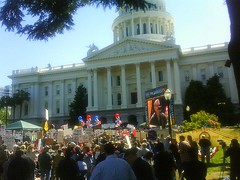
The California Library Association hosted Library Legislative Day on April 15th. (There was a press conference included, which was a bit overshadowed by coverage of Anti-Tax protesters.)

We were able to speak with our local State representatives and provide support to other libraries on several issues:
  • ACA 9 which reduces the requirement for bond to a simple majority from a super majority (66%).
  • Lobbied to fully fund the Public Library Fund, which allows libraries to share resources and allow reciprocal borrowing.
  • We also lobbied for Recovery Act funds to be set aside just for libraries.

When it comes to lobbying and advocacy, the best stories are human stories. This story came from a library's Friends board member who attended:


"A high school student comes into the library weekly to use the computers to finish her homework online. She not only completes her own homework, but does her mother's as well. Now, the first thought is, 'Hey she is doing her Mom's homework!' In reality, she prints out the homework assignment afterward and then tutors her mom at home. Her mom can't make it to the library during its open hours. If the library were to close just one hour earlier from budget cuts, both of them would fail through lack of resources."

We can talk about how efficient we are and our great services, but the human stories often make the most compelling argument.

Thursday, November 06, 2008

Who's talking about your library?

There were several great presentations from Internet Librarian 2008. I didn't even have to be there to enjoy them! IL is certainly one of the best for providing presentations online.

Two presentations that caught my eye were Greg Schwartz's Branding: not just for cows anymore and a combined presentation by Sarah Houghton-Jan and Aaron Schmidt's Digital Marketing. After viewing them, I began thinking about how our library shows up online, the conversations that happen, and how we present ourselves.

Branding
Greg Schwartz states that your online reputation is more dependent upon what other's say about you, but that you do have influence over that. He has six tips on how to manage your identity. Keep in mind that his presentation is really focused on your personal brand, rather than your library brand. I am making the distinction of using examples from a library's perspective.

SNIP
1. Have a Homebase
2. Own your username
3. Aggregate your lifestream
4. Join the Conversation
5. Follow what others are saying about you
6. Be Authentic
END SNIP


Homebase/Username
For a library, the homebase would obviously be the library homepage. It would be nice to have a library url that is very friendly, as opposed to the many that are still stuck with a .ci/.us url. We use cglibrary often since it is short and easy to remember. In hindsight, I should have been more consistent with our various accounts. For instance:

http://twitter.com/cglibrary
http://www.slideshare.net/cglibrary
http://flickr.com/photos/casagrandelibrary
http://youtube.com/user/jdscott50
www.splicemusic.com/people/cglibrary (used this to put background music in podcasts, before I knew about Audacity)
http://odeo.com/channels/144553-City-of-Casa-Grande-Public-Library-News-and-Events
http://www.librarything.com/venue/1220/Casa-Grande-Public-Library
http://cglibrary.blogspot.com/


When you search for our library, our library (map included, shows up with our various accounts. Since I have online video, pictures, and other content, that can show up as well. When I search using technorati instead of google, more of the library produced content shows up. It looks good for your library and your community to see great events and programs happening. I was talking about our J.A. Jance program to a new resident and she said she knew all about it, she saw it on our Flickr page.

Aggregate your lifestream


We aggregate our lifestream through Twitter. We also use all of our services in our weekly email blast newsletter. I have played a bit with twitter and sent our new books feed, library events, and library photos through it. According to the report by Rubicon Consulting (Online Communities and Their Impact on Business: Ignore at Your Peril), Twitter is a smaller aspect of social networking, with MySpace and Facebook the biggies.

What's neat about twitter is what it does to RSS feeds. If the marc record of the new book has a notes field that describes the book, it provides it in the 140 character limit. You can also directly link to the catalog entry and place the book on hold, or be the first to pick it up. There's a great article in School Library Journal by Ellyssa Kroski that talks about what we are doing with it, as well as other libraries (46 libraries in all).


People are talking on Twitter
Twitter seems to be a good source of what people are saying about you online. Twitter Search is a service where you can search for what people are saying about your on twitter. This is how I was able to find out some feedback about the library's twitter service. It wasn't a positive comment, but I was able to respond to the person just a day after it was posted. LinkedIn uses a similar service called Company Buzz where it uses twitter and your work search terms to see what people are saying about your company.

For twitter, joining the conversation would involve either direct messaging another twitter user, replying to a twitter user with an @ symbol, or replying to any questions. I do get great feedback from it as well as some complaints. Good feedback are those that know about our books and events faster and we show up where you wouldn't expect libraries. The complaints are usually that there are too many tweets. When there is an rss dump, it can take up 10 spaces all at once. It's always a work in progress.

Your Library Needs to show up
Digital Marking by Sarah Houghton-Jan and Aaron Schmidt's. is more specific to libraries. I will highlight points of interest:
SNIP
Make your library website two-way
Show up in searches whether they are library directories, search engines, wifi finders, community sites, library thing local and community sites.

What are people saying about you? Search social sites to look for reviews.

Find Local Blogs and intereact in a human way.

We're experts too, library staff can show up at answer sites.

Push the information out: newsletter software, email addresses, etc.
END SNIP

Free Wi-fi Directories
The first thing I did when our library provided wi-fi access was to place our library in every single wi-fi directory. People should be able to google and know if you have wifi access. We are still one of the few institutions in our community even providing wi-fi access.

Social Networking Sites

Most social sites aren't providing any feedback. We are either too small of a community, or those that use those sorts of sites aren't using the library. I have often thought there is probably a correlation between the circulation of Science Fiction books and the amount of library digital services being used. We don't have a high science fiction circulation. If we did, perhaps feedback would show up more often on those sites.

Local Blogs
As far as local blogs go, there are over 156 people in our community that have a blog, of those, only 24 are active. For those that are active, they do provide good feedback about the community. I have only had one mention the library and that was many years ago.

Email is king
We have found the greatest success in digital marketing through our email newsletters. Recently, we have been experimenting with different types of newsletters. We were able to market the newsletter service and also harvesting our database off email addresses. Currently, we have over 3300 subscribers to our newsletter. It's almost 10% of the community. We provide our library news (like food for fines), tutorial via youtube (like how to download books from overdrive), events, and a list of top ten books that provide links to the catalog. We tried the fee based newsletters, but we are just beginning to utilize the email features in our CMS. It's free, and seems to work just as well (we are currently using Liferay).

Overall, most of the sites we have used have been good for promotions and demonstrated that we can do innovative things. The more successful pieces were more practical; not everyone has rss (in the Rubicon report, it's only 11%), but almost anyone has an email address.

More people have mentioned the email newsletter as a factor when they came into the library for a program or found out about a service. We are sending them a personal email, a personal invitation, to come see us.


Your patrons should see your library like Mecca. They should rise and think about how we connect today.

Too often, a patron gets a card, and they don't hear from the library unless they have a book overdue, a hold, or a fine. This way, we can make a connection about everything we do.

Our cost of service for marketing is about 17 cents per person. That's how much time it takes for a library staff member to get a newsletter together, send it out, and copy and paste that information into the email newsblast, the local newspaper, the local magazine (that goes to everyone in the county for free), and any other agency that tracks local news and events. It's the best way to scale and to show up everywhere for a library.

Friday, March 14, 2008

French Concierge Customer Service

In the United States, you only see your landlord once a month, typically with an outstretched hand asking, "Where is my money?" You call the landlord to have something repaired, it takes forever, it doesn't get done correctly, and the landlord gives the appearance that he/she doesn't care.

This is the same disconnect many people feel about a library or any organization. The average patron wants to feel engaged about what is going on in their library. They want to feel like they are getting extra attention. It is much like the show Cheers, they want to feel like everybody knows their name. We provide that service. We find them books and materials that they like and then we buy more of it. We attempt to make our services quick and available to our public and we do it in a way that shows them pleases us, to please you.

To deter patrons who cause problems, it must be known that there is some consequence for their actions. We must demonstrate that bad behavior is not tolerated. We do this for the patrons who expect order . In both cases, there must be a feeling that they are being attended to.

We must assess what is going on in the library and identify people who need help and assist them as we can. In France, the role of the concierge is to meet the needs of their tenants, and bounce bad people off the premises. The highest dedication is to their charges. The same viewpoint must be taken in service industry (the library is always considered a service industry). You are in charge of the experience and care for those who visit you. You are in charge of their personal care and to make sure they have the best experience they can. This doesn't mean you let them break rules, but it does mean to treat people with kindness and respect. Treatment as you would like to be treated.

We must ensure that we are available for patrons to provide quick access and services. A greeting desk and greeter sets the tone. If you are the first person they see, it is your moment of truth that will determine if that patron has a good experience or a bad one. Roving reference plays a large role in what we do in providing good customer service. The purpose is to walk around, see how people are doing. Do they need help? Are there problems or problem people we need to take care of? Do we know who we are taking care of and introduce ourselves when they need assistance? It is the small personal touches that ensure good experience. Instead of saying, NO CELL PHONES IN HERE, you can simply state that the patron can please take their call into the lobby and thank you. It is difficult to continue to provide good service when patrons may be rude, and there may be many of them, but it is our job as a service to provide the best service we can.

We are here to take care of them and they have demanded our service by walking into our building, calling us on the phone, or sending us an email. Every experience is a reflection on the library and every experience must demonstrate that we care about our patrons. We do this and can continue to do this. It is important to remember this as we move forward as a service. Who do we serve and why? We must ask our purpose every day before we begin the day.

I will share this one from a library director's experience at a restaurant.http://tscott.typepad.com/tsp/2007/02/making_the_best.html February 12, 2007Making The Best Of A Bad Day

Wednesday, October 17, 2007

Viral marketing in libraries

Public libraries have always been information hubs. Before the internet, most people would agree that going to the local public library for information was a sure bet to get the answers. Today, the answer is not in the local library, or even the internet; the source for many is someone they know.

People will always trust their friends over an organization. A friend is someone they spend time with and trust. An organization is something that can be treated that way, but it is not the organization that is trusted, but rather the people who work there.

Over at the Church of the Customer Blog, they reflect on a recent Nielsen study that states 78% of people trust their friends over any other source for information.

SNIP
Despite an ever-expanding array of advertising platforms and sources, consumers around the world still place their highest levels of trust in other consumers, according to a recent global Nielsen Internet survey.
END SNIP

As a library, or for any organization, every transaction with a customer has to be so fantastic that people will talk about it afterward. That is how a reputation is established. If your customer service is bad, everyone will know by asking their friends. If the service is fantastic, you will see a usage jump. A great marketing plan means nothing if people walk into the building and get terrible service. There is long term planning that goes into a successful marketing plan.

Training in Basic Competencies
All library staff should be able to handle 90% of questions and issues. If a patron walks into the library and staff don't have a clue how to serve, then they walk out of the building and then tell their friends how bad you are. Many librarians have experienced this and blogged about it.

Training in Customer Service
Library staff must be placed in the patrons' shoes. They have to understand what it is like to walk into the library for the first time and get what they need. This type of empathy is crucial to good customer service (and consequently management). In this area, advanced classes are often needed in dealing with the angry or dangerous patron. The angry patron training helps staff diffuse situations and pull back out of the circle of anger. This actually helps staff understand a person objectively and without getting personal or let their emotions get the better of them. Furthermore, if you have library staff who are perpetually cranky, a group class dealing in customer service brings across the point of what is expected. Get on board, fake it, or leave.

Training in Technology
Learning 2.0 is all the rage. It is important to cover the basics first. One thing about technology training is that the ones who want to learn have a desire to learn. It can be a personal desire, or a desire to be the best they can at their job. To be able to handle everything thrown at them. Technology training covers both of them. However, if the seed has been sown in basic training and customer service, there is a higher chance for everyone to be on board for training. The reason from management must be there (providing better service), and the desire from staff must be there (lifelong learner or wants to be the best).

There is one thing you may be thinking at this point, "I thought this was a post about marketing?" It is, but it is about viral and word of mouth marketing. If you give someone fantastic service, you are marketing. People will know that they can get friendly, helpful people that will work with them to get what they need and will actually feel bad if they don't achieve their goal. This is the best type of marketing one can do and provides groundwork to achieve bigger and better things.

A brief Story
When we created and enacted our strategic plan, we made the assumption that we need to create a new level of service with new programs and service. Then we can market those services. Sometimes these service market themselves. If the service is that good, and you are on target with a strategic plan, then the service will spread through word of mouth. That is what happened to us. Usage went through the roof almost immediately. New library cards doubled each month. Currently, 90% of our community owns a library card. Consequently, new library cards are flat or down since there are not many more people to get a library card. We were concerned about this since our strategic plan stated that we need to increase library card ownership by 10% by marketing. Now that 90% have a card, we won't hit that mark. However, our new plan is to advertise the fact that 90% of the population owns a library card. It will be something to the extent of "Don't be 1 in 10" with a statement that 90% of our community owns a library card. Then talk about all the great things the library does. We might make shirts or bags to promote this as part of our library card sign up campaign in January.

How to become ubiquitous:RSS Feeds
Now that the groundwork has been lain, the library can now begin expanding its realm and appear ubiquitous. The library can show up everywhere if you choose to do so and it doesn't take any staff time to do so. Just some set-up time. This can easily be done with rss feeds. Most Integrated Library Systems have or are starting to produce RSS feeds.

Why would you library want to do this? Imagine standing on a corner of a busy street. You have lots of books you want to sell. You stand there displaying your books, thinking everyone will just come to you because you are so fantastic. You don't get the traffic you anticipated.

Why? You are not shouting out what you have. You just let people pass by and rely on the fact that you are so fantastic to speak for itself. This is the wrong approach. RSS feeds (really simple syndication) shouts out your information. You may think at this point that not many people use News Readers to read these feeds, but you can produce an email distribution list from these feeds using Feedburner. Feedburner is not the only service that can transmit an rss feed into email. Everyone has email so by producing this feed in this way, everyone can sign up to get the latest books, music, and movies available.

I love these feeds because I am the first to find out when a new book is available. I can be the first in the library to grab a book off the shelf because only I know it is there. This of course helps internally with library staff as they are also aware of what is available as soon as it is available. I once had a patron come in and ask for United 93. We searched everywhere for it, but couldn't find it. We called upstairs to Technical Services and they had it. They stated, "I just put that in the system, how did you know I had it so fast?" She had only put the dvd in the system five minutes before. That's how fast someone can get an item.

These feeds can also be dumped anywhere, twitter, myspace, facebook, google homepage, the list goes on. Your library can be everyone online with rss feeds. You don't necessarily need a presence on all of these social networking sites. However, you can keep them updated with rss feeds that require no additional staff time.

It takes staff time to be everywhere with traditional marketing
It must be written into one or more job positions and time must be given for marketing. Currently, we have one librarian dedicating 20% of their time to marketing. They need to be allowed off desk time or whatever that needs to be done to do this. This involves creating a weekly news blast to the local newspaper, chamber of commerce, our email listserv, it goes on our website, it goes to a monthly magazine that is delivered to every household in the county, our friends newsletter, the county visitor's bureau, and anywhere else we can squeeze in. This takes a lot of time. In reality, all of the events are planned out six months in advance. So it mostly involves grabbing what is happening this week, adding library news (such as advertising our flash drives for sale, our food for fines, library closures, and other non-programming events) and adding our top ten list. Our top ten list is the top ten books our community is reading at any one time. For instance, we put in the top ten circulating books for fiction, non-fiction, juvenile, teens, and then pick different subject (like gardening or cooking for diabetics) or genre areas (like romance or mystery).

We also cheat a bit with the list. We don't just put out the most circulating items, we put out the hotlist. Most circulating will only provide older titles and give the impression the library only has old titles. We get a hotlist by subtracting the date entered from the date it was checked out. This then predicts what the circulation will be for one year. For instance, if a book was only in three days and was checked out, it would predicted it would be checked out every three days, giving it a circulation of over 100. So instead of the Da Vinci Code showing up at the top fiction books, A Thousand Splendid Suns shows up first instead. People reading the paper for library news may be surprised that we have the latest fiction. This helps promote that.

The actual viral piece/Our plan

To actually get viral, you must have a particular service or services that is so great people are always prompted to talk about it. As a library director once told me, people need to see their library like mecca, how do we connect today? Here are some things we have done and will be planning:

We gave away free gold bookmarks and canvas bags with the library's logo on it for a library card sign-up month. Not terribly exciting, but new cards went up.

We upgraded everyone's library card from a red piece of plastic, to a dual card with a wallet card and a keychain card with the library's picture, website, hours of operation, and phone number on the back. This prompted conversation because the picture was attractive, and anytime someone pulled out their keys, a conversation could occur. (hey what's that, this is my new library card, they are giving them away free at the library.)

We sell flash drives with the library's logo and website address. This has been the most successful viral campaign as we were able to penetrate the schools with it. If a teacher can fit you into their busy schedule, then you are truly successful. Read more here

We bought into the Greater Phoenix Digital Library consortium. We plan to wrap our library card campaign with marketing for this service. Our plan it to give away 2gb mp3 players and show people how to use them. The first 50 who sign up for the service will get a free player and instructions on how to download an audiobook or music to their player. All library staff will each get a player first so they can see how it works. We will also issue an fm transmitter with it so that it can be played in any car. This gets over several compatibility issues. The mp3 player can play everything, can be placed in any car, and has enough storage to play 40 hours of audiobook, which is the largest capacity of audio.

We plan to expand our bandwidth once our e-rate application is resolved. We will expand from 1.5 mbps to 6mbps. We plan to have a campaign to the extent of, be careful, speed this fast can be dangerous. We will probably have a video launch to demonstrate the speed.

We plan to renovate the library by replacing the dvd shelving with videostore shelving, replace the new bookshelving with clear face-out shelving, create a greeting desk, clean the front of the library, and put out a new security system that will enable more self-service. This will change the entire look of the library for very little cost. If all goes exactly, it will create an entirely different effect when one walks through the library. It is my hope that this will further get the public to talk about our library.

This should all result in increased traffic in all user points. We should see double digit jumps in circulation (with particular notice to how fast an item is checked out and particular higher marketed collections), computer usage, walk-in business.

This takes an incredible amount of back work, training, and planning. I have done this before with a renovation. It is why all of our service usage has increased the last two years. We are almost always looking to improve and change services to make them better. We want to be the best and that involves change.

Monday, September 24, 2007

The Five Dollar Flash Drive


I had meant to share this before, so this will be a quick post. I had mentioned in my post about "10 Ways to Hack your Local Library"that we sell flash drives for $5.

For some time, our patrons have had problems saving documents to our computers. They were under the impression that if they saved the document to the desktop, that it would be there when they returned. We began to sell floppy and CD-RW discs, but this created another problem. Some of our computers have floppy drives and some do not. The floppy drive is now an upgraded piece of hardware. As a result, some computers have a cd burner and a floppy drive, some have one, and some have the other. To solve both issues, library staff suggested to only allow flash drives on the computers and to lock up the floppy and cd burner drives. This seemed a bit severe, but I understood why the extreme move. Patrons do not know which computers had floppy or cd available, so just enabling a flash drive seemed like a viable option. However, the technology was not readily available or affordable in town.

Now, I am the type of person that is reluctant to cut off a service that people need. Certainly when cost is a factor. In order to solve the problem, I decided the library should sell flash drives to the public. I remember that Webjunction gave away flash drives as a promotion. They weren't that big, usually 128 mb, but it was a neat marketing trick. They can provide something useful, but it also has their logo and information on it. 128mb isn't much for someone like me, but for the public, it is a huge improvement.

My task was to find a way to order affordable flash drives, that had a good amount of memory, and had the library logo on it.
I found one


Just to be straight, I am going to plug the company that provided the drives. They gave me a good deal and it is a great service.


http://www.allmemoryupgrades.com/customusb.htm

sales@allmemoryupgrades.com

Here are the rates
Capacity 25 50 100 250 500 More
64MB $17.00 $9.50 $8.50 $7.75 $6.50 Contact us
128MB $18.00 $10.00 $9.00 $8.50 $7.75 Contact us
256MB $19.00 $11.00 $10.50 $10.00 $9.50 Contact us
512MB $21.00 $15.00 $14.25 $13.00 $11.75 Contact us
1GB $25.00 $18.00 $17.00 $16.00 $14.00 Contact us
2GB $33.00 $27.00 $26.00 $25.00 $23.00

We started off with an order of 250 at 256mb. They gave us a deal for $5 each. They even go up to 8GB. You can customize them too, so your library logo and information is on the memory stick. I ordered 250 that I received August 1st, I have 50 left now.

Once we had the drives and advertised them, it spread like wildfire. Even the local schools are telling their students to buy the flash drives at the library. Patrons are buying them four at a time. Some people are coming in JUST TO GET THE FLASH DRIVES.

So I have been able to provide a resource to the community, without cutting off an essential service, plus I have word of mouth marketing that anyone would kill for. Just think of this story:

"I went to plug in my flash drive on my work computer when my co-worker asked what that was. I told her that it was a flash drive that the library is selling. (She holds up the flash drive that has the library logo and url.) Co-worker says "Wow, I didn't know libraries did that."

Next stop for her was the library.

Monday, June 04, 2007

Amazon Comes to Twitter

Amazon Comes to Twitter

Hey someone figured out another good use for twitter. This is essentially the same thing my library is doing with twitter. Sending out notices for events, sales, new information to the public. Whenever a new book is released, twitter knows about it. Amazon and organizations like Woot are doing the same thing, releasing information and sales through twitter. This is about marketing people!

Take a look at this:

SNIP

This is a great example of how instant communication tools like Twitter are being used for commercial means. Basically the Amazon and Woot deals are feeds of offers, pushed out via Twitter. These kind of feeds could also be received in your RSS Reader, or email.

The next step for Amazon and Woot is to allow personalized Twitter feeds - e.g. you could sign up to an Amazon Twitter feed of just music deals (if music is what you want to buy). This would equate the "followers" of Amazon's Twitter feed to leads for the company - very fine grained ones, because Amazon knows what their "followers" want, based on which e-commerce deals they sign up for via Twitter.

END SNIP


The next phase for Amazon is EXACTLY what I am trying to do with twitter. Establish customized feeds so that specific patrons can sign up for their particular interests. Parents can sign up for new kids books, kids events, and other information. There is so much more that can be done with this. Very cool stuff.


Saturday, May 19, 2007

How a Library Works

Management: the brain, it makes decisions processes information. (Hey maybe they don't make great decisions, but they make the decisions :)

Collection Development: The eyes, need to find good things to eat, books. If you can't find books that are good, you won't have a healthy body.

Reference/Outreach: the mouth, the ability to speak. If you cannot speak, people cannot gain your knowledge or find out more about you.

Circulation/Technology: The heart, keeps the body alive. Without the heart, the body would die (aka library would close).

Technical Services: The digestion system, it digests and processes the food (new books) that enters the system. Without this function, the body cannot add new books and build a healthy body, eventually making it unhealthy and ultimately killing the body.

Programming: The muscles, the body needs exercise, programming provides a variety of activities to keep the body (and mind) sharp.


Saturday, May 12, 2007

New Comm Road Podcast Available

Bryan Person's interview with me about my library's use of 2.0 technologies, including twitter, is now up and available. In the interview, I am crediting the 2.0 model as increasing the library circulation by 30%. 2.0 is not just about technology, but about being reactive to your users and allowing your users to take control.

Here is the podcast information:

http://www.bryper.com/2007/05/07/ncr-030-libraries-and-new-media/

SNIP

IN TODAY’S SHOW:

Feature interview

END SNIP

What I found most interesting about the interview, and sometimes the point of library 2.0, is that he would have never of thought about libraries doing these sorts of things. It's not a question of what the results are necessarily, but how perceptions are changed in your community, across the nation, and around the world. I remember the words David Keeber from Sedona Public Library told me during my library's planning for results process. "Your users must always think about the library. They must wake up and think of it as Mecca, how are we going to connect today?" That statement has always stayed with me.


Monday, May 07, 2007

Library 2.0 Usage Results

We have several library 2.0 uses at the library. This is a result of our efforts. We began developing these new services in September 2006, but the full roll-out of services didn't begin until January 2007. This is a report on usage from January to April and a comparison on usage between traditional methods and using library 2.0 methods.

AUDIO
Podcasting versus Phone Tree
Our progams are placed on our phone tree and they are also podcasted on our website.

Number of patrons who listened to the telephone program list:
5 Adult
5 Youth
5 Technology

So in the past four months, 15 different people listened to the automated phone message about programs.

Number of patrons who listed to the program podcast:
4 may technology (I posted May on April 30th)
3 mayyouth
5 may adult
23 april tech
12 APRIL YOUTH
14 ADULT APRIL
6 MARCH ADULT PROGRAMS
6 MARCH YOUTH
36 MARCH TECHNOLOGY
7 FEBRUARY ADULT
22 FEBRUARY YOUTH
7 FEBRUARY TECHNOLOGY
So in the same time period, we had 145 downloads of all podcasts.

PHOTOS
Patrons who viewed the library photo album on the library webpage:
12 photos, viewed 125 times

Flickr views
Your photos 169 photos / 638 views

Engaging Teens with Technology
Recently received a grant from the Arizona State Library to provide opportunities for teens to create, blogs, podcasts, and vodcasts about stuff that interests them in our community. We also allow myspace, chatting, game playing, etc. on our public access computers. As long as you don't want to download anything onto the computer (because it will get wiped) you can do pretty much whatever you want. We do engage a filter, but it is fairly light and literal so we don't have any issues with it blocking ok sites. One out of every three computer users is a teen, right in line with our strategic plan.

Here is a description of the grant:

Grant person would help guide the SPARC group under the direction of Youth Librarian. This person would develop news information for teens in the area using blogs, podcasting, and other formats working with our teen group, SPARC (Students Participating in an Advisory Reading Committee). The grant person would meet with the group once a week for 4 hours to help develop the project. This will take a year to develop. Cost would be $5,500, ($4500 for three laptops for the group, $1000 for recording equipment).

Staff WIKI
wiki busted never took off with staff, trying the library technology handbook in google docs. Right now, its use is mostly in the paper format.

Blog versus email versus web versus paper
Number of bookletters email subscribers: 442
Number of patrons on email distribution list: 598
Number of blog subscribers: 10
Number of people who look at content via the web: 48,989 from January to April
Number of people who read our events via the Community Services Brochure: 30,000 (mailed to each home during the summer and sent in each newspaper in the Fall and Spring, effectively canvassing every home in my community.)

From this I can gather that more people would prefer to receive information via email after they check the website. I think paper and people trump everyone.

In a recent survey, the library wanted to find out how people heard about the library.

Here are some of the results:
Newspaper, 66%
Community Services Brochure, 47%
Word of Mouth 45%
Visited/Call the library, 28%
Flier/program at schools 23%
website 13%

For communication via mobile phone, twitter and library elf, I only have two library elf subscribers. Twitter is more popular, but the problem is a local one. I don't think we have any local subscribers yet. We plan to advertise the service through our library news on the website and in the local paper. I will report on the effectiveness of the campaign. I would say the most successful techniques we have used to advertise our services have been getting a library news section in the newspaper and word of mouth. I know word of mouth since people are talking about the new computers and it spread like wildfire. Also, when we had a new library card campaign, people were talking about how great the new cards were. A board member pratically created her own psa. When pulling out her keys a co-worker noticed the keychain library card. She mentioned how neat it was, and the board member said that you can pick one up for free at the local library all this month for library card sign-up month. Sold American!

Sunday, April 29, 2007

Twitter Update or how I was able to exploit the latest social networking site without really trying

So I posted last week about how my library is using twitter. A few people didn't see how twitter could be useful for libraries, but there are several benefits to using twitter for your library. When twitter originally came out, I did not see much use for it. I did not want to keep track of the every move of strangers. However, when several twitter tools came out, things began to materialize.

My library puts out a lot of RSS feeds using a subscription through http://bookletters.com. They produce newsletters, reviews, and other information about new books. It sends an update on new fiction, new non-fiction, mystery, romance, science fiction, and many more newsletters. Right now it produces over 20 newsletters that are preset and are produced without staff intervention. It also produces staff developed newsletters. Most of these newsletters are produced by staff and deal almost entirely with events. Again, the neat thing about these newsletters is the fact that I can dump the calendar of events into it and the old programs go away once they have expired. Once we plan out three months of programming staff only need to click a button to update the website for the newest program. These newsletters can be followed by going to the website, by getting the rss feed, or by subscribing via email. The majority of information produced is performed by this subscription. You can see it here.

Another piece of information we produce is information through our google calendar. This is a way for patrons to review all of our events at a glance. They can subscribe to our events through their own google calendar. I also set it up so the calendar sends the daily agenda to our library blog.

I established a blog through blogger and dump all of the feeds into the blog. It continuously updates without any staff time. I had some trouble with spam at first when I tried to automate the updates. I was able to develop a filter through gmail to send the update to the blog. I have not had any problems so far. An advantage of the blog is that one can subscribe to it, or follow it all they want. It also highlights all of the library newsletters so patrons don't have to subscribe to every single one, they can just subscribe to the blog. The daily events are also sent to the blog so patrons can see what we are doing that day, or if we are closed.

Polaris creates a feed for all new materials added. New books, videos, audio, and large print all have a separate feed and is updated as soon as the book is on the shelf. This is neat because you can follow the new materials in real time. I am attempting to develop a custom feed so that adult fiction, non-fiction, juvenile, easy, and Spanish books all have separate feeds. These are not dumped onto the blog, but can be followed on our website.

We also established a flickr and photobucket account. I have a direct link to flickr on our main page, and it has an rss feed. We use photobucket just to establish our library gallery page. The library gallery also has a feed as it is developed through the bookletters content management system.

So all this information and it can be dumped anywhere. What to do with it other than push it to subscribers? After reading about twitter and investigating the other tools with twitter, it became easy just to dump all of the feeds into to twitter using http://twitterfeed.com/or http://www.rss2twitter.com/ rss2twitter is an easier interface since twitterfeed requires an openid. However, there is more control at the twitter feed site as you can tell it how often to update. So I just starting dumping the feed in there.

My plan is to advertise the service in the local paper and one the website. I would have liked to advertise that anyone can subscribe to library news, events, and new books just by texting "follow cglibrary" to 40404. However, when I attempted the experiment myself, it didn't follow. I am investigating as to why. I set up the account and tried it with my own phone. It seemed to work fine when I texted. It prompted me to set up an account, and then it told me that whenever cglibrary updates, I would be notified. It didn't work. Of course, the side affect of trying this is that people who are just using the twitter interface online can follow the library quite easily that way.

From the trends I am seeing, I think only the truly dedicated would use only their cell phone to use this service. This also calmed my fears about just using it for cell phones since if people were following us via their cell phone, they would get at least six text messages a day, that can get a little expensive. I also thought that I might customize the feeds depending on the user. I am developing that now, but not sure if I will have a separate twitter account for adults, children, teens, and Spanish users. More investigation is required.

Another bright side is the incredible attention the library is receiving by developing the twitter feed. Really, it's not much different from many news organizations dumping their news stories into twitter. I think the discussion on how useless it was led to the attention since I found a simple practical use. Thanks to all the bloggers who brought it attention, Shifted Librarian David Lee King,Steven Cohen at Library Stuff (sorry had Thing originally), and to Daniel Cornwall at Alaskan Librarian for sending the information to the For Immediate Release Podcast. It's great to see libraries mentioned in non-library settings. This also helped produce an interview with Bryan Person via Twitter for his New Comm Road Podcast

Other libraries are twittering as well: Cleveland Public Library, Ada Comm Library, and the Lunar Planetary Institute Library. I am sure there are more, just not enough attention is being paid to them. If your library twitters, send a comment over to David Lee King. I will keep you posted on the twitter progress.


A book is not a piece of music, nor is it a movie

The e-book struggle continues. The Sony e-reader has responded to the complaints that people will not read a book on a computer screen. Now the computer screen looks just like the page of a book, it reacts to light, it's not back-lit, and it's not hard on the eyes. It IS however, hard on the wallet. No one will shell out $350 for an e-book reader, especially if they have to shell out an additional $25 for a book, why not just buy the book? There is something about books that is different from movies and music. In many ways it is easy to define the difference. However, there are many differences that are difficult to explain other than how people act about books.

Two quotes from Lawrence Clark Powell:

" We are the children of a technological age. We have found streamlined ways of doing much of our routine work. Printing is no longer the only way of reproducing books. Reading them, however, has not changed."

Another quote I cannot find and so I probably shouldn't mention it. However, this quote was repeated to be by former University of Arizona School of Information Resources and Library Sciences Dean Brooke Sheldon. It mentioned something about the soul of books and how one could drink from them and find everlasting nourishment. It was a quote she mentioned when recruiting for library school. I signed up soon afterward.

The point being that books cast a magical spell on the reader. Something unexplainable that no technology can ever master or reproduce. It's the reading of the book quietly at night and staying up until 2 in the morning finishing it, satisfied. I think the problem with the internet so often is that there is no end to it, no quiet. It is a constant state of doing something with no accomplishment. Reading a book gives you a story that inspires the soul that lasts forever long after the book has been read. It reminds me of a quote I read about The Lovely Bones by Alice Sebold.

"
Aimee Bender, author of An Invisible Sign of My Own
The Lovely Bones is the kind of novel that, once you're done, you may go visit while wandering through a bookstore and touch on the binding, just to remember the emotions you felt while reading it.."

It is difficult to explain that emotion. Many publishers and technologists may say, "It's silly that these people go on about you can read the book in bed and you can't share it, its electronic you can put it anywhere, give it to anyone". It seems simple, but it is not the same thing. The feel of the book, to touch the spine, it's something real, tangible, it transforms you to that place in the book, just be feeling the paper, touching the spine. I even like the vinyl cover on library books.

Some posts in the last month have hammered the e-book industry about the systemic problems with e-books. No one will buy an expensive reader AND pay for the book. Especially since they can only use the book on that reader. They can, of course, download from Gutenberg and other free sites. Those are nice for the classics, not very good for current titles.

The most prominent was this post:
SNIP
Why the commercial ebook market is broken
"
My take on ebooks is that they are — and should be seen as — the cheapest form of disposable literature. They're not cultural artefacts (pace Cory Doctorow); you don't buy them in signed, slipcased, limited editions. They're like stripped mass market paperbacks without even the value-added of doubling as wood pulp wall insulation once you've read them."

AND

"I don't think most of the ebook sharing subculture is even about reading the books in the first place — it's about collecting, and participating in a gift sub-culture where your kudos is governed by how much stuff you can give away."
END SNIP

Which leads to this quote:
"To be a book-collector is to combine the worst characteristics of a dope fiend with those of a miser. "
Robertson Davies

Which explains the obsessive nature of book collectors, or just readers in general, to collect books. They may have a house full of books, with no room for more, and then they convert their garage. Look at Library Thing!

Then this article from Wired! talking about the problem of digital rights management. Something I talked about in a post a while back.
Wired! article:
http://blog.wired.com/gadgets/2007/04/killed_by_drm_e.html

"E-books are growing, thanks to the improving simplicity and mobility of acquired content. With the masters of digital music finally relenting and offering DRM-free tracks, it's time to kill e-book rights management once and for all: give us we want, in the file format we want, and you get our money. Once."

END SNIP
Then to add to that, we have very clueless publishers trying to charge PER PAGE! (older article, probably will never materialize)

SNIP
Random House Announces Ambitious Pay-Per-Page E-Book Project
November 03, 2005
By Max Chafkin
The world’s largest trade publisher will charge websites four cents per page for fiction and narrative nonfiction (a 350-page book would cost $14, for example), ostensibly allowing vendors to determine their own pricing schemes.

END SNIP

Why would I want to pay for one page of a book? Books don't work this way. Music can be broken down to a song, even a favorite part of a song (which ends up on your cellphone), but the same cannot be done for a book. You cannot rip it apart and just read its parts, you need the whole thing. It is not a CD, nor a song, it must be complete.

A few more articles from this week:

On Mobileread.com:
SNIP
Fujitsu to release colour e-book reader
http://www.mobileread.com/forums/showthread.php?threadid=10598

"So, of course, all this is too good to be perfect. The price, for one, is over $1000 per-reader (for ten readers, for testing purposes - presumably the final product will be slightly less expensive), for the small size. The large size more-than-doubles that price. It's also running "Japanese Windows CE 5.0" (apparently something different from Windows Mobile), and will only be available in Japan."
END SNIP

Again, very expensive and a very closed system.

Why e-books are bound to fail
Electronic books pack bleeding-edge technology, too bad they'll never catch on
http://www.computerworld.com/action/article.do?command=viewArticleBasic&taxonomyName=mobile_devices&articleId=9017934&taxonomyId=75&intsrc=kc_feat
"People who care enough about books to spend $25 billion on them each year tend to love books and everything about them. They love the look and feel of books. They like touching the paper, and looking at words and illustrations at a resolution no e-book will ever match. They view "curling up with a good book" as an escape from the electronic screens they look at all day. They love to carry them, annotate them, and give them as gifts. Book collecting is one of the biggest hobbies in the world."

I liked this comment on the article as well:
http://www.mobileread.com/forums/showthread.php?threadid=10588
"Perhaps 'e-book reader' is just too misleading a name, as these are at least as well suited - if not better - to non-book written material. I highly doubt the e-book reader will ever disappear, and I honestly believe these could replace everything I noted. References, like encyclopedias, probably in only 5-10 years, and completely replacing newspapers and magazines in, perhaps, 10-15 years."

Another e-book fallout is around the corner. One thing I loved reading over and over again on mobileread.net was how many people use their local library for books. Hey its free, your taxes already pay for it, so why not use it. It certainly makes a lot of sense to me. Think about it this way, you own 100,000 books at your library. Not many people can collect that much AND the more you use it, the more it gets for you. The public library was designed to provide the most money towards the people that use it most. Save $350 or $1000 or even $25 and check out a book. Even some of the e-book vendors aren't pushing as hard as they once did. Music and movies are easy to download since they have always been electronic. Books have never been and it will be difficult to get them there due to proprietary reasons and eyesight annoyances. Until then, you can always get free books at the local library.


Monday, April 23, 2007

Use a laundry basket to avoid library fees from Life Hacker


http://www.lifehacker.com/software/library/use-a-laundry-basket-to-avoid-library-fees-254125.php
See comments too!


Its always great to see a general audience blog, news, or other organizations talk so much about the library. Look at all the comments on this post! I often recommend keeping a library bookshelf. At home, we have a small basket for our library books. I think Library elf works best (
http://libraryelf.com) since it sends me an email or text message saying I have books due in a few days. Then I know to renew them or to grab them out of the basket to return it.

How I found a good use for Twitter

I did it! I was able to take all of the library's notifications and put them into twitter.

I set up our twitter account at http://twitter.com/cglibrary

Then I dumped all of the library's rss feeds into http://www.rss2twitter.com/

The great part about that is that twitter feeds itself. No staff time is required except to check to make sure it is working. I dumped the new books, new videos, new audio, new large print, the google event calendar (http://www.google.com/calendar/embed?src=casagrandelibrary%40gmail.com), library news, library programs, and all of our newsletters rss feeds into it (http://www.booksite.com/texis/scripts/bookletter/addrss.html?sid=6503).

Now every time the library has an update, a library event, a new book or video, or new newsletter, it goes automatically to twitter. I have set up most of the library's information this way. We have a content management system through Bookletters (http://www.bookletters.com/) that automatically produces newsletters on books, from Fiction, to Non-fiction, to books in the news. We also have custom newsletters for library events that are posted on the libray's website and are sent via email. Everything also goes through our blog at http://cglibrary.blogspot.com and finally it goes through Twitter.

I have to find a way to get messages down to 140 characters so that the entire message is received via a text messag. If the content is too long for the message, it automatically creates a tiny url. Like this:

Reading comprehension success in 20 minutes a day. : http://tinyurl.com/2nsvf9

Which doesn't work too badly, but I think most users wouldn't go to the link. I think if there was a program that day related to the user, a new book, or just to send a message that the library is now open and the library is now closed might be some very practical uses. I haven't placed it on our website yet or advertised it. I only recently was able to get it to work so I was very excited about that.

Now I just need to customize the feeds a bit for different users, but I was amazed at how easy it was to set it up. I don't know how many users will subscribe to it, but the functionality is there. I bet the more I can customize it, the more people will subscribe since customizing will not make it overwhelming. Its amazing how many free things there are out there that provide great service!

Monday, April 09, 2007

Seth's Blog: Stinky Durian

Great post about marketing and listening to consumers on Seth's Blog:

SNIP

Stinky Durian

The feedback you get from non-consumers is rarely useful, because the objection they give is the reason they don't buy from you, not the thing that will cause them to affirmatively choose you.

END SNIP

With libraries offering all kinds of books, programs, and services, it is always the email that asks for something different. Why don't have you have storytime at night so working parent could come, or have book discussions.....or...?

Every time we listened and tried something that was suggested, invariably, no one would show up. I remember running a book discussion at night after it was suggested (again via email) that we should have one. I ran it for six months and not a soul every showed up. I say via email because it is a distant request by someone who never comes to the library, but went to the website to find information. They emailed rather than call or come in and ask. I am not saying emails are bad, but it sends a distant message that if someone is not willing to take the time to come in, maybe he or she never will.

This is also why many focus groups don't work. They suggest things that they would like to see, but then never show up at the library. Its not the reason they don't use the library, but something else is keeping them from doing that.


Saturday, April 07, 2007

Friedbeef Tech: Top Ten Places to get Free Books

From Friedbeef Tech (via Lifehacker) a top ten list of places to get free books. On a tech blog, it makes sense that it just covers online books, but I was hoping libraries would show up in part II.

Top 10 Best Places to Get Free Books (Part 1)

1. Find Popular Public Domain Works With The Gutenberg Project Top 100 List

2. Exchange Used Books With BookMooch

3. Get Technical Books With ebookspyder

4. Read the Classics Online with Google Book Search

5. Download Plain Text Novels With Dwalin

I guess not:

Top 10 Best Places to Get Free Books (Part 2)

6. Find Specialized IT Books With FreeComputerBooks.com

7. Get Someone to Read Books to You at Librivox

8. Skip the Book and Get Free Study Notes with CliffsNotes

9. Save Money on Textbooks With WikiBooks

10. Receive Books In Small Parts via Email Using DailyLit


Friday, March 16, 2007

Feeling the same way all over again

Its always fun to break in new library users in by talking about all the amazing things your library can do. There is never enough time to mention everything, but I always love the wows. Its like feeling the excitement of the first time you step into the library and you imagine the possiblities.

It also makes me feel like "the man" (not like I'm cool "the man", but I am the authority). I always like the ad from the Samuel L. Jackson movie, He walks the walk, the man just talks and talks. Explaining all the complexities of how a library is run can make anyone's eyes glaze over. I usually try to make it exciting by just talking about the end result.

I do find all that stuff exciting. I love a challenge and finding grant money. Some of the intracacies I find interesting will bore even a librarian to tears. I just have to be careful to tell the difference between tears of joy and tears of boredom.

The library can get $100,000 by applying to e-rate, wow. That works. E-rate money is from the federal government (eyes glaze). You pay a fee on your phone bill to the universal service fund in which funds library and schools telecommunication needs (starting to drift off). It can also....snore. Talking about the details on how that is done will make you want to drop off a cliff.

Then you get into acronyms, the kiss of death. What is LSTA again? I always make the mental note of stating the full name before using acronym(as if I am writing a paper). Otherwise you get, "This LSTA grant will....snore. "

Its all about results. This saves you money (enter exact dollar amount). This expands computer acccess (every third computer user is a teen, making the library a "third place" for them in the community.) This database helps our literacy efforts (you can learn to speak Spanish online for free through the library's website). We are exploring ways to provide programming online for our users(you can see last week's program online through our website). And on and on.

I think that is why ALA and PLA went towards performance based results rather than just stats, it tells a better story. I certainly like to tell stories. I get excited about our services, I hope I can do the same for others.

Saturday, February 17, 2007

Successful Saturdays: Keeping in good with the press

What is your perception of libraries?

Is it this?


or this?


In some communities, you can ask the question, when was the last time you visited your public library. The reply can sometimes be, "There is a public library in town?" I remember when I first interviewed for a job at my library, I didn't know where the public library was. That is still one of the things that I don't like about my library, its location. A library should be located off the main street so it can be seen driving by. In addition, the library is the old city hall building so it doesn't look like a library.

Often, the perception of public libraries are that they are a throwback to the 1950s. You can insert the obvious antiquated references here (you know the glasses, the hair in a bun, shushing, dusty old books). It seems that many people have not entered into a library in quite some time. The obvious perception of libraries are the first two pictures. However, you want the perception to be the third picture. People at the library enjoying everything the library has to offer. It is not just about books, or computers, it is about a sense of place. It is somewhere to take your family to get an education, entertainment, and a great experience.

The younger generation that never has entered a library are stuck with stereotypes from the media. They will see more saturation from television and the internet's perceptions of libraries, than from actual libraries. In order to combat this, you need to take an active approach in getting attention for your library.

When I first started working at my library, we had no programming and some technology classes (in which attendance was dismal). Circulation wasn't bad, but it seemed that most of the community did not know where the library was. After doing some research, I realized, there was no way we were telling the public about us. No articles in the newspaper, no press releases, no calendar of events, nothing.

I began to write press releases for the local newspaper. It began to get some attention, but the articles were placed irregularly and usually not in enough time for people to be aware of the program. Most of the attendance for programs (if anyone showed up) was between zero and seven people. It was hard to continue with such low attendance. It wasn't until I had a big series of programs in February, did things begin to take off.

The library was conducting a focus group on the direction of the library. It was mostly a defensive maneuver to ward of cuts to the library budget. (It was post-9/11 everyone was getting cut.) I had a series of cultural events I was planning for February. Most of them came from the Arizona Humanities Council. I hoped to get all of the events together at the beginning of the month in a big spread. The paper did one better by getting images to put in the paper of the performers, a full page spread, and well ahead of time. I ended up getting 45 people for the first program, 30 for the second, and 20 for the third. It was a huge success. So when the focus group was asked if they knew about library programs, they said yes and that they checked their local paper for it.

In this vein, I developed a weekly library news section in the paper. Every Tuesday, we were able to have the paper run the library news for the week. Now people can expect when to get the news and were informed well ahead of time of programs. However, it gets better.

Over time, we began to get reporters from the local paper to cover library news. They came to library board meetings. Some of the first articles they ran were not positive and the information was incorrect or out of context on many occasions. The worst one was when they identified someone else as running the library (grr!). So when the library began its strategic planning process, it was a golden opportunity to change the perception of the library in the newspaper and the local community. I asked the paper to send me a reporter to cover the event and to participate in the process. They sent me the same reporter who made the mistake in the paper (double grr!)

The strategic planning process changed the communities perception of libraries. The reporter wrote a wonderful article about how libraries are not what you thought them to be. That classic, libraries are not about books article, it was great. The community's perception of the library was beginning to change. This is exactly what we wanted.

The best part came just last year. We had been receiving consistent positive coverage from the local paper. However, the lead reporter had never written an article about the library. We received coverage from the valley life reporter and other reporters, but nothing front page, no major article.

In April, I gave the library's annual report to City Council which described our efforts toward fighting adult illiteracy, creating a place for teens, and creating opportunities for workforce development. I was hoping for a big article because we had just started our adult literacy program and were accepting tutors. It was a big step. However, a week went by and no article. I was very disappointed. I had worked so hard, but I still did not get anyone's attention. Then, after a week, the article showed up. It was FRONT PAGE ABOVE THE FOLD! It even had a picture of the chart I provided showing the adult illiteracy rate in the community. We received a dozen calls from the public wanting to be tutors for our program. It was fabulous.

Ever since then, whenever I make a presentation to city council, there is a good chance there will be an article and for that article to be on the front page. If I apply for a grant, request a council action, or described progress on a library issue, it gets great coverage.

Furthermore, since we were receiving such good press, attendance at the library shot up. The April article resulted in twice as many sign-ups for summer reading, circulation, computer use, reference questions, and more are all up double digits. We get coverage in the local paper, the local magazine, and free monthly newspapers throughout town. If there is an event in the library, everyone in town knows about it. Just this week, we had two articles and one photograph of our new bookmobile in the paper. We have market saturation. Oh, and the third picture above, that is a local politician who came to the library for a photo shoot for her campaign advertisement.

Some tips on how to get your marketing started:

1. Find out how people get information.
There is always a source of information. A local newspaper, magazine, radio or television show, and sometimes even word of mouth works. We receive coverage in the paper and magazine. When we did some planning for our Spanish language outreach, we talked to the right people since usage of our Spanish language materials shot up right afterward.

2. Get to know your local media.
Who covers the big stories? Who covers the valley life? Who handles the calendar of events? These are all essential to drum up business for your library.

3. Get to know your local photographers for the local media.

Sometimes a photograph is just as good as a news article. Get your name out there. Call the photographer and ask them to come to your next storytime. Have them take a picture of you with your 20,000 customer of the month. Do something creative, just remember, they don't like talking heads. The shot needs to be framed.

4. Create a calendar of events.
Always have library events or library news. Even if you don't have any events there is something going on in the library that no one may know about. Did you get a new database? Did you get a bunch of new books in? Libraries are happening places, just talk about it.

5. Write press releases.

You always need a snazzy headline. It needs to get the reader's attention. Make sound (music) @ your library, Fight the harsh summer sun @ your library, do something creative. People will most likely go to a good program, but you have to fight the many headlines of other events going on at the same time.

6. Create newsworthy events.

Sometimes a good angle always helps. If you are having a storytime, you can advertise getting your child ready to read at your library. Talk about the increase of people using your computers to apply for jobs.

7. Use your monthly reports.

If you are using a strategic plan, then you probably need to report on its progress each month. This is a time to shine. Show how much the library is being used, demonstrate your impact by how you are accomplishing your goals. Have lots of pictures and charts and use bullet points to make your messages clear and succinct.

8. Find out what stories interest the paper.

If they are pro-library, great, if not, change their perception. There should be a theme that the library likes. Read anything written by the editor and show your library's accomplishments in the same light.

9. Always find an opportunity.

There is always an opportunity for a news story. When our library broke 20,000 circulations in one month, I found out who had the 20,000th circulation, threw some stuff in a bag and presented it as a gift. I called the photographer and they had a small thing in the paper about it. It was a great press opportunity for the library and make the patron's day.

10. Be everywhere.

Usually, you can combine your events with other events in town. You can combine your outreach with your marketing by making your outreach stand out. We plan to paint a mural on our bookmobile so that we are easily identifiable. Whenever we go out, if there is a picture of a general event we are at, you will be able to see us.

Marketing is everything. You can have the greatest program ever and no one will show up if no one knows about it. That is the only way to test the popularity of the program. If everyone knows about it and no one shows up, it is not a popular program. Libraries are fantastic concepts. Free books, free music, free movies, educational and recreational programs, computers with internet access and its all free!