I don't like lugging laptops to conference so I thought that I would try to rely on my Blackberry, iPod Touch, and Sony Reader. I made a big mistake on the last device; I forgot the power cord for my Reader. There I was foolishly reading my book while listening to music on my Reader (so that I could conserve power on my other devices). Of course this drains the battery like nobody's business. I also brought a digital camera, not thinking about how I would upload those pictures. Luckily the hotel had a business center and I was able to upload pics just fine.
I tried Foursquare with my Twitter account. I felt Foursquare was valuable for the conference, but doubt that I will use it outside of that. Foursquare is a good tool if you already know people and are in close proximity, fostering social connections, especially at a professional conference in a new city. It was a great tool to see who was around and I got to meet people in real life that I only knew on Twitter. I geeked out a bit and put my Twitter handle and picture on my badge as well. It was helpful and fun to associate a photo with the Twitter persona.
Overall, I would say the mobile conferencing was a success.

Sunday, March 28, 2010


Saturday, March 27, 2010
Changing Course: Leadership for Navigating the New Library
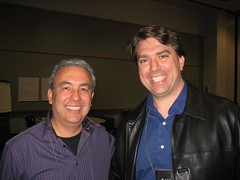
With Luis Herrera, San Francisco Public Library Director
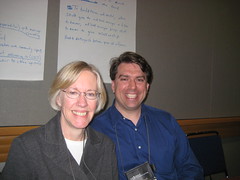
With Susan Hildreth, Seattle Public Library Director
This was a wonderful program that I had the privilege to attend. There were many of my library management heroes there like Susan Hildreth (Seattle), Luis Herrera (San Francisco), and a good friend, Laura Isenstein with Providence Associates. I met some new friends there, some from Twitter, and other brilliant library admin people.
We had homework for this program, four articles that are available online. These are classics in the management profession, one of them by Peter Drucker. I will post the links to my Delicious account.
This session was held over two days during the pre-conference. The main focus was to understand the basic principles of the articles; the community building and building personal networks were the high points for me.
The thing that puzzled me a little is that I feel like I have gone down this road before. I used the Planning for Results model sponsored by PLA. However, even though many libraries went through the strategic planning process, many didn't engage the community in a meaningful way. They grabbed the same people that were already in their circle and asked them what they already knew. As the presenter told me, they didn't expand their sandbox or their social circle, thereby they didn't gather meaningful support. I even discussed a very prominent library and wondered surely they did this, and in fact they didn't. They got complacent.
I can't tell you how meaningful those relationships in the community are. You don't have to be a director to make them. In fact, my library has several staff members who are so embedded. It's amazing what they can accomplish, how "in the know" they are. They are valued and consulted, particularly on non-library issues. This is a big part of what we are talking about. Do you have the relationships that move beyond library and into community? Are you at that point? Great takeaways!
Another concept discussed was the personal board of directors concept- trying to establish a network of coaches and mentors that you can speak freely with and that can guide you in any aspect of your life. This is a circle that will inoculate your decision-making so that the first person telling you an idea is stupid isn't a staff member or a board member. Another point of emphasis is to not limit this circle just to librarians. I would think non-librarians would be particularly valuable, as you don't get too tunnel visioned. Library organizational issues are almost never unique to libraries, and we shouldn't treat them as such.
Overall, it was a great program. Our moderator understands our profession needs to change and to accomplish that he needed to change the people in the room, a tough sell. I think we can change and be the center, the Mecca of our communities. Surprisingly, it only takes one phone call.
- Posted using BlogPress from my iPhone
Thursday, March 25, 2010
The post where I gush about PLA and other thoughts
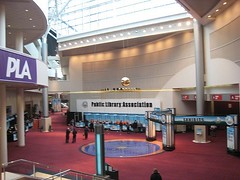
I can't tell you how impressed that I am with the 2010 Public Library Association Conference. This conference just did everything right. Beautiful location, beautiful venue, free working wireless and world class presenters. They even got the weather to cooperate! Sunny days in Portland in MARCH, someone must have good connections.
Having Natalie Merchant at the program was huge! Playing stuff yet to be released and having her serenade librarians with a thank you and going into the audience! Wow, that's what librarians need right now. The conference started a bit melancholy for me as I knew many colleagues were suddenly pulled from coming and many more would shortly be laid off. In fact I got news of a friend who was to be laid off, just as the program was starting. I hope that I can make a connection for her, but I couldn't help thinking of others. Like soldiers falling in the line, we must move forward but it's hard not to mourn what's going on, I can barely read the news anymore.
In sharp contrast, Kristoff gave us a lot to be thankful for. If you've read Half the Sky you know about the oppression of women worldwide. Women not considered worthy enough to save their lives, pay for an education, or even to pay for a simple surgery that could improve their quality of life. The book resonated with me, but not in the specific way of women in third world countries. What makes the book different was that it breaks down the problem, offers a solution, then goes further in discussing how good deeds and relief can be fruitless and difficult. Sometimes solving the problem doesn't end at one stage in the effort, but must be seen through. He told the story of a woman kidnapped and sold into sexual slavery. To save this woman, he purchased her and brought her back to her village. However, in one week she ran back to the brothel because she was addicted to meth that only the brothel could supply. How to solve that problem?
It reminded me of our library's literacy efforts. Literacy is only the first step. They then need a GED, job skills, soft job skills, then afterward to find a job, but then there aren't any. It's a great deal of work, and rewarding, but the work doesn't stop at literacy. The problems are much bigger and multifaceted. It's not just literacy, it's getting teens out of gangs and into the library. It's so much more. This is the work libraries need to do.
At the end of the day I'm energized and thankful about the work I can do in my community. I run an organization that is unique in one particular way. Other community agencies, schools and nonprofits have specific goals, mandates, and parameters that restrict them from doing the most good; libraries aren't as restricted. I can get on a committee and say we can give resources, know how to get funding, and can bridge the gap on your mandate. It's a wonderful feeling, like being a superhero and that's how this conference made me feel, thank you PLA!

- Posted using BlogPress from my iPhone
Thursday, December 17, 2009
Why bandwidth is important
The Internet is the lifeblood for libraries. With so many people out of work or unable to pay for information, entertainment, and necessities, libraries providing free and fast Internet is the only means to stay connected. There are so many things that can be done online now, from something that requires little bandwidth like submitting a job application, to watching full length movies online. With the influx of services that can be done online, a problem arises with providing enough bandwidth to provide the basic services patrons expect.
Does Library Bandwidth need to double every 18 months?
The need for increasing bandwidth seems to flow right along with the rate of computer memory. Keeping up with technology comes with a price, as computers can handle more memory and work faster, the bandwidth required to make them effective also needs to increase. With many needed services going online, libraries need to keep up with this need, but the problem is bandwidth creep. It seems that library bandwidth needs to double every 18 months to keep up, but then it should be less expensive according to Nielsen's Law. Our communities depend on us now more than ever to keep up since:
1. Libraries are the only free internet resource in town, often the only resource.
2. Bandwidth for an individual goes up faster than in an organization.
3. Libraries can't do as much if content requires more bandwidth, leading to feature freeze
4. Services deteriorate if we can't keep up, other services become affected. By trying to pay for more bandwidth, ongoing costs to maintain it can burden other services in an already stripped down service economy.
As mentioned in this Ars Technica article a few weeks ago reporting on ALA's report on Bandwidth. It's nice to see mainstream blogs provide attention to these issues.
Bill Gates fund: libraries need more cash for broadband
SNIP
As we've reported, libraries across the United States have become something like first economic responders for low-income people thrown out of work by The Great Recession. As job listings go online, and more and more require an on-line application form, computerless employment seekers are besieging local libraries—often the only place where they can get free access.
END SNIP
Libraries dying for bandwidth—where's the fiber (and cash)?
SNIP
But another problem is simple availability. As the ALA's report (PDF) points out, "moving from a 56Kbps circuit to 1.5Mbps is one thing. Moving from 1.5Mbps to 20Mbps or to 100Mbps or even to a gigabit—depending on the size and need of the library—is another." Even when they can pay for it, many libraries are finding that higher speeds simply aren't available.
END SNIP
Take for example a new service at our library. It is a VR Sorenson machine that provides a relay service for the deaf. A patron comes up to this machine, dials the number and a VR Sorenson employee signs to the person. This relay person can then contact any phone number anywhere and the person using the service can get help from businesses or other contacts that do not have a TTY machine or other services for the deaf. The machine requires high bandwidth. Most individuals can't afford this high level of bandwidth even though these machines are provided for free to many. It is superior to a TTY machine. Word of mouth spread like wildfire and we get several people using it per day. Even when it was getting set up, patrons knew exactly what it was and without advertising, word of mouth sold the service. It's an example of what a library can do, but without the bandwidth it wouldn't have happened. Without sufficient bandwidth, not only are library services frozen, but we are then forced to protect our scarce bandwidth resources.
Bandwidth Police
There is a recent article about libraries becoming bandwidth police. Libraries that don't have the ability to increase bandwidth have to rely on throttling so that all patrons can have enough bandwidth to get what they need online. Software vendors provide these tools to libraries, in which, an automatic limit is set so that one single individual cannot exceed a certain amount of bandwidth. A patron attempting to watch a streaming movie on Netflix would have their efforts hampered so that another patron can still use enough bandwidth for basic internet use, mostly textual in nature. Without enough bandwidth, throttling like this can affect services critical to library patrons, but because not enough resources have been providing for libraries to keep up with the bandwidth creep, libraries are reduced to this practice, leading to these articles on the practice.
Why a Shortage of Bandwidth is Turning Public Librarians into Traffic Cops LIS News points to an article from the Citizen Media Law Project, The Library Police: Why a Shortage of Bandwidth is Turning Librarians into Traffic Cops The author's basic premise is that because of poor bandwidth to libraries, and considering libraries are often the only place to get bandwidth, throttling leads to censorship:
SNIP
"A short time ago, the American Library Association (ALA) released the latest update to the Public Library Funding & Technology Study, a long running survey of public access to the Internet. The survey reveals that public libraries are the only point of free Internet access in the great majority of communities, and many libraries do not have enough bandwidth to meet the needs of their patrons. The entire situation is an embarrassing reminder that the US has a hideous Internet access rate...
While the latter approach is certainly disconcerting (especially in a country with such poor per capita connectivity), I am terrified by the former bandwidth austerity measure. Libraries have become a proving ground for two dangerous arguments: that content throttling is not filtering and that resource limitations justify content throttling."
END SNIP
I have personal experience in which I tried to expand computer access with old assumptions about bandwidth. It used to be 1.5 Mbps for 50 computers would be just fine, but now you would be lucky to get access with four times that bandwidth rate. E-rate helped me out there, but for many libraries that don't have the funds, can't reallocate them, can't figure out Erate, or are doing all they can and it's still not enough bandwidth. It can be very frustrating. Now with throttling becoming more common, people are beginning to notice, but at least with the author, he is in support of libraries getting more bandwidth so that they don't have to do this.
 What Libraries are doing for their communities
A recent Library Journal article highlighted what the ALA submitted to the FCC on libraries critical role to the economic well-being of their communities:
Salt Lake City Public Library terminals
Originally uploaded by Mal Booth
ALA to FCC: Consider How Broadband Fosters Economic Opportunity
SNIP
As Community Hubs:
Public libraries go beyond stopgap measures in creating and supporting economic opportunity
The added value libraries offer includes job training, information, and digital literacy programs
For Business Adoption and Usage:
The library as a small business
Libraries need high capacity broadband to provide essential services to the general public
Effective negotiation requires open dialog between service providers and small businesses
Broadband's role in regional economic development
Libraries are critical institutions in supporting regional economic development
Government-provided social benefit programs
Information literacy skills are critical to navigating online social benefit forms
Workforce development
The value of the public library’s suite of services cannot be overstated
END SNIP
A recent sneak peak at an FCC reports provides promising news to underserved areas:
"One proposal would use money from the Universal Service Fund to build broadband networks in underserved communities and pay for high-speed Internet connections for those who cannot afford them. The Universal Service Fund, which is supported by a surcharge on phone bills, was established to subsidize phone service."
What Libraries are doing for increased Broadband
The California State Library recently sponsored a competition called Fast Internet Matters @ Your Library. Libraries throughout California were to create video on Youtube that highlights why Fast Internet is important. Salinas Library was announced as the winner with this funny video:
Opportunity Online has been going around libraries and speaking with library staff and patrons about how important broadband is to the community. This is to help the broadband summit the Bill and Melinda Gates Foundation plan to have around the United States to help providing funding for broadband. You can watch some of those videos here.
The Bill and Melinda Gates Foundation have also announced a round of funding for broadband projects.
Foundation Announces New Support for Public Libraries to Help Provide Broadband Access for More Americans
SNIP
“Federal, state, and local government investments in connecting libraries to broadband are important steps toward realizing the vision of universal broadband access,” said Jill Nishi, deputy director of the Bill & Melinda Gates Foundation’s U.S. Libraries program. “When libraries have access to broadband, they can effectively deliver critical educational, employment, and government services for residents that lack Internet access elsewhere. As community anchor institutions, libraries can also help drive local broadband adoption.”
END SNIP
The hope here is that with the Bill and Melinda Gates Foundation stepping in with states and combing the Federal Broadband Stimulus program that local libraries can provide better, faster access and ensure sufficient bandwidth in the future to keep up with demand. The American Library Association has been spearheading this movement and has consistently demanded more broadband and bandwidth for our libraries. They have submitted to the NTIA and now the have submitted to the FCC the critical role libraries play in the local economy.
The last round of broadband stimulus went towards the truly needy. If funding is only going towards getting locations to a 742 kbps or half of a T-1 line and that is a big step up for them; that's very critical. However, in the next two rounds libraries are pulling for expanding access for more modern needs. Without this round of stimulus, libraries will continually fall behind the fast moving internet, crippling existing services and stopping progress for future needs. More affluent communities will be able to maintain and increase access, but those that cannot afford it will be severely hurt. Increasingly, this will lead to lost connections with the rest of the world, leaving pockets of many Americans behind. The concept is scary.
![Reblog this post [with Zemanta]](http://img.zemanta.com/reblog_e.png?x-id=b0d42e75-328d-4f58-8404-7983fb0338c4)
Does Library Bandwidth need to double every 18 months?
The need for increasing bandwidth seems to flow right along with the rate of computer memory. Keeping up with technology comes with a price, as computers can handle more memory and work faster, the bandwidth required to make them effective also needs to increase. With many needed services going online, libraries need to keep up with this need, but the problem is bandwidth creep. It seems that library bandwidth needs to double every 18 months to keep up, but then it should be less expensive according to Nielsen's Law. Our communities depend on us now more than ever to keep up since:
1. Libraries are the only free internet resource in town, often the only resource.
2. Bandwidth for an individual goes up faster than in an organization.
3. Libraries can't do as much if content requires more bandwidth, leading to feature freeze
4. Services deteriorate if we can't keep up, other services become affected. By trying to pay for more bandwidth, ongoing costs to maintain it can burden other services in an already stripped down service economy.
As mentioned in this Ars Technica article a few weeks ago reporting on ALA's report on Bandwidth. It's nice to see mainstream blogs provide attention to these issues.
Bill Gates fund: libraries need more cash for broadband
SNIP
As we've reported, libraries across the United States have become something like first economic responders for low-income people thrown out of work by The Great Recession. As job listings go online, and more and more require an on-line application form, computerless employment seekers are besieging local libraries—often the only place where they can get free access.
END SNIP
Libraries dying for bandwidth—where's the fiber (and cash)?
SNIP
But another problem is simple availability. As the ALA's report (PDF) points out, "moving from a 56Kbps circuit to 1.5Mbps is one thing. Moving from 1.5Mbps to 20Mbps or to 100Mbps or even to a gigabit—depending on the size and need of the library—is another." Even when they can pay for it, many libraries are finding that higher speeds simply aren't available.
END SNIP
Take for example a new service at our library. It is a VR Sorenson machine that provides a relay service for the deaf. A patron comes up to this machine, dials the number and a VR Sorenson employee signs to the person. This relay person can then contact any phone number anywhere and the person using the service can get help from businesses or other contacts that do not have a TTY machine or other services for the deaf. The machine requires high bandwidth. Most individuals can't afford this high level of bandwidth even though these machines are provided for free to many. It is superior to a TTY machine. Word of mouth spread like wildfire and we get several people using it per day. Even when it was getting set up, patrons knew exactly what it was and without advertising, word of mouth sold the service. It's an example of what a library can do, but without the bandwidth it wouldn't have happened. Without sufficient bandwidth, not only are library services frozen, but we are then forced to protect our scarce bandwidth resources.
Bandwidth Police
There is a recent article about libraries becoming bandwidth police. Libraries that don't have the ability to increase bandwidth have to rely on throttling so that all patrons can have enough bandwidth to get what they need online. Software vendors provide these tools to libraries, in which, an automatic limit is set so that one single individual cannot exceed a certain amount of bandwidth. A patron attempting to watch a streaming movie on Netflix would have their efforts hampered so that another patron can still use enough bandwidth for basic internet use, mostly textual in nature. Without enough bandwidth, throttling like this can affect services critical to library patrons, but because not enough resources have been providing for libraries to keep up with the bandwidth creep, libraries are reduced to this practice, leading to these articles on the practice.
Why a Shortage of Bandwidth is Turning Public Librarians into Traffic Cops LIS News points to an article from the Citizen Media Law Project, The Library Police: Why a Shortage of Bandwidth is Turning Librarians into Traffic Cops The author's basic premise is that because of poor bandwidth to libraries, and considering libraries are often the only place to get bandwidth, throttling leads to censorship:
SNIP
"A short time ago, the American Library Association (ALA) released the latest update to the Public Library Funding & Technology Study, a long running survey of public access to the Internet. The survey reveals that public libraries are the only point of free Internet access in the great majority of communities, and many libraries do not have enough bandwidth to meet the needs of their patrons. The entire situation is an embarrassing reminder that the US has a hideous Internet access rate...
While the latter approach is certainly disconcerting (especially in a country with such poor per capita connectivity), I am terrified by the former bandwidth austerity measure. Libraries have become a proving ground for two dangerous arguments: that content throttling is not filtering and that resource limitations justify content throttling."
END SNIP
I have personal experience in which I tried to expand computer access with old assumptions about bandwidth. It used to be 1.5 Mbps for 50 computers would be just fine, but now you would be lucky to get access with four times that bandwidth rate. E-rate helped me out there, but for many libraries that don't have the funds, can't reallocate them, can't figure out Erate, or are doing all they can and it's still not enough bandwidth. It can be very frustrating. Now with throttling becoming more common, people are beginning to notice, but at least with the author, he is in support of libraries getting more bandwidth so that they don't have to do this.
What Libraries are doing for their communitiesA recent Library Journal article highlighted what the ALA submitted to the FCC on libraries critical role to the economic well-being of their communities:
Salt Lake City Public Library terminals
Originally uploaded by Mal Booth
ALA to FCC: Consider How Broadband Fosters Economic Opportunity
SNIP
As Community Hubs:
Public libraries go beyond stopgap measures in creating and supporting economic opportunity
The added value libraries offer includes job training, information, and digital literacy programs
For Business Adoption and Usage:
The library as a small business
Libraries need high capacity broadband to provide essential services to the general public
Effective negotiation requires open dialog between service providers and small businesses
Broadband's role in regional economic development
Libraries are critical institutions in supporting regional economic development
Government-provided social benefit programs
Information literacy skills are critical to navigating online social benefit forms
Workforce development
The value of the public library’s suite of services cannot be overstated
END SNIP
A recent sneak peak at an FCC reports provides promising news to underserved areas:
"One proposal would use money from the Universal Service Fund to build broadband networks in underserved communities and pay for high-speed Internet connections for those who cannot afford them. The Universal Service Fund, which is supported by a surcharge on phone bills, was established to subsidize phone service."
What Libraries are doing for increased Broadband
The California State Library recently sponsored a competition called Fast Internet Matters @ Your Library. Libraries throughout California were to create video on Youtube that highlights why Fast Internet is important. Salinas Library was announced as the winner with this funny video:
Opportunity Online has been going around libraries and speaking with library staff and patrons about how important broadband is to the community. This is to help the broadband summit the Bill and Melinda Gates Foundation plan to have around the United States to help providing funding for broadband. You can watch some of those videos here.
The Bill and Melinda Gates Foundation have also announced a round of funding for broadband projects.
Foundation Announces New Support for Public Libraries to Help Provide Broadband Access for More Americans
SNIP
“Federal, state, and local government investments in connecting libraries to broadband are important steps toward realizing the vision of universal broadband access,” said Jill Nishi, deputy director of the Bill & Melinda Gates Foundation’s U.S. Libraries program. “When libraries have access to broadband, they can effectively deliver critical educational, employment, and government services for residents that lack Internet access elsewhere. As community anchor institutions, libraries can also help drive local broadband adoption.”
END SNIP
The hope here is that with the Bill and Melinda Gates Foundation stepping in with states and combing the Federal Broadband Stimulus program that local libraries can provide better, faster access and ensure sufficient bandwidth in the future to keep up with demand. The American Library Association has been spearheading this movement and has consistently demanded more broadband and bandwidth for our libraries. They have submitted to the NTIA and now the have submitted to the FCC the critical role libraries play in the local economy.
The last round of broadband stimulus went towards the truly needy. If funding is only going towards getting locations to a 742 kbps or half of a T-1 line and that is a big step up for them; that's very critical. However, in the next two rounds libraries are pulling for expanding access for more modern needs. Without this round of stimulus, libraries will continually fall behind the fast moving internet, crippling existing services and stopping progress for future needs. More affluent communities will be able to maintain and increase access, but those that cannot afford it will be severely hurt. Increasingly, this will lead to lost connections with the rest of the world, leaving pockets of many Americans behind. The concept is scary.
Subscribe to:
Comments (Atom)