Showing posts with label Economic Development. Show all posts

Friday, November 18, 2011

Job in a Box CLA presentation 2011 #calibconf

(I am posting the slides and text from my California Library Association conference presentation. It provides a little more detail from when we unveiled the machine back in June. Feel free to contact me for more information.)

Intro
Good Morning. My name is Jeff Scott and I am the Deputy County Librarian for the Tulare County Library. Our program is about our Job in a Box. This is a $60,000 LSTA project that would place a Brodart Lending Library book machine in the Visalia and Dinuba Workforce Investment Board One Stops. We fill the machines based on feedback from library staff, library circulation statistics, and job coaches at the One Stops.

Pitch an idea
For those unfamiliar with this new way of applying for LSTA grant, I will provide a little background. The program is called Pitch an Idea. Instead of investing the blood, sweat, and tears over a grant that may not get funded, the state library has simplified the process here. You get a notification that these grants are available and you have one week to write up your elevator talk, develop a total cost, and submit that to the state. The State Librarian, with a group of experts, then makes conference calls with questions about your proposal. If you make a compelling case, your project gets funded. I really like this approach since it saves a lot of time for library staff and it’s an opportunity to be very creative.

Inspiration
What inspired the project? This project was actually one of two we submitted to the state library. For those of you familiar with Pub-Lib Robert Balliot you may recognize the phrase, "There’s a Book for That." That was actually the title of our other project that we had submitted. The idea behind that was that we would place a machine in community centers around the city with a focus on that center’s purpose. For instance, if there was an Art Museum or non-profit center, we would place a machine in there and create a collection based on the users needs. If it is a history museum, we would place a machine in there and have materials relating to museum displays. Lastly, we included Work Investment Board One Stops. After carefully considering the work that would be involved in placing several of these machines in the city and throughout the county all at once, we decided to focus on the biggest need, job assistance.


Segway to partnership
Last year, the State Librarian’s office held a conference to help library directors collaborate with their local Workforce Investment Boards. The Department of Labor had recently instructed their local boards to work with their local community specifically targeting libraries.

De-facto job centers
For many years, libraries have acted as de-facto job centers. We help with resumes, set-up email addresses, and navigate an often complicated online application process. Even though we often receive no recognition (monetarily speaking anyway) for these efforts, it has become particularly critical for libraries to take on this role during our recent recession. We are the safe place to forage in this harsh winter of recession.

Funding
The biggest objective for a library to build a partnership with the Workforce Investment Board is funding. When you turn on the news and you hear about job bills that are trying to get pushed through Congress, much of that funding is going to your local Workforce Investment Board. Most of the money that they receive is distributed to partners in the area. Adult Literacy and Job Assistance are two of the key sources of funding. The key to receiving funding is to partner with WIB and put yourself in a position to receive distributed funds. One of the key aspects is to find out more about how your local WIB operates.

Libraries and WIBs are Similar     
WIBs and Libraries work in a very similar fashion. If you were to enter a facility and ask for job services, you would fill out an application, and then be whisked to a computer center. These centers look just like computers in libraries. Some examples:

Computer Labs
There are no time restrictions in the WIB centers. They can actually be there all day on the computers. It’s interesting how reversed this concept can be. Even though a library computer lab does not have to have a specific mission, a WIB center obviously does, yet you can get completely unrestricted time. Customers can go in the center and not do one bit of resume writing or job searching. Furthermore, there isn’t anyone on the floor to help them with the computers. Typically, there is just a security guard available. A typical WIB center doesn’t receive funding to provide this service, therefore, support is minimal. And you wondered why you receive so many job seekers at your computer labs; you are the only one there to help them in your communities.

Job Coaches
Most of the steps taken by serious customers involve Job Keys, Job Coaches, and Placement. A customer comes in and asks for job services. The customer is brought over to the computers and takes a job keys test. This makes an assessment of their abilities. If their abilities are below what the One Stop can support, they can refer the person to other services. Often, the library will see those people who don’t make that cut as they may require literacy skills or someone that can provide technology training that WIB doesn’t provide. Those that possess necessary skills are passed onto job coaches. Job coaches work with the customer to find out more about what the customer needs. If they possess the right set of skills, they can more likely be placed. Those successfully placed at a job provide the revenue for One Stops.

Where WIB makes its money?
One Stops make their money on placement. How many of the unemployed can they find jobs for? They do this very well. For example, a recent grocery store chain Vallarta came into town needing employees. WIB already had the names and abilities of people that would fit right into the job on their rolls. They established the interviews in their facility and helped with all the paperwork. The grocery store was able to get up and running far more quickly with their help rather than having to do all of the work, the advertisement, the placement all themselves.

How do libraries fit in?
Libraries can fit into the funding cycle by searching for ways to partner. The local WIB in Tulare County has an Employment Connect Council that coordinates all job training efforts in the county. CSET, Proteus, and other private contractors all go to this meeting and report. They also get many of the magnets to come in and give a talk about what they are looking for in employees. We were able to become part of this council and talked about our computer classes, literacy programs, and job seeking assistance efforts. After this meeting that the State Librarian coordinated, we got a seat at the table and began discussions on how we can partner.


Gaining a Foothold
One way the library could integrate itself into the One Stop service flow was by providing resources at critical junctures. When a customer came in, the ones that have the highest potential for getting a job are provided a job coach. This person provides guidance and resources. The library can play a very strong role here by providing the needed resource. In the past, we had tried office hours (providing a staff person available to answer questions and help with library services), but we wanted something that had smaller staff time and higher impact. Job coaches often refer their clients to book resources. What better place to get that resource than at the library? However, an easier way to go about it was to provide the books at the point of need. They may make referral to us, but that doesn’t mean we will see that person. This is how we decided on using the Brodart Lending Library book machine inside the One Stops.

Previous Experience
We have had previous experience with these book machines. Last year, we were awarded a United States Department of Agriculture grant to provide library services in poor rural areas. We used the lending library and placed it in the small town of Cutler near a school. The circulation on the machine by children was more than we could have possibly hoped for. The first day we had the machine, the books were almost entirely cleared out. We decided that we can use this as a model to expand future library services with minimal staff impact.

One Stops
We decided to place the machines in the Visalia and Dinuba One Stops. We decided on those two since out of the four One Stops in the county, these were the only two that were run by our library (Porterville and Tulare libraries are run by the city, but there is still potential to partner with them to expand the book machines there).

What needed to be accomplished
The many problems with this plan were manifest. We could place a book machine in the one stops, but who would choose the books? What would happen if they didn’t have a library card? What are all the obstacles that we could face? Furthermore, how could we encourage One Stop Customers to be full library patrons if they didn’t have to come to the library to get materials? What cross training was needed for WIB and library staff so that we can know what we both do?

Our plan was to coordinate the unveiling of these machines with a program that was paid for through the state grant. The grant would pay for cross training of both WIB and Library staff. Furthermore, Paul Clayton, a popular motivational speaker for One Stops, was hired to have the kick-off program in April of this year. Our main problem was how to solve these operational problem between February and April.


The Collection
What material would go in the machine? The library already had a strong test collection that includes GED, ASVAB, and SAT prep, but we had to research the most popular items that would be most beneficial for job seekers.

We surveyed our reference librarians and ran circulation statistics in the areas of 658 (business), 373 (secondary school) as well as other areas. We also asked WIB staff, particularly the job coaches, what type of books we should have. The result was a list of over 300 titles.

The problem that we encountered with this was that even though the machine could hold 300 titles, we wanted to focus on a core list and purchase duplicate copies inside the machine. That way, there isn’t a title that is missed. As you can see from the machine, you can only see what is in the front row of the machine. In the case of job help, it’s difficult to recommend a book if it is buried in the back.

Some example titles would be What color is your parachute?, How to write better resumes, 48 days to the work you love, GED, high school equivalency exam and How to prepare for the ASVAB.

Even as we filled the machine, job coaches approached us on what we were missing. Many of their customers were veterans recently returned from their tour of duty. We ending up purchasing books on how to adjust to civilian life after a tour of duty and what to do next.

Some interesting problems with the collection I will describe in detail later on. One of which was a misunderstanding at one of the one-stops about what should go in the machine. While we had agreed on workforce books, she had thought we should put childrens picture books in the machine. More on that later.

Issuing Cards
Another issue that we had to tackle was what if customers weren’t library patrons. Sure the books were there, but if there is no way to get a library card, then they are useless. After cross training WIB staff we described the problem. Staff were willing to provide library card applications since they often need customers to fill out paperwork. However, they did not have access to our database so it could not be activated in real time. What to do?

Our plan was to create dummy cards that were created with names like OneStop1 so that the WIB staff would have a live card that would work on the machine. WIB staff would issue the card, connect the library card number with the paperwork and fax the paperwork in. We would then create the patron. This worked exceeding well and helped accomplish another goal of the project, getting more One Stop customers to become full-time library patrons and realize all the library had to offer. We also saw a dramatic change in perspective in regard to the library.

Surveys
We conducted a pre-survey of WIB customers and their perception of the library. We asked them how often they used the library, what did they think of when they thought of the library, and what would make the library easier to use. What we found in the survey results was that the more people used the library, the more they saw the library as other than a repository for books. After three months with the machine in place, we reversed the perception as more WIB customers became library patrons. Whereas only 18% saw the library as a place to get books in the pre-survey, 75% saw the library as a place for job resources and computers after the survey. Even though, ironically, we found a way to integrate library services into the One Stop using library books. Customers found something tangible right in front of them and once they see a small aspect of what they could do, they wanted to see all the could do. Getting a library card at a WIB One stop resulted in more customers becoming full library patrons and utilizing all of our services.

Caveats
Some things to keep in mind in regards to the machine. The machine can hold up to 300 books at one time. Providing a variety of books in each row will only block the books behind the front book. It’s important to try to find a small selection of the most needed books and provide multiple copies of them. Some of these books can be quite heavy as well. An entire row of a heavy GED book may end up straining the coiling system on the machine. Sometimes it is necessary to use every other slot in placing the books or using two different rows. The Brodart Lending Library can be used with or without a connection to your catalog. If you choose to connect it, there can be issues with the SIP connection dropping that can leave the machine inoperable. We chose to leave the machine offline so any transactions are stored on the local computer inside the machine. The information can be retrieved and then uploaded to our catalog. This can even be done remotely with an internet connection. We haven’t had any issues with authentication, but using the machine in a different environment can lead to some minor problems. Even if you choose to not connect the machine to the Catalog, you will still need an internet connection to the device so that the manufacters at PicInk can trouble shoot or re-boot the machine if necessary. It’s easier to make a connection inside a facility with an internet connection as the One Stops do have. However, even in a remote environment, a sprint card can be enough of a connection to troubleshoot issues with the machine.

You should also look into moving the collection around to add more books and take out ones that aren’t moving. This isn’t necessarily a hot check-out spot since the collection is very specific as is the clientele. We don’t need to check on the machine more than once a month as circulation is low. We check-out around 10-20 books a month at each location.  

Lastly, it’s important to have all One Stop Center coordinators on the same page. Whereas we felt we were clear about what we were doing with the committee that was formed with Library and WIB staff, some people misunderstood. We had a complaint from the Dinuba facility about the collection. We had first thought that maybe the machine wasn’t working properly or we had the wrong books in place. It turns out that she had expected regularly library books, particularly children’s picture books. We explained that the machine was for workforce development materials. She still insisted on getting children’s books and actually tried to work up several rungs on the administration ladder (both up and down) to change this. This kind of issue ties back with general WIB management. While most One Stops are dedicated to providing services to the unemployed, others are not so vigilant about what customers do on their computers (in some cases booking their cruise) and therefore, would prefer to have just general library books in the machines. A further point, an ironic one at that, was that the One Stop was only three blocks from the library branch.


The Results
In the end, we changed the perception WIB customers had of our libraries. We also changed the perspective of WIB staff and administration. Our partnership was highlighted both in the Library’s and the Workforce Investment Board’s annual reports. This partnership now puts us in a position to partner with WIB for future grant projects whenever another Jobs bill is passed. Furthermore, the project in of itself has generated more publicity for the library. It has demonstrated innovative thinking in tough economic times. Furthermore, it’s generated enough interest from our foundation to warrant using the machines for a fundraising campaign entitled "Your Library in More Places". There are many underserved rural areas in Tulare County and we could use these to quickly deliver service that is more reliable and more available than a bookmobile stop. We hope to see these pop up all over the county in the coming few years.


Wednesday, June 01, 2011

Job in a Box Unveiled

I’m happy to announce the expansion of our book machine programs using the Brodart Lending Library. This post will describe our latest venture and also update our Cutler machine.

Through a new California State Library Program called Pitch an idea, we pitched placing a book machine in two Workforce Investment Board One Stops. These One Stops are places where the unemployed can get job assistance that includes anything including job searching, computer time, job coaching, training, and even job placement.  I am currently on their Employment Connection board for about six months and we have been searching for a way to collaborate to help the unemployed. Tulare County has a 19% unemployment, one of the worst in California, and is one of the most stressed counties in the nation. Any way in which we could collaborate can only help our citizens.

Each machine will carry 300 books with multiple copies focusing on workforce materials, GED Testing, ASVAB, Resume Writing, Cover letter, and career searching. All the materials included in the machines were selected by a group of WIB staff, library staff, and library circulation statistics. There are about 11 different books in the machine and we will receive advice from job coaches on how to adjust the collection to meet their customer’s needs. We have also held cross training with both WIB and Library staff to make both sides more aware of available options for job seekers in the community.  Overall, the program implementation cost about $60,000 for two book machines, two book drops, 600 books, and a paid motivational speaker. 

One of the interesting quirks is that job seekers that do not have a library card can get one from WIB staff. Those interested can get an application and a card, with those applications being sent into the local branch, checked for duplication, and entered into the system. A person can walk in and check-out those books even though they haven’t had a card with us before. We also conducted a pre-survey on library usage by WIB customers and found that many did not realize the library's job resources. Only 18% of participants found that the library was place to receive job assistance, whereas 73% saw us as a place for books, and 21% for computers. Part of this program will work to change that perception and work hand in hand with WIB to integrate the library into the job searching process. 

We also hosted a nationally recognized motivational speaker Paul Clayton speak to WIB customers in Visalia and Dinuba and unveiled the job in a box program.
I would say overall, that the Cutler book machine is getting more usage and will probably continue to do so since it is a less targeted market. Providing picture books to kids just getting out of school is just as easy as if we had an ice cream truck out there. Providing assistance to job seekers who may be frustrated and not sure what to do is a bit harder.  

So far, the Cutler machine averages between 350 and 750 check-out per month. The machine made it through frost, heavy storms and wind, and a variety of other weather and still works. It actually out circs about three of our smaller rural branches and it may be the start of a new level of service to complement our bookmobile services.  We plan to investigate more targeted book collections like this in the future and hope to see what that will bring in new library services. 

Thursday, October 01, 2009

Libraries receive stimulus grants, key to economic recovery

Barack Obama

The October 1st deadline for the first round of reporting for stimulus grants is upon us. I remember going to numerous webinars for the American Recovery and Re-investment Act (ARRA) training for these grants. Our library was the recipient of three of these grants. I did quite a bit of research before pursuing these grants as I knew that the reporting requirements were very extreme. I particpated in many a webinar and heavy research before proceeding.

If these webinars did anything, they drilled into your head that the Federal Government was serious about the reporting. Any lack of transparency or errors in reporting can kill your project immediately, result in the return of all funds, and have the agency blackballed from any future projects.You would think that Obama himself is going to show up himself to chastize you and take your money away.  It reminded me of an Art History class I took with my wife in college. Obama as the Pantocrator, a mild but stern, all-powerful judge of humanity.

Not enough for libraries
ALA has done a good job informing libraries about these opportunities. I wonder, however, how many libraries will receive these grants. I was very disappointed by the inability for libraries to get funding for fiber. Even though there have been various reports and studies produced to indicate the need and benefits, it hasn't been backed-up with funding. If there is one thing for sure, libraries will need increased bandwidth for future needs. Furthermore, anyone can tell that libraries are key to the economic recovery (there is an endless supply of stories), but is that backed up by stimulus grant funding? It seems to be lacking so far.

What kinds of grants
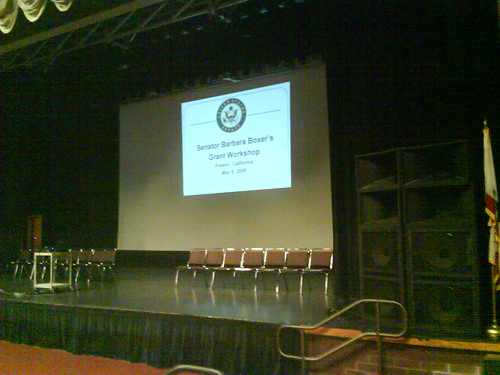
It was time to ramp up the detective-work to find those stimulus grants. I signed up for Grants.gov to receive alerts and began to research the process to get the grants. They were very elusive. Most of the library information about the grants was focused on fiber, most of the others focused on ways to partner with major agencies to receive funding. After attending a conference sponsored by Senator Boxer, I was able to track down several leads. What I did find was an opportunity to renovate some of our branch libraries. The reason why can provide a great explanation of the importance of libraries.

Libraries stimulate the economy
In the end we got the grants, three totalling $165,000. Altogether, we were one of three libraries in the country to receive a USDA stimulus grant and the only one in California. Knowing this about libraries, there should have been more funding to more libraries. I think I will know more about how much libraries received after the October deadline.

We received three stimulus grants from the USDA. The primary reason was that we provided the only public building in some of these areas where unemployment was 19%. In researching the grant, not only was there high rates of unemployment, but almost 80% of the population didn't attain a high school diploma. In rural areas, not only are resources scarce, they are non-existent. There are no buildings or services for the public. There is a school and after-school there is nothing without the library. It's the only public place, a safe place for someone to go where there is nowhere else to go. It's the only chance to get skills to be able to get a high school diploma, to get the skills needed for a job, to be a productive member of society. It starts with the library.

Reblog this post [with Zemanta]

Friday, May 29, 2009

Library Literacy Conference in Three Rivers

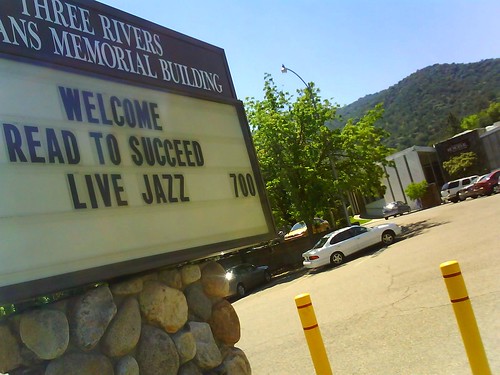
I attended the library's 9th annual literacy conference in beautiful Three Rivers, California. I had the honor of speaking to them before the event where I focused on the importance of their work in our economic recovery.

I referenced a recent Washington Post article that compares two rural communities and their broadband success. One was more successful than the other because their community was more affluent, the population had a higher education, and there was a workforce development program already there.


Rural Riddle: Do Jobs Follow Broadband Access?

Two Hamlets That Got High-Speed Lines Show Wildly Different Results
http://www.washingtonpost.com/wp-dyn/content/article/2009/04/22/AR2009042203637.html

"And the education gap cannot be dismissed", said John Horrigan, Director of the Pew Internet & American Life Project.

"It's Economic Development 101 to try to improve the supply of infrastructure to make a locality more attractive for businesses, but you do need a skilled workforce to fully exploit that," Horrigan said. "In rural America, for broadband adoption, skills and relevance still remain a barrier."

Even further explained by this Federal Communications Commission (FCC) report on rural broadband access:

Bringing Broadband to Rural America: Report on a Rural Broadband Strategy FCC

"Stimulating and Sustaining Demand for Broadband. Various factors may affect demand for broadband services in rural areas, including a lack of knowledge regarding the benefits of Internet access, lack of training on how to use a computer, socioeconomic and demographic factors, and affordability. To help stimulate and sustain demand for broadband services in rural areas, both public and private entities should consider developing consumer education and training initiatives, broadband affordability programs, and other incentives to achieve sustainable penetration rates."


So the key to any economic recovery, even if the library were to receive a broadband grant, isn't just fast internet access, but a skilled workforce. Without the literacy program, any other efforts wouldn't be as productive.

Literacy Issues and Stopping Short

There were great insightful discussions at the conference. Some great topics were:

The lack of diversity among tutors.

In some cases, adult literacy has focused too much on English Acquisition for Spanish Speakers instead of just general literacy.

The literacy center can deter students that have basic skills, but still need improvement.

In many cases, there is a frustration that the student only goes so far. They get to a level that they want to get a job, but no further. It's the problem of good enough.

"Literacy will be useful for the rest of their lives. Not just enough to get a job, or get what you want, but you can enjoy reading, writing, and an informed mind. Too many stop short, how can we change that?"

The best story: A woman wanted to learn how to speak English. Her children could do it. It took months of tutoring and help. One day, she was paying for her groceries when the check-out girl was wondering about how to make a Mexican dish. The student was able to tell her how to do it in English. When she walked out of the store, her six year old son said "Mommy, I'm so proud of you."

There is more information on Literacy from a May 2009 report:
Basic Reading Skills and the Literacy of the America's Least Literate Adults

Literacy Leadership

There was a great open forum where tutors, students, and literacy leaders discussed issues. There are some fantastic comments about leadership and how to make changes in communities.

"Leaders are doers. You see a need and you do something about it. You don't complain, you don't wait for someone else, it's about making it happen."


Matching tutors with learners.Image by Newton Free Library via Flickr


What it takes to be a tutor

It doesn't take much knowledge to be a tutor. Many of the tutors remarked that they didn't feel they could help the program because they didn't have a college degree. In the end, if you know how to read, you can help someone else learn to read. It's that simple. It's not the skills to teach, you just need to be patient and willing to help.

Anyone can find a literacy program near them by going here. In California, volunteers can also find programs nearest them by going here.

Reblog this post [with Zemanta]

Thursday, May 21, 2009

Recovery Act funds for libraries or I have broadband, I need faster broadband

President Obama's intention for the American Reinvestment and Recovery Act (ARRA) is to find ways to stimulate the economy. Many libraries qualify for existing grants (even though no money has been provided just for libraries.) The real trick is often finding a local federal office and working with them to get funding. If you know the right local federal agency, the right grant, and apply it to the right project, there are huge benefits. (The American Library Association has a great deal of information on how to get stimulus funds, I liked this one from District Dispatch Blog). As librarians, we definitely need to be creative and snoop so that we can find money that is applicable to us.
The process can be very confusing. Here was a good quote from the Technology Policy Summit discussing rural broadband potential:


Much of the money can be found in different places, and in many cases, wrapped into existing grant projects.

from Stimulating Broadband:
Given that these continuing programmatic efforts of the Rural Development division of USDA -- the division which includes RUS -- operate under an established body of regulations, the NOFA to be issued by the agency for ARRA broadband stimulus funds must be groomed to coordinate with those strictures already in use in rural jurisdictions around the country.
"
There is also more potential coming from the state:
Teri Takai: California Budget Crisis Won't Block Technology Progress

"The state also will step up efforts to prepare citizens for success in the digital economy. Schwarzenegger intends to sign an executive order promoting digital literacy within two weeks (article posted 5/17/2009), Takai said. And the CIO's office is launching efforts to assess statewide broadband Internet connectivity, with the intention of strengthening access in unserved and underserved areas."

After some investigation, we found our local Department of Agriculture office provides building construction and broadband connectivity to any public building in a rural area. For this alone, there is potential to get $300,000 in building construction money for library branches.


Broadband has been the biggest discussion in the library world. It seems like $7.2 billion is easy to get, but if your library already provides broadband, then what?

The Internet Runs on This stuff
Originally uploaded by Lacrymosa


Do we still qualify for broadband if we just need more speed? We really can't afford an ongoing cost to upgrade.

There is a great deal of potential for rural libraries to update buildings, and provide the infrastructure for increased internet access. However, if I repair or build a building, it can last 5, 10, or 50 years past the grant cycle, depending on the project. For broadband, the costs are always ongoing and always increasing, but the stimulus money isn't. What do we do then?

Friday, April 18, 2008

The people who need libraries most use us the least

A quote that caught my eye from the Library Revolution Blog. Emily Clasper covered Computer in Libraries on her blog. This quote (and I am not sure if the first sentence is the presenter and the second is her thought, it seems that way) speaks to the big problem libraries have in serving the public.

Library Revolution » Blog Archive » CIL 2008: Day 1 Keynote: "Education level is a good predictor of library use. Should this make us worried that the people who may be the least likely to use the library may be those who need us the most?"
END


Education and red-lining
When I read this post, it coincided with a piece I heard on NPR about the anniversary of the Fair-Housing Act and Dr. Martin Luther King, Jr.'s assassination.
How has the Fair-Housing Act fared? The piece documented how African-Americans were blocked from living in certain areas. This practice was commonly known as Red-lining. Dr. King spoke in this piece and provided an example. "When a black man goes into a realtor's office, the realtor tells him the only houses that are available are in the ghetto. When a white man goes in, the realtor suddenly has more openings in nice areas."

This practice is heavily detailed in the book Minorities in Phoenix by Brad Luckingham. He discusses how Phoenix was populated. It explains why there is a South Phoenix which has a high density of minorities and is a very poor and crime-filled area. The book is 16 years old now, but not much has really changed in these areas. The reason is that realtors blocked minorities from going into any neighborhood except the one designated for them. Then, these areas had all of their resources sucked out of them. With no businesses willing to locate there and no jobs offered, it is no wonder that these areas are as they are. It wasn't always that way, but it was designed to be so.


This impacts libraries as well. A public library exists because no private entity can provide the same vital service. These public libraries can be established in poor areas. In most cases, it is the only vital link for a depressed area to revitalize and for its population to pull itself out of poverty. In some areas, the situation is hopeless so resources like public libraries aren't used as heavily because "What's the point?" That's something serious libraries have to look at. So when I read the first post from Library Revolution, it rings very true. Those who need us most use us the least. I have looked at the stats for libraries in poor areas and the usage is low.


Consistency and equality supersede efficiency

However, the reality is that it takes a disproportionate amount of effort to make the library heavily used again. If the public can see the library's value and understand what it can do, then they will come. Part of that is faith in the library administrators. It is easy to cut funding where there is little use, it's efficient. It is being a good public steward of funds and allocate resources where it is used the most. Those in poorer areas have less usage, more lost books, and more damage to libraries. Low usage means less hours, less funding. How do you turn this around? An administrator must be dedicated to provide fair and consistent services. Consistency and equality supersede efficiency. If we don't put funding where it is needed most, we are not holding up to our true mission of service.

Place a public library in any affluent community and people will be banging on the door wanting to get in. They understand that libraries are power. That they can provide the resources to leverage anything. That the library's resources only lead to improvements to one's self. In a poor area, the people are so depressed, they don't see the need in trying. They must be convinced otherwise. I remember when Tony Garvey of the City of Phoenix Public Library made the decision to provide consistent hours throughout the city. It was a controversial move, but it provided the same level of service no matter where you went. How did she fair?


SNIP
Phoenix Librarian Toni Garvey Named Librarian of the Year (2004)
During her seven-year tenure at Phoenix Public Library, circulation has increased by more than 100 percent, and visits to library facilities have grown by 26 percent.
According to the latest statistics released by the American Library Association, Phoenix libraries are open more hours per facility per week than almost any other system in the country serving one million people or more.


Librarian of the Year 2004: Toni Garvey
First came expanded hours of service. Every PPL branch, including the central library, is open seven days a week, for 66 hours. This schedule, which provides more hours of service than most city libraries, includes generous Sunday hours. Before budget cuts, PPL offered 75 hours of service a week.

When Garvey arrived, branch library schedules varied widely and hours of service were far fewer. Some branches were open 40 hours, others up to 55. Some opened on Sunday in the school year, others not at all. The fewest hours were often in the neediest neighborhoods.
"It was a fine political message to say, 'We serve everyone equally,'" says Garvey. "In a place like Phoenix, with 13 libraries to serve 1.4 million people, you have to redefine what access means. Lots of hours and uniform schedules are critical to that."


Access also means serving a diverse population. When a librarian visiting a branch in a Hispanic neighborhood found no staff who could speak Spanish, Garvey immediately discovered which staffers had language competencies. She transferred people into branches with gaps and began to recruit people fluent in Spanish. Most remarkably, PPL hired someone to teach Spanish to the whole staff, and now there are basic and intermediate Spanish classes going on all the time, with teaching geared to library situations and vocabulary.
END SNIP


Boost the community
It is true of urban and rural libraries in bad areas. We must provide resources and services consistently to everyone. What message can we send if we don't do that? It is difficult during today's economy to do this. At a time like this, a library's need for additional resources rises. We were able to take advantage of the booming economy. We are building a new library and have money to provide a great opening day collection. We can also continue to purchase new materials and replace damaged and lost materials. It is like the broken windows theory, if we can replace something that is damaged (and in poor areas things are damaged constantly) we can help prevent more problems. It is to provide consistent services that are always available and to be able to boost the community, when it needs us the most.

Monday, November 19, 2007

Using your media, Elevator Talk vs. TV Talk or How I ended up on Good Morning Arizona

Too often, libraries only receive news coverage for something bad. It is the nature of modern media to seek out bad stories. Therefore, it is imperative that libraries seek out their local media to tell good stories.

Good can be as communicable as Evil
I remember listening to This I Believe audiobook from NPR. There was an essay by Norman Corwin called Good Can Be as Communicable as Evil. Here is a quote:

"Because of the principle that a calm sea and prosperous voyage do not make news but a shipwreck does, most circulated news is bad news. The badness of it is publicized, and the negative publicity attracts more of the same through repetition and imitation.

But good can be as communicable as evil, and that is where kindness and compassion come into play. So long as conscionable and caring people are around, so long as they are not muted or exiled, so long as they remain alert in thought and action, there is a chance for contagions of the right stuff, whereby democracy becomes no longer a choice of lesser evils, whereby the right to vote is not betrayed by staying away from the polls, whereby the freedoms of speech, assembly, religion, and dissent are never forsaken.
"

In telling the library's story, it is imperative to find interesting positive news stories that demonstrate the library's impact. We cannot wait for the media to create a bad story. They inevitably will if we remain mute.

What are your stories?
What good stories does your library tell? At my library, we tell about impact. We can tell about the joys of reading, the available technology, and what we are able to do for the community. Developing the workforce so that there are better qualified applicants for jobs which, in turn, draw more businesses into the community. We provide a literacy program so that more adults and read and write in English, thus further bolstering the economy. We provide public space where free thought and discussion can take place. It is where everyone is welcomed and a community is built and joined together from all walks of life. We welcome teens and create spaces, services, programs, and materials for them. We are a space that represents the community and assists in its construction. Everyone knows our story and knows about the library because of our efforts in getting the message out. Yet, I was still surprised when I received the call from Westcor in conjunction with Channel 3 and Good Morning Arizona.

Going on Good Morning Arizona


What was amazing about it was that when Channel 3 was trying to find a story about our community in conjunction with the opening of a new regional mall, the library was suggested. I received the call several weeks ago that it was a possibility, but wasn't sure if it would happen. Then, two weeks ago, it was confirmed. I would be on the show at 8:15 with Brad Perry. I was really excited about it at first, but then I began to worry. What would happen on the show, how much time would I have, and how would this all work out? I began to worry a bit more about it when they called and said that some people request questions ahead a time, but that they weren't going to do that. I didn't think it would be a problem, but then I began to think about what I would be asked, how would I respond, and how would I be able to convey our message with no preparation and nothing but my wits?

I think my performance went well. I rolled up to the site and staged the bookmobile, satellite dish running, laptops, books on display, library cards, and anything else I could think of. Brad came over about five minutes before we began and looked at the Inglis Sin Barreras, wondering what it was. I told him that it was a English acquisition kit for Spanish speakers and that it meant English without barriers, without borders. He liked that and used it as the lead in. I think I did fine in my response.

Elevator Talk vs. TV Talk
Afterward I was reminded of a story about advocacy called elevator talk. If you were stuck in an elevator and someone asked you about libraries, what message could you convey in the few minutes you had? In this case, it was a TV talk in which I had even less time to respond and advocate, plus it was on live television so appearance plays a bigger role.

Will it make impact or is it the result of already good work?
In the end, I had about one minute. I doubt it could have conveyed any message in that short period of time. Anyone I told who was actually waiting for me to come on probably would have missed it. Luckily, my wife recorded it for me and I was able to post it to my blog and share it with my board, library staff, and the general public. The actual piece hasn't had the impact as other media formats. When the library made the front cover of the local paper, our phones rang off the hook for literacy volunteers, questions about the library, and increased usage.

I realized though, that it wasn't the television appearance that was really the impact, it was an outcome of the library's good press. When Channel 3 was looking for a story, everyone suggested the library. The movers and shakers in our community know the library is place to get a good story. There is no mystery as to how we operate, what our resources are, and why we are successful. We also have 90% of our community owning a library card. That is often twice as many as the average community. One of the other tests I personally do, is to see what people are reading. It is really neat to go into the public schools and see that the teacher has a whole bookshelf of the public library's books for their kids to read. It is wonderful to be out in public and see a child reading a book, and knowing it came from our library. I always check for the spine label. That is a better result than going on television.

Saturday, May 26, 2007

Dare to Dream: A best practices document to further the needs of Adult Literacy

A great document that was just released on how to change adult literacy programs to make them more effective and longer lasting. These studies are extremely important for any community since adult illiteracy permeates every community. What I thought was striking about this study was that if you talk to any business, you will find that they are already aware of this problem, and would have the same suggestions. Businesses need qualified workers, otherwise, they cannot be profitable, nor will they stay in business.

SNIP
National Council on Adult Literacy
Dare to Dream
A Collection of of Papers from a Resource Group of 102 Educational and Literacy Professionals

http://www.caalusa.org/daretodream.pdf

Suggestions and clusters center around several broad themes: (parenthesis mine)

  • Make adult education a mainstream education system with strong articulation to post-secondary education and occupational training. (Workforce development)
  • Articulate clearly that adult education and literacy provides economic benefits to students via workforce preparation and postsecondary education. (Adult literacy and workforce development go hand-in-hand.)
  • Establish clear goals and a few achievable priorities
  • Treat ESL/immigration as having high importance (This is a larger part of the workforce than most would admit. We also rely in it more than anyone would admit.)
  • Ensure teacher quality and elevate status of adult education professionals
  • Improve both the accountability system and assessment tools (probably heading towards performance-based budgeting)
  • Make far greater use of technology and distance learning to improve service and expand outreach. (Online resources such as Rosetta Stone, bookmobile services, and remote internet access are key to this. Those in need may be reluctant to go to a center such as a library to get assistance.)
  • Adopt and mobilize new approaches to building public awareness and business advocacy--especially at the state and local levels--as part of comprehensive planning for education and economic development. (Again if you talk to many businesses, they find adult literacy a very critical component of their operations.)
  • Strengthen ongoing basic and applied research
  • Differentiate local, state, and federal roles
END SNIP

I think the best piece talked about how the GED was not the end-all be-all of Adult Education. Most of this population goes through this process to get and hold down a job. The GED is just a piece of paper without a job.

SNIP
Members believe attainment of the GED and increased levels of basic skills proficiency as measured by standardized tests are not adequate measures of preparation for further education and job readiness, and the GED should not be considered the terminal goal of AE (Adult Education).
END SNIP

SNIP
Most members believe that AE is more likely to be sold to the public through a "top down" process via elites, as part of economic development initiatives.
END SNIP

The same could be said for making the case for the need for public libraries as well. Getting the right people involved and placing this need in the context of the "elites" priorities makes for successful advocacy.


Monday, April 23, 2007

Technology Centers Empower Low-Income Hispanic Communities

Technology Centers Empower Low-Income Hispanic Communities

April 17, 2007

END SNIP
Hey, just what libraries are doing! Have you seen Webjunction, http://webjunction.org/do/Navigation?category=10555
More from the article

SNIP
While a higher percentage of Hispanics are employed compared with any other ethnic group (64 percent employment rate versus 63 percent for the next highest, Current Population Survey, April 2006), Hispanics are far more likely than the average American to be among the working poor. In addition, according to a new study by Pew Hispanic Center, 53 percent of Hispanics who are not online say this is because they do not have access. Empower Hispanic America with Technology is aimed at combating these inequities by giving Hispanics the necessary skills, and access, to compete in today's technology-driven workplaces.
END SNIP

Economic development, workforce development, and more can be developed by providing computer and internet access. I remember when our bookmobile went to an underprivledged area; some elementary aged children used our laptops from our van. It was like they had never seen a laptop before. In this day and age, the introduction of the computer at a young age is almost as important as introducing reading.

AND

LATINOS ONLINE PEW Internet Study
http://www.pewinternet.org/pdfs/Latinos_Online_March_14_2007.pdf
Hispanics with lower levels of education and English proficiency remain largely disconnectd from the internet
SNIP
Just one in three Latinos who speak only Spanish go online
78% of Latinos who are English-dominant and 76% of bilingual Latinos use the internet compared with 32% of Spanish-dominant Hispanic adults.
76% of US-born Latinos go online, compared with 43% of those born outside the US. Some of this is related to language, but analysis shows that being born outside of the 50 states is an independent factor that is associated with a decreased likelihood of going online.
80% of second-generation Latinos, the sons and daughters of immigrants, go online, as do 71% of third-general latinos who did not complete high school go online.
Mexicans are the largest national origin group in the US Latino population and are amont the least likely groups to go online: 52% of Latinos of Mexican descent use the internet. Even when age, income, language, generation or nativity is held constant, being Mexican is associated with a decreased likelihood of going online.
END SNIP

An uphill battle indeed, and I thought literacy programming was hard.

Saturday, April 21, 2007

Literacy in Everyday Life: Results from the 2003 National Assessment on Adult Literacy

Literacy in Everyday Life: Results from the 2003 National Assessment on Adult Literacy
http://nces.ed.gov/Pubs2007/2007480_1.pdf

Literacy in my community
A 2003 survey indicated that 19 percent of adults could not read at level one. 4,000 adults could not fill out a job application, read a food label or a simple story to a child.

Community Impact
We cannot afford to leave any adults behind. We need each and every individual to work to their full potential. Businesses need a well-trained workforce; our economy depends on a skilled, educated workforce. We cannot afford to send jobs overseas because of deficits in essential workplace skills. Individuals with lower literacy levels are disproportionately represented in the unemployed.


Graph provided by Literacy in Everyday Life: Results from the 2003 National Assessment on Adult Literacy, published April 2007
http://nces.ed.gov/Pubs2007/2007480_1.pdf

Economic Impact
1 out of every 5 adults is below basic in literacy skills, which means that 1 in 5 adults do not score above 200 in the literacy scoring used by the National Assessment on Adult Literacy, or 1 in 5 adults do not qualify for any jobs offered in the City. Businesses that cannot find good quality workers will go elsewhere for their business or will not be attracted to the City to conduct their business. At first, they may see an advantage in paying a low wage to its workforce, but the business will never be able to grow or evolve its workforce without qualified applicants. This situation threatens economic development in the city.

Personal Impact
He is a stranger in a strange land of incomprehensible symbols. Knowing the stigma attached to illiteracy, he uses many strategies to conceal his inability - - though he knows people will see through it anyway. That takes even more work, as well as the shame inherent in the ruse. Keeping himself convinced he isn't stupid is a constant effort.

Action is required now to solve this problem in the future.

"The great French Marshall Lyauteyone asked his gardener to plant a tree.The gardener objectedthat the tree was slow growingand would not reach maturity for 100 years.The Marshall replied,In that case, there is no time to lose,plant it this afternoon!"
John F. Kennedy

It takes seven years to acquire a new language and it takes a year for basic literacy skills for current English speakers. Attracting businesses to our community is important now!

"Furthermore, many researchers caution against withdrawing the support of the home language too soon. There is a great deal of evidence that, whereas oral communication skills in a second language may be acquired within two or three years, it may take up to four to six years to acquire the level of proficiency for understanding language in its instructional uses"
(http://www.ncela.gwu.edu/pubs/issuebriefs/ib5.htm Lessons From Research: What Is the Length of Time it Takes Limited English Proficient Students to Acquire English and Succeed in an All-English Classroom? September 2000, Issue and Brief)

What the Library is doing to provide assistance with this problem:

One on One Tutoring Program
Laubach technique is used for one on one tutoring.
Tutors for Pre-Lit to 3rd grade reading level.
18 hours of training plus working with the students ahead of time to become a regular volunteer.
Nine month commitment to each student
Need to meet with students two (2) to three (3) times per week (at least 4 hours).
Need at least 30 tutors, 60 when at full steam and they need to fill out monthly reports on progress.
Coordinator will meet with tutors 4 times a year

Library resources
The Library provides a host of resources to assist our tutors and the general public. The library currently has a full set of Laubach materials for one on one tutoring and other resources for the general public. The library will also have computer programs available for students to use on their own to supplement their training.

Library Bookmobile
The Library maintains bookmobile services. This service provides transportation for tutors, the ability to provide literacy training on site, job searching and internet access on site, as well as general bookmobile services.

Other literacy details:

Literacy Levels

"The percentage of adults with Below Basic quantitative literacy decreased, and the percentage of adults with Proficient prose and document literacy also decreased. In 2003, some 5 percent of adults were nonliterate in English."

Education and Literacy

"Educational attainment increased between 1992 and 2003, with a higher percentage of adults completing an associate’s or college degree and fewer adults ending their education before completing high school. In 2003, average prose, document, and quantitative literacy increased with each increasing level of education, except for students who were still in high school."

Employment, Earnings, and Job Training

"In 2003, adults with higher literacy levels were more likely to be employed full-time and less likely to be out of the labor force than adults with lower literacy levels. Adults with lower literacy levels also generally earned lower incomes. On all three literacy scales, a higher percentage of adults with Proficient literacy were employed in professional and related occupations and management, business, and financial occupations than in other occupations. Many individuals with lower literacy levels were employed in service occupations. Specifically, 30 to 35 percent of adults with Below Basic and 22 to 24 percent of adults with Basic prose, document, and quantitative literacy worked in service jobs, compared with 7 to 10 percent of adults with Proficient prose, document, and quantitative literacy."

Wednesday, March 28, 2007

English Language Learning: Quick Hits

SNIP
Petitions target immigration
Group seeks tougher Arizona laws against illegal migrants


"Saying that they will do what the government has failed to do, a group of citizens spearheaded by a lawmaker and a former gubernatorial candidate on Tuesday launched twin petition drives to create tougher immigration laws in Arizona.

One measure is aimed at punishing employers who knowingly hire illegal workers. The second would require police agencies to enforce federal immigration laws."

END SNIP

Getting tougher on illegal immigration, but at what cost?

SNIP
"At a news conference organized by House Democrats after the rally, he said many officers worry the law-enforcement initiative would distract them from their priority of pursuing violent criminals. And, citing a federal court case, he questioned whether police would be within their rights to enforce immigration law.

Sheridan Bailey, owner of a structural-steel plant in Phoenix and founder of Arizona Employers for Immigration Reform, said the employer-sanctions measure would harshly punish employers if they're found to have illegal workers on the payroll."

So we are punishing businesses for hiring illegal immigrants and causing the police to add even more duties to their thinning ranks? Who benefits from this? Economic development doesn't and public safety doesn't. Isn't a good economy and public safety two very key factors for a thriving community?

Next:
SNIP
Goddard to have say on migrant education
Dianna M. Náñez


"Arizona Attorney General Terry Goddard said his office will issue an opinion next week that should determine how Proposition 300 affects undocumented immigrants enrolled in adult-education classes in public schools."

"While answering questions, Goddard referred to a federal law that prohibits public schools from inquiring about a student's citizenship.

"Adult education is considered primary and secondary education. . . . Providers of that (education) may not inquire (about) citizenship," he said, adding that federal law supersedes state law."

END SNIP

I just hope 300 gets thrown out. This is such a bad proposition that will hurt our economy dearly. We need to help this essential piece of our workforce.

Next:
SNIP
Next step in English learners ruling up to lawmakers
Lawmakers to decide on appeal of English learners school case


"Republican legislative leaders will huddle Wednesday with the state schools superintendent to decide what they should do in the wake of the latest ruling in the long-standing legal battle over English language learners."

END SNIP

I just don't understand. It costs money to fix the system, or it costs money to fight for keeping a system that isn't working. We lose just as much money fighting the positive change as we do fixing the system that benefits everyone. This change would improve Arizona students' chance at a better education and create more well-trained employees for the workforce. Why are we fighting this?


SNIP

English-learner leader hired
"Former Nogales Unified School District Superintendent Kelt Cooper, who has been lauded for his successful reforms in teaching students English, was hired by the Arizona Department of Education to help schools statewide to improve.

Cooper will be director of technical services in the English acquisition section, Superintendent of Public Instruction Tom Horne announced Monday.

A federal judge ruled last week that the state's plan to educate children struggling to learn the English language violates federal law and puts hundreds of millions of dollars in federal funds in jeopardy."
END SNIP

At least we are looking at solving the problem by hiring people that know how to do it. I hope we see some improvement. I will be optimistic and say we might see something good come out of this.

Saturday, March 24, 2007

English-learner funds are ruled still not enough

This goes back to why Arizona struggles with education and why it has trouble with its workforce. If there are not opportunities for Spanish speakers to learn English, no one wins. By attracting this labor force to the United States and making sure there are no opportunities for them to learn English makes this population slave labor. They come here for jobs, they live in substandard housing, and they can't do anything about it because they don't know their rights, let alone how to understand what is happening to them.

It takes seven years to learn a new language. I don't know why so many people are fighting this. This is a critical segment of our population and by keeping these opportunities away from them, we are only hurting ourselves.

English-learner funds are ruled still not enough

Amanda J. Crawford
The Arizona Republic
Mar. 23, 2007

SNIP
"U.S. District Judge Raner C. Collins said a plan approved by state lawmakers last year to satisfy a seven-year-old court order still does not provide adequate funding to school districts to educate the state's nearly 160,000 English-language learners. By requiring school districts to use federal funds in lieu of state funds, the funding scheme directly violates federal law and could "jeopardize the entire stream of federal educational funds available to the state's students," he wrote."

END SNIP

So Arizona legislators are putting the entire system at risk by resisting this basic right? How much money does it cost the state fighting this?

SNIP

"The case, Flores vs. Arizona, was originally filed in 1992 on behalf of a Nogales family. In 2000, a federal judge ruled that the state funding was not adequate to teach struggling students English, which is required by federal law. Since then, the court has rebuffed several attempts by lawmakers to satisfy the court order by changing its funding models.

"For the last seven years, they have tried to get along with putting as little money as possible into this," said Tim Hogan of the Arizona Center for Law in the Public Interest, which is representing the plaintiffs."

END SNIP

People are forced to learn English, but nothing is done to help them do that.

SNIP

"In his ruling, Collins said the state's plan systematically underfunds English-language instruction. He called the per-pupil funding amount arbitrary and noted that it is less than the amount called for by previous state cost studies.

Plus, he said the plan has two serious flaws that run afoul of federal law: It makes funding available only to teach students English for two years, despite evidence that it can take much longer."

END SNIP

There it is. In fact it takes seven years to learn a new language. I don't know how long we can go around and around on this, but the fight is obviously hurting the states economic vitality and the state's educational system. I am not exactly sure what is behind it, but it looks suspicious.


Sunday, March 11, 2007

GOP, business at odds on migrant reform

Not sure why all these stories on how anti-immigration reform have hurt local businesses come out on Sundays. Today's article demonstrates a surprising rift between the business community and the Arizona Republican Party. Stringent immigration reform in Arizona only would hurt business since that same workforce will simply go into neighboring states for work. This demonstrates how much this immigrant workforce is needed to keep the local economy going.

GOP, business at odds on migrant reform
Mary Jo Pitzl
The Arizona Republic
Mar. 11, 2007
http://www.azcentral.com/news/articles/0311immigration-GOP0311.html

SNIP
"Last week, 32 chambers of commerce sent a letter to state lawmakers and Gov. Janet Napolitano imploring them to hold off on state actions and work for "comprehensive immigration reform" in Congress this year."
END SNIP

32 chambers of commerce is quite a bit for Arizona. I would imagine it is every major metropolitan in the state.

SNIP
"But in their letter, the business leaders say that an Arizona-only immigration crackdown would hurt the state's competitiveness and make it less attractive for prospective employers.
END SNIP

So workers would go elsewhere, so then there IS a competition for this workforce and a desire to attract it to Arizona.

SNIP
"And although the business community may want to wait for Congress' plan, Arizonans don't, Boone argued. He pointed to the lopsided success of three ballot measures last fall that ratcheted up the pressure on illegal immigrants.

But chamber officials say that such policies would dampen Arizona's business climate and create a regulatory mishmash. Among those sending the letter were the Arizona Chamber of Commerce and Industry, the Greater Phoenix Chamber of Commerce, the Arizona Hispanic Chamber of Commerce, the East Valley Chambers of Commerce Alliance and the Southern Arizona Chamber of Commerce Alliance.

"Our ability to bring new companies and jobs into this state will be compromised if the Legislature implements onerous and discriminatory regulations that create a negative perception of Arizona as a place to operate a business," the chamber officials wrote."
END SNIP

This goes back to my past posts demonstrating how necessary this population is to the local economy. This isn't even a local issue, but a STATEWIDE issue. Many Arizonans don't realize how much they benefit from this population coming to work here. It attracts business and keeps their goods at a low cost of living. Mostly because this population is paid very poorly.


Sunday, March 04, 2007

Inmates Will Replace Migrants in Colorado Fields

The negative impact on the economy and local economic development is felt in Colorado where immigration law has become stricter. Farmers are reduced to hiring prison help to work their crops just so they can stay in business. Take this same example, and imagine it as factory work and you have the same problem across the country once these stringent anti-immigration laws pass. We need to find a solution that helps the economy that has become reliant on this labor force.

Snip

"Under the program, which has drawn criticism from groups concerned about immigrants’ rights and from others seeking changes in the criminal justice system, farmers will pay a fee to the state, and the inmates, who volunteer for the work, will be paid about 60 cents a day, corrections officials said.

Concerned about the possible shortage of field labor, Dorothy B. Butcher, a state representative from Pueblo and a supporter of the program, said, “The workers on these farms do the weeding, the harvesting, the storing, everything that comes with growing crops for the market.”
“If we can’t sustain our work force, we’re going to be in trouble,” said Ms. Butcher, a Democrat.
The program will make its debut in Pueblo County, where farmers have been hit hard by the labor shortage. Frank Sobolik, director of a Colorado State University extension program that works with farmers in Pueblo County, said he expected that about half of the 300 migrant workers employed by area farms might not return this season.

“There’s a feeling, a perception that these laborers won’t be back because it’s safer for them to find work in other states,” Mr. Sobolik said. “The farmers are really concerned. These are high-value crops we’re talking about here with a high labor requirement.” "

End snip

And further evidence that these policies end up hurting businesses, even turning farmers against each other for workers.

Snip

"“It’s very frustrating,” he said. “I’m definitely going to lose customers. We’ve never had an issue like this. With all of us trying to get enough workers on our farms, I’m worried this is going to turn into farmer against farmer.” "

End Snip

The solution to provide prison labor is not as effective here either. Perhaps in a factory you might have more success, but in the end it turns into slave labor. You certainly don't have as a good of an end product with someone forced to do the job versus someone getting paid for it.

Snip
"But Ari Zavaras, executive director of the Colorado Department of Corrections, said the merit of a hard day’s work outdoors was invaluable to an inmate.

“They won’t be paid big bucks, but we’re hoping this will help our inmates pick up significant and valuable job skills,” Mr. Zavaras said. “We’re also assisting farmers who, if they don’t get help, are facing an inability to harvest their crops.”

With the start of the farming season looming, Colorado’s farmers are scrambling to figure out which crops to sow and in what quantity. Some are considering turning to field corn, which is mechanically harvested. And they are considering whether they want to pay for an urban inmate who could not single out a ripe watermelon or discern between a weed and an onion plant. "

End Snip

So your choice is between someone forced to do it, with a worse crop or product, or you can raise the wages for people who do that job. It makes it more attractive for the local population, but to make the job attractive for people outside of this immigrant labor force, the end result would be your average consumer paying a lot more for their daily groceries and basic essentials. It affects everything and people need to think about how to solve the problem before they go to such extreme examples.

Read the whole thing here: http://www.nytimes.com/2007/03/04/us/04prisoners.html?ex=1330750800&en=6ae85ab9020c21b5&ei=5124&partner=permalink&exprod=permalink