Showing posts with label bandwidth. Show all posts

Thursday, September 23, 2010

Library Bandwidth in Terms of Gigabytes

I attended the meeting for CENIC's project to provide high speed fiber for California's Central Valley last week. When completed, this project will provide high bandwidth fiber pipe from Kern County (Bakersfield) up to Colusa County. The Central Valley is California's most rural and poorest area, encompassing over 500 miles with a population of over 6.2 million. This is an often neglected part of California. A largely agricultural area, so it is no wonder that this area doesn't have fast bandwidth.


CENIC approached many different partners earlier this year when they submitted an ARRA grant to get high speed. In this area, we refer to bandwidth in megabytes if we are lucky, but it seems soon, we will be speaking in terms of gigabytes.


It's an ambitious program that has identified anchor institutions receiving one Gigabyte per second download speeds. Our Visalia branch library will be an anchor institute, one of 20 headquarter libraries chosen in this project. Currently, the library has 5mbps download times, but with this new fiber coming through, there is the potential to have 1 GBPS, almost 1000 times more bandwidth.


This is the second stimulus grant in which we will benefit. The first from USDA for library construction. This one will be a group project involving schools, public safety, universities, and public libraries. We are one of many organizations, in particular public libraries, that are receiving stimulus grants for broadband. In order to track the progress of these awards, you can go to the United States Department of Agriculture Utilities Page to track grant awards or to the Broadband USA page to see various broadband and Public Computer Center grants.


The grant intends to accomplish the following:
"According to a June 2009 report by the Public Policy Institute of California, Internet and broadband use has increased in all regions of California except for the Central Valley, where 49 percent of households cannot access high-speed service. Current broadband infrastructure in the region is largely inadequate to meet the needs of local community anchor institutions. In response to this situation, Central Valley Independent Network (CVIN), along with its project partner, Corporation for Education Network Initiatives in California (CENIC), intends to deploy a 1,371-mile fiber backbone network through 18 Central Valley counties. The network, consisting of 720 newly constructed miles of fiber and the leasing of 164 miles of dark fiber, will provide Internet backbone service to Amador, Calaveras, Colusa, El Dorado, Fresno, Kings, Kern, Mariposa, Merced, Madera, Nevada, Placer, San Joaquin, Stanislaus, Sutter, Tuolumne, Tulare, and Yuba counties. In addition, the project will construct 12 new wireless nodes in order to deploy WiMax last-mile service to the rural portions of Fresno, Tulare, Kings, and Kern Counties."


Further, the FCC will fast track these sorts of projects and allow schools and libraries to borrow pipe. Even though we have an anchor institution in Tulare County, we have 15 libraries that could also use high bandwidth fiber. With the many anchor stations in the county, we could tap into four and possibly six other locations, vastly improving service. In fact, this project is scheduled for completion in October of 2012, just two years away. This is the kind of service desperately needed in this rural part of the country. I wrote about bandwidth choking late last year and how that can affect new features and services from libraries. This kind of project can unlock so many doors and provides so much potential. I couldn't believe my ears when Cenic spoke of a one gigabyte pipe and I can hardly contain my excitement at the possibility of having this amount of bandwidth.

Thursday, April 08, 2010

A Thanks to KVPR and the future of libraries

I have always loved National Public Radio. When I was asked to be interviewed for the local NPR affiliate, KVPR's Quality of Life Program, I was ecstatic. The program aired Tuesday and is now available online here. During the program, the moderator speaks to a varied selection of people about the future of libraries and information. The program included segments with a Fresno County Librarian, Rick King, Chairman of the Minnesota High Speed Broadband Task Force, and later in the show, myself.

As I was listening and speaking on the show, one of the things that kept surfacing in my mind was- how do we get our services to people? How do we connect the information that we have to them? iPads and ebooks are all the rage, and are certainly a great innovative step into our future. However, for the here-and-now, it's a question of, "how do I get this print book or this DVD to the person who wants it?"

Here in the San Joaquin Valley, there isn't sufficient broadband to provide e-content consistently and the population typically isn't affluent enough to have e-book readers or the bandwidth to download an audiobook online to their mp3 player. We need to provide the content that we currently have, most of which is non-digital. That's why I continue to be impressed with our library consortium. The San Joaquin Valley Library System includes 13 different jurisdictions, making 2 million books and other items available. If you live anywhere in the area, whether it is the biggest city such as Fresno, or the smallest community, which might be Alpaugh, you can still have access to a variety of material, from critical information to the latest bestsellers. It's all moved around by hand and delivered to your local library.

It's truly amazing what we can do by pooling our resources, responding to the community needs right now, and getting them the services they want. It's looking to the future as well, and being able to plan for future needs.  However, it's the right now that needs to be figured out. How do we do that?

Thursday, December 17, 2009

Why bandwidth is important

The Internet is the lifeblood for libraries. With so many people out of work or unable to pay for information, entertainment, and necessities, libraries providing free and fast Internet is the only means to stay connected. There are so many things that can be done online now, from something that requires little bandwidth like submitting a job application, to watching full length movies online. With the influx of services that can be done online, a problem arises with providing enough bandwidth to provide the basic services patrons expect.

Does Library Bandwidth need to double every 18 months?
The need for increasing bandwidth seems to flow right along with the rate of computer memory. Keeping up with technology comes with a price, as computers can handle more memory and work faster, the bandwidth required to make them effective also needs to increase. With many needed services going online, libraries need to keep up with this need, but the problem is bandwidth creep. It seems that library bandwidth needs to double every 18 months to keep up, but then it should be less expensive according to Nielsen's Law. Our communities depend on us now more than ever to keep up since:

1. Libraries are the only free internet resource in town, often the only resource.
2. Bandwidth for an individual goes up faster than in an organization.
3. Libraries can't do as much if content requires more bandwidth, leading to feature freeze
4. Services deteriorate if we can't keep up, other services become affected. By trying to pay for more bandwidth, ongoing costs to maintain it can burden other services in an already stripped down service economy.

As mentioned in this Ars Technica article a few weeks ago reporting on ALA's report on Bandwidth. It's nice to see mainstream blogs provide attention to these issues.

Bill Gates fund: libraries need more cash for broadband 

SNIP
As we've reported, libraries across the United States have become something like first economic responders for low-income people thrown out of work by The Great Recession. As job listings go online, and more and more require an on-line application form, computerless employment seekers are besieging local libraries—often the only place where they can get free access.
END SNIP

Libraries dying for bandwidth—where's the fiber (and cash)?

SNIP
But another problem is simple availability. As the ALA's report (PDF) points out, "moving from a 56Kbps circuit to 1.5Mbps is one thing. Moving from 1.5Mbps to 20Mbps or to 100Mbps or even to a gigabit—depending on the size and need of the library—is another." Even when they can pay for it, many libraries are finding that higher speeds simply aren't available.
END SNIP

Take for example a new service at our library. It is a VR Sorenson machine that provides a relay service for the deaf. A patron comes up to this machine, dials the number and a VR Sorenson employee signs to the person. This relay person can then contact any phone number anywhere and the person using the service can get help from businesses or other contacts that do not have a TTY machine or other services for the deaf. The machine requires high bandwidth. Most individuals can't afford this high level of bandwidth even though these machines are provided for free to many. It is superior to a TTY machine. Word of mouth spread like wildfire and we get several people using it per day. Even when it was getting set up, patrons knew exactly what it was and without advertising, word of mouth sold the service. It's an example of what a library can do, but without the bandwidth it wouldn't have happened. Without sufficient bandwidth, not only are library services frozen, but we are then forced to protect our scarce bandwidth resources.

Bandwidth Police
There is a recent article about libraries becoming bandwidth police. Libraries that don't have the ability to increase bandwidth have to rely on throttling so that all patrons can have enough bandwidth to get what they need online. Software vendors provide these tools to libraries, in which, an automatic limit is set so that one single individual cannot exceed a certain amount of bandwidth. A patron attempting to watch a streaming movie on Netflix would have their efforts hampered so that another patron can still use enough bandwidth for basic internet use, mostly textual in nature. Without enough bandwidth, throttling like this can affect services critical to library patrons, but because not enough resources have been providing for libraries to keep up with the bandwidth creep, libraries are reduced to this practice, leading to these articles on the practice.

Why a Shortage of Bandwidth is Turning Public Librarians into Traffic Cops LIS News points to an article from the Citizen Media Law Project, The Library Police: Why a Shortage of Bandwidth is Turning Librarians into Traffic Cops The author's basic premise is that because of poor bandwidth to libraries, and considering libraries are often the only place to get bandwidth, throttling leads to censorship:

SNIP

"A short time ago, the American Library Association (ALA) released the latest update to the Public Library Funding & Technology Study, a long running survey of public access to the Internet. The survey reveals that public libraries are the only point of free Internet access in the great majority of communities, and many libraries do not have enough bandwidth to meet the needs of their patrons. The entire situation is an embarrassing reminder that the US has a hideous Internet access rate...

While the latter approach is certainly disconcerting (especially in a country with such poor per capita connectivity), I am terrified by the former bandwidth austerity measure. Libraries have become a proving ground for two dangerous arguments: that content throttling is not filtering and that resource limitations justify content throttling."
END SNIP

I have personal experience in which I tried to expand computer access with old assumptions about bandwidth. It used to be 1.5 Mbps for 50 computers would be just fine, but now you would be lucky to get access with four times that bandwidth rate. E-rate helped me out there, but for many libraries that don't have the funds, can't reallocate them, can't figure out Erate, or are doing all they can and it's still not enough bandwidth. It can be very frustrating. Now with throttling becoming more common, people are beginning to notice, but at least with the author, he is in support of libraries getting more bandwidth so that they don't have to do this.


What Libraries are doing for their communities
A recent Library Journal article highlighted what the ALA submitted to the FCC on libraries critical role to the economic well-being of their communities:


Salt Lake City Public Library terminals
Originally uploaded by Mal Booth


ALA to FCC: Consider How Broadband Fosters Economic Opportunity


 SNIP
As Community Hubs:
Public libraries go beyond stopgap measures in creating and supporting economic opportunity
The added value libraries offer includes job training, information, and digital literacy programs

For Business Adoption and Usage:
The library as a small business
Libraries need high capacity broadband to provide essential services to the general public
Effective negotiation requires open dialog between service providers and small businesses

Broadband's role in regional economic development
Libraries are critical institutions in supporting regional economic development

Government-provided social benefit programs
Information literacy skills are critical to navigating online social benefit forms

Workforce development
The value of the public library’s suite of services cannot be overstated
END SNIP

A recent sneak peak at an FCC reports provides promising news to underserved areas:

"One proposal would use money from the Universal Service Fund to build broadband networks in underserved communities and pay for high-speed Internet connections for those who cannot afford them. The Universal Service Fund, which is supported by a surcharge on phone bills, was established to subsidize phone service."

What Libraries are doing for increased Broadband
 The California State Library recently sponsored a competition called Fast Internet Matters @ Your Library. Libraries throughout California were to create video on Youtube that highlights why Fast Internet is important. Salinas Library was announced as the winner with this funny video:


Opportunity Online has been going around libraries and speaking with library staff and patrons about how important broadband is to the community. This is to help the broadband summit the Bill and Melinda Gates Foundation plan to have around the United States to help providing funding for broadband. You can watch some of those videos here.

The Bill and Melinda Gates Foundation have also announced a round of funding for broadband projects.

Foundation Announces New Support for Public Libraries to Help Provide Broadband Access for More Americans

SNIP
“Federal, state, and local government investments in connecting libraries to broadband are important steps toward realizing the vision of universal broadband access,” said Jill Nishi, deputy director of the Bill & Melinda Gates Foundation’s U.S. Libraries program. “When libraries have access to broadband, they can effectively deliver critical educational, employment, and government services for residents that lack Internet access elsewhere. As community anchor institutions, libraries can also help drive local broadband adoption.”
END SNIP

The hope here is that with the Bill and Melinda Gates Foundation stepping in with states and combing the Federal Broadband Stimulus program that local libraries can provide better, faster access and ensure sufficient bandwidth in the future to keep up with demand. The American Library Association has been spearheading this movement and has consistently demanded more broadband and bandwidth for our libraries. They have submitted to the NTIA and now the have submitted to the FCC the critical role libraries play in the local economy.

The last round of broadband stimulus went towards the truly needy. If funding is only going towards getting locations to a 742 kbps or half of a T-1 line and that is a big step up for them; that's very critical. However, in the next two rounds libraries are pulling for expanding access for more modern needs. Without this round of stimulus, libraries will continually fall behind the fast moving internet, crippling existing services and stopping progress for future needs. More affluent communities will be able to maintain and increase access, but those that cannot afford it will be severely hurt. Increasingly, this will lead to lost connections with the rest of the world, leaving pockets of many Americans behind. The concept is scary.

Reblog this post [with Zemanta]

Thursday, October 01, 2009

Libraries receive stimulus grants, key to economic recovery

Barack Obama

The October 1st deadline for the first round of reporting for stimulus grants is upon us. I remember going to numerous webinars for the American Recovery and Re-investment Act (ARRA) training for these grants. Our library was the recipient of three of these grants. I did quite a bit of research before pursuing these grants as I knew that the reporting requirements were very extreme. I particpated in many a webinar and heavy research before proceeding.

If these webinars did anything, they drilled into your head that the Federal Government was serious about the reporting. Any lack of transparency or errors in reporting can kill your project immediately, result in the return of all funds, and have the agency blackballed from any future projects.You would think that Obama himself is going to show up himself to chastize you and take your money away.  It reminded me of an Art History class I took with my wife in college. Obama as the Pantocrator, a mild but stern, all-powerful judge of humanity.

Not enough for libraries
ALA has done a good job informing libraries about these opportunities. I wonder, however, how many libraries will receive these grants. I was very disappointed by the inability for libraries to get funding for fiber. Even though there have been various reports and studies produced to indicate the need and benefits, it hasn't been backed-up with funding. If there is one thing for sure, libraries will need increased bandwidth for future needs. Furthermore, anyone can tell that libraries are key to the economic recovery (there is an endless supply of stories), but is that backed up by stimulus grant funding? It seems to be lacking so far.

What kinds of grants
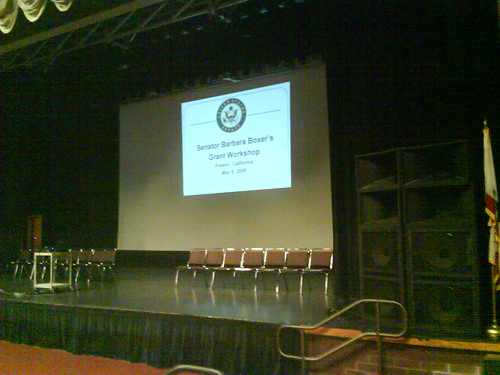
It was time to ramp up the detective-work to find those stimulus grants. I signed up for Grants.gov to receive alerts and began to research the process to get the grants. They were very elusive. Most of the library information about the grants was focused on fiber, most of the others focused on ways to partner with major agencies to receive funding. After attending a conference sponsored by Senator Boxer, I was able to track down several leads. What I did find was an opportunity to renovate some of our branch libraries. The reason why can provide a great explanation of the importance of libraries.

Libraries stimulate the economy
In the end we got the grants, three totalling $165,000. Altogether, we were one of three libraries in the country to receive a USDA stimulus grant and the only one in California. Knowing this about libraries, there should have been more funding to more libraries. I think I will know more about how much libraries received after the October deadline.

We received three stimulus grants from the USDA. The primary reason was that we provided the only public building in some of these areas where unemployment was 19%. In researching the grant, not only was there high rates of unemployment, but almost 80% of the population didn't attain a high school diploma. In rural areas, not only are resources scarce, they are non-existent. There are no buildings or services for the public. There is a school and after-school there is nothing without the library. It's the only public place, a safe place for someone to go where there is nowhere else to go. It's the only chance to get skills to be able to get a high school diploma, to get the skills needed for a job, to be a productive member of society. It starts with the library.

Reblog this post [with Zemanta]

Wednesday, July 08, 2009

Broadband Stimulus Fails

The NOFA (Notice of Funds for Availability) for the Broadband Stimulus package of $7.2 billion has been released. However, the strict definition of broadband will leave many organizations in need dead in the water.

The American Recovery and Reinvestment Act of 2009 has a great deal of focus on broadband in rural areas with $7.2 Billion intended to help the underserved. The probelm now is that the definition of broadband is one half of a T-1 line or 768 Kbps. This puts a lot of libraries out of the running. In my opinion, libraries were the key to making this connection.

If we have a public community building, with computer and internet access, in a place where there is limited or no connectivity, then provide money to a library that fits all the categories. I have worked in many rural areas and even the ones that are the most cut-off can muster this amount. Therefore, they get no money even though the potential for increased bandwidth that can lead to innovation and job creation is dashed by this restrictive definition. It hits hard because it is too low for the average library to qualify, but it cuts such a small window, that there will be no demand in those communities that ARE that low.

From this Gigaom article, One-Third of U.S. Doesn’t Have Broadband:

"The firm found that the more money a household has, the more likely it is to have a computer and broadband access (see chart). The study also revealed that only 4 percent of subscribers were unsatisfied with their broadband service, and about 29 percent would be interested in faster services. However, 37 percent didn’t feel a need to boost their speeds. In line with other surveys, Leichtman found that 3 percent of Internet subscribers say broadband is not available in their area. So in addition to policies encouraging the buildout of broadband infrastructure, the government should also be thinking about getting computers to lower-income homes and teaching folks the advantages that come with using broadband."

More articles have firmed up this argument:

Free broadband won't entice all (news.bbc.co.uk)

"Broadband is becoming increasingly important to people's ability to participate in the economy and society," said Ofcom's market development partner Peter Phillips.

"The report shows that some creativity will be required if we wish to capture the imaginations of those who have yet to engage with the benefits the internet may bring," he said.

.....(yet)

"Some 43% of adults who currently do not have internet access would remain disconnected even if they were given a free PC and broadband connection."

This debate is interesting because while many advocated for broadband in rural areas, those actually living in those areas are not creating a demand. Many Internet Service Providers are trying to drum up interest and demonstrate the need. Unfortunately, only communities that have an affluent section will probably get that broadband. They often are the ones that have broadband at home and want to increase their speed or have moved from an area where they had broadband and now they don't.

by smiling_da_vinci

Libraries are typically the only place to get internet access in rural communities. Furthermore, they are the only places to provide fast broadband access. This quick access can create demand from communities for faster access. In the library itself, demand for faster access provided by the library varies by community.

As a private citizen, I can get up to 18 mpbs at my house, but the local library may be only limited to 1.5, that's a big difference. As someone who uses the library, I would think the slow internet would be an embarrassment and wouldn't use it unless it was faster. As a private citizen using dial-up, I wouldn't know what you could do with faster internet. I may not even understand the difference. I would only know that if wanted to send photos to someone via email, it seems like it takes forever. Which brings up another post (humorous), Gigaom, Broadband Confession: I have Pipe Envy:

"However, my upload speeds are still miserable, at less than 512 kbps, and that’s what has me feeling like an outsider looking in when it comes to technology. Sure, I can talk the talk about broadband as a platform for innovation, and hype cloud computing, online backup and uploading video files. But whenever I attempt it, I have to shamefully set up my uploads for the nighttime hours while I creep off to bed knowing that, otherwise, sending the standard definition video clip of my daughter’s first haircut would cause my Internet connection and daytime productivity to crumble. Om feels my pain."

It seems that the demand would be created in reaction to a need. I may not understand the overall value of faster broadband, but it could realize it if day-to-day tasks are executed more quickly. It's difficult not to try to offer broadband everywhere, but it is further difficult to spend money in areas that don't demand it. Things should be equal, but the resource could be wasted. In the end, this legislation is about job creation. However, the only jobs that will be created will be the one time cost of laying down fiber. There aren't any additional jobs created by increasing my bandwidth. After that, the hope is the new faster internet can lead to innovation and opportunities to those in rural areas.

Reblog this post [with Zemanta]

Friday, May 29, 2009

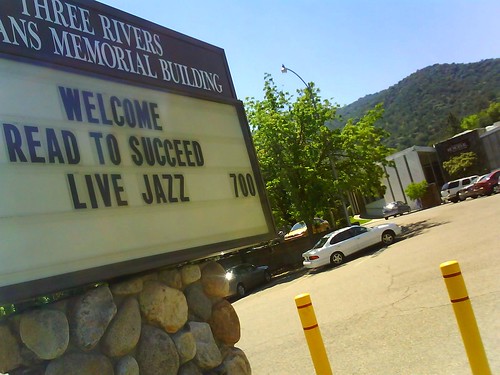
Library Literacy Conference in Three Rivers

I attended the library's 9th annual literacy conference in beautiful Three Rivers, California. I had the honor of speaking to them before the event where I focused on the importance of their work in our economic recovery.

I referenced a recent Washington Post article that compares two rural communities and their broadband success. One was more successful than the other because their community was more affluent, the population had a higher education, and there was a workforce development program already there.


Rural Riddle: Do Jobs Follow Broadband Access?

Two Hamlets That Got High-Speed Lines Show Wildly Different Results
http://www.washingtonpost.com/wp-dyn/content/article/2009/04/22/AR2009042203637.html

"And the education gap cannot be dismissed", said John Horrigan, Director of the Pew Internet & American Life Project.

"It's Economic Development 101 to try to improve the supply of infrastructure to make a locality more attractive for businesses, but you do need a skilled workforce to fully exploit that," Horrigan said. "In rural America, for broadband adoption, skills and relevance still remain a barrier."

Even further explained by this Federal Communications Commission (FCC) report on rural broadband access:

Bringing Broadband to Rural America: Report on a Rural Broadband Strategy FCC

"Stimulating and Sustaining Demand for Broadband. Various factors may affect demand for broadband services in rural areas, including a lack of knowledge regarding the benefits of Internet access, lack of training on how to use a computer, socioeconomic and demographic factors, and affordability. To help stimulate and sustain demand for broadband services in rural areas, both public and private entities should consider developing consumer education and training initiatives, broadband affordability programs, and other incentives to achieve sustainable penetration rates."


So the key to any economic recovery, even if the library were to receive a broadband grant, isn't just fast internet access, but a skilled workforce. Without the literacy program, any other efforts wouldn't be as productive.

Literacy Issues and Stopping Short

There were great insightful discussions at the conference. Some great topics were:

The lack of diversity among tutors.

In some cases, adult literacy has focused too much on English Acquisition for Spanish Speakers instead of just general literacy.

The literacy center can deter students that have basic skills, but still need improvement.

In many cases, there is a frustration that the student only goes so far. They get to a level that they want to get a job, but no further. It's the problem of good enough.

"Literacy will be useful for the rest of their lives. Not just enough to get a job, or get what you want, but you can enjoy reading, writing, and an informed mind. Too many stop short, how can we change that?"

The best story: A woman wanted to learn how to speak English. Her children could do it. It took months of tutoring and help. One day, she was paying for her groceries when the check-out girl was wondering about how to make a Mexican dish. The student was able to tell her how to do it in English. When she walked out of the store, her six year old son said "Mommy, I'm so proud of you."

There is more information on Literacy from a May 2009 report:
Basic Reading Skills and the Literacy of the America's Least Literate Adults

Literacy Leadership

There was a great open forum where tutors, students, and literacy leaders discussed issues. There are some fantastic comments about leadership and how to make changes in communities.

"Leaders are doers. You see a need and you do something about it. You don't complain, you don't wait for someone else, it's about making it happen."


Matching tutors with learners.Image by Newton Free Library via Flickr


What it takes to be a tutor

It doesn't take much knowledge to be a tutor. Many of the tutors remarked that they didn't feel they could help the program because they didn't have a college degree. In the end, if you know how to read, you can help someone else learn to read. It's that simple. It's not the skills to teach, you just need to be patient and willing to help.

Anyone can find a literacy program near them by going here. In California, volunteers can also find programs nearest them by going here.

Reblog this post [with Zemanta]

Thursday, May 21, 2009

Recovery Act funds for libraries or I have broadband, I need faster broadband

President Obama's intention for the American Reinvestment and Recovery Act (ARRA) is to find ways to stimulate the economy. Many libraries qualify for existing grants (even though no money has been provided just for libraries.) The real trick is often finding a local federal office and working with them to get funding. If you know the right local federal agency, the right grant, and apply it to the right project, there are huge benefits. (The American Library Association has a great deal of information on how to get stimulus funds, I liked this one from District Dispatch Blog). As librarians, we definitely need to be creative and snoop so that we can find money that is applicable to us.
The process can be very confusing. Here was a good quote from the Technology Policy Summit discussing rural broadband potential:


Much of the money can be found in different places, and in many cases, wrapped into existing grant projects.

from Stimulating Broadband:
Given that these continuing programmatic efforts of the Rural Development division of USDA -- the division which includes RUS -- operate under an established body of regulations, the NOFA to be issued by the agency for ARRA broadband stimulus funds must be groomed to coordinate with those strictures already in use in rural jurisdictions around the country.
"
There is also more potential coming from the state:
Teri Takai: California Budget Crisis Won't Block Technology Progress

"The state also will step up efforts to prepare citizens for success in the digital economy. Schwarzenegger intends to sign an executive order promoting digital literacy within two weeks (article posted 5/17/2009), Takai said. And the CIO's office is launching efforts to assess statewide broadband Internet connectivity, with the intention of strengthening access in unserved and underserved areas."

After some investigation, we found our local Department of Agriculture office provides building construction and broadband connectivity to any public building in a rural area. For this alone, there is potential to get $300,000 in building construction money for library branches.


Broadband has been the biggest discussion in the library world. It seems like $7.2 billion is easy to get, but if your library already provides broadband, then what?

The Internet Runs on This stuff
Originally uploaded by Lacrymosa


Do we still qualify for broadband if we just need more speed? We really can't afford an ongoing cost to upgrade.

There is a great deal of potential for rural libraries to update buildings, and provide the infrastructure for increased internet access. However, if I repair or build a building, it can last 5, 10, or 50 years past the grant cycle, depending on the project. For broadband, the costs are always ongoing and always increasing, but the stimulus money isn't. What do we do then?

Wednesday, May 14, 2008

The Public Access Computer Problem

Since the 1990s, public libraries have provided computers with Internet access. The introduction of this new service has brought more people into the library and more people using all of the library's services. It is a great and vital service for communities around the world. One problem that libraries have is that they don't keep up with these machines, neither in replacing old machines, providing critical software, or providing adequate bandwidth. Bandwidth is something that I have written about extensively. Fast, reliable Internet is one of the most important services a library can provide. Furthermore, the web 2.0 revolution has resulted in more patrons using bandwidth hogging services like watching and uploading video and photos.

The Trouble with Computers
The main problem I have with public access computers is that we don't often look at what that service really provides. Late last year, our bandwidth was terrible. We knew from June forward that we had to expand the bandwidth and after some work in finalizing our e-rate appeal, we were able to secure funding to upgrade.

The other problem we discovered was that critical free programs were not being updated regularly. Flash, shockwave, and windows media player all needed to be updated. Patrons couldn't even watch the latest news videos because it was not upgraded. In some cases, it impacted videos for school work.

Internet Explorer needed to be upgraded to 7.0 as many services began to state that programs would not work properly without the upgrade.

We needed to upgrade Open Office and also try to provide Microsoft Office suite on all of the computers. I prefer to have both since patrons often have file formats that are not compatible with Word. A problem I discovered was that most people bring in files on Word Perfect, since most computers sold have Word Perfect already installed, but not Microsoft Word. It is possible to set Word Perfect to save as a Microsoft Word file, but most patrons don't realize the difference until they cannot open their file at the library.

Lastly, not all of the computers had the same drives in them. Some had floppy and some had Cds and some had both. Due to a snafu when we ordered the computers when we upgraded all of our computers, we received some that can only fit one drive at a time. To solve this, we began selling flash drives. Flash drives are as simple to use as a floppy with our computers, and they were a big hit and solved a big problem for us.

Before all of these changes:
  • The bandwidth was so slow, patrons could barely check their email.
  • They couldn't watch video effectively (due to both bandwidth and lack of updates)
  • They couldn't fully utilize all critical programs
  • They couldn't save their files to a disk in the same way.
What the Future Holds
The experience has taught me that public access computing is very difficult with most libraries. Many libraries are not even going this far in providing their service. The way I see it, we are competing with a home computer. If a patron gets fast, reliable Internet at home, they don't need to use your services. That's a good thing, but we should provide the equivalent at the library so that there is no disadvantage. My belief is that we should attempt to make the public access computer as close as possible to a personal computer. That's when I read this post from Swiss Army Librarian. They are switching from Internet Explorer to Firefox. In my technology plan, it was suggested to do this, but we were rebuffed for security reasons. Swiss Army Librarian posted their solution:
SNIP:
The reason we are switching is a simple one - Firefox is just cooler. It lets us have more control over how the browser functions, and lets us offer more tools integrated right into the browser. Better for us, better for patrons.

Here’s a list of the customizations we’re making:

Add-OnsPublic Fox - this is designed to make Firefox a public web browser, as opposed to being used and customized by a single, private person. We’re using it to lock down add-ons, preference, about:config, and a few other things, as well as control what file types can be downloaded

Menu Editor - also for the control freak in us, this one lets us remove menus from the tool bar (we’re getting rid of bookmarks, help and history)

Greasemonkey - one of my favorites, this lets us embed custom coding on webpages, such as a link from Amazon to our catalog, and helpful links on our catalog’s “no search results” page (more info on those on our Tech Tools page)

Add To Search Bar - this fun one lets us easily add our library catalog right to Firefox’s search bar. The other searches we chose to include are Google, Yahoo, Amazon, the Internet Movie Database, Answers.com, Wikipedia, and Merriam-Webster

IE Tab - For all of those “Best viewed in Internet Explorer” websites, this one lets you toggle back and forth between the Firefox and IE rendering engines, so IE-only pages and scripts will load in Firefox

Image Zoom - just like what it sounds, this adds zoom controls to the right-click menu, to make images bigger and smaller. This one is most useful to patrons who get emailed digital photos at 1024 x 768 resolution, which is too big for our screens. This lets them zoom out so they can see all of their grandchild’s face at the same time.
END SNIP
The top problems with firefox was the customizable nature of the program and pages that only work with IE. This solves both of those problems. There is more written, go read the entire post.
These are services we always need to assess to provide the best service. If you have your own IT, or work with a larger organization's IT, build a relationship with them so that you can start this conversation. I recently purchased 10 laptops through a grant program. We weren't going as far as to do the laptop check-out program that Alachua County Library is doing, but I wanted to make the laptops as close to a personal PC as possible. We set up an automatic log-in, we set up the user as a power use, and we even allowed programs to be downloaded and minor changes to be made. We still used the windows security toolkit and most of the usage will only be used under direct supervision (like our teen group or on the bookmobile with wireless Internet). In this way, we can provide a great service that is similar to someone's "at home" experience. ACLD does this with their laptop check-out:
SNIP
Although ALCD had installed the Fortres disk-protection program Clean Slate on hundreds of desktop machines, Fettes' staff decided that this application was too restrictive for the laptops, partially because Clean Slate does not allow users to update Flash or Java platforms. The staff were resolved to offer patrons wide open access to these powerful laptops, considering in particular the needs of gamers who download plug-ins to play resource-intensive programs.


To protect their investment, Fettes' staff began experimenting methods to restore a laptop to its original settings with partitioning software and the disk-imaging program Norton Ghost, ultimately arriving at a solution that was both fast, easy, and smart.


“They played around with it and found that they could actually create a ghost image, put it in a hidden partition, and using a flash drive with a run-time version of [Norton] Ghost on it, they could actually redo the C: drive within three to four minutes between each use,” said Fettes.
Fettes added that this restoration system not only helped protect patrons' privacy, but the ease of this solution allowed non-technical staffers the confidence to turn the machines over with little effort.


“All they had to do was basically insert the thumb drive and we set it up to boot off of USB,” Fettes said. “They essentially turned [the laptop] off, put in the thumb drive, turned it on, and [the C: drive] rewrote itself. And then it beeped at them when it was done.”
END SNIP

A Public Computer as a Personal Computer?
It wouldn't be as easy to do this on a public access computer. However, I think every library should try to make their computers as close as possible to a personal computer. In my opinion, there should be standards for libraries to follow so libraries have the same programs available on their computers and should be able to easily replace bad computers. Once there is a standard interface, the image can be ghosted and shared. Furthermore, libraries should provide back-up computers for when their computers break or are inoperable. We are attempting to have four always available with the same set-up ready to go. If one breaks beyond what we can do, we should be able to replace it until the heavy assessment and repair work performed by IT. We should have a relationship, a service level agreement like this one. We should have the ability to always assess that service and be able to have a plan to improve it with the fast-changing tide of technology for the ease of use and the betterment of our patrons.

Tuesday, April 08, 2008

Librarians and Directors need to utilize their own services

It is difficult to be objective when looking at the services your own library provides. In any industry, an organization must look at their services and see it from the outsider's perspective. Is it easy to use? Does the service make sense?

For libraries, a problem that I see is the public computer stations. Do librarians actually sit down at one of these stations and try to do what they would do normally on them? Can you check your email? How fast does it go? Don't just rely on a speed test that the computer tells you. Sit down at the computer and try to do what you would normally do at home. Can you do them? Why not? Is it slow?

When we had computer slow-downs at my library I did a simple search on Google. The page itself took 30 seconds to load. At that point I realized we had a problem. The library only offers an hour to the patrons per day. In the study, we found that most patrons could barely check their email before their time was up due to the bandwidth strain. Thanks to e-rate funds, we were able to upgrade the service from 1.5 mbps to 6mbps. It's funny, on the first day of the new bandwidth, I could noticeably hear the clicking of mice (mouses?) and noticed that it was unusually fast. Blazing even. Many people will suffer through bad services since they have nowhere else to turn, but it shouldn't be so painfully poor. I read this post today and it made me laugh:

Tales from the "Liberry" 2.0: Gene FINALLY Poops: "Back when I had dial up at home, it used to be that going to work was my great escape from the slow speed at home. Now that I have amazingly reliable Verizon DSL at home, however, going to work is like sliding into a nice pool of tepid tar."

I think this is the next big issue for public libraries, bandwidth assurance. We need to start budgeting and paying for network upgrades for our t-1 lines. It is great that the Bill and Melinda Gates Foundation gave us computers in 2001, then replaced them in 2005, and they even upgrade libraries from dial-up to broadband. However, the next big push needs to be in sufficient bandwidth. The average library doesn't have enough pipe to make the service acceptable. The result is the post from above, it's terrible.

Wednesday, October 24, 2007

Digital Divide to Digital Continuum: has the digital divide been bridged?

The general reason for public libraries to provide access to technology is the digital divide. Low income has always been tied to lack of access to technology. Libraries have increased the number of computers and internet bandwidth to keep up with demand. However, a recent report by the Department of Education (Digital Divide to Digital Continuum) refutes the idea that there is a digital divide in relation to income and technology. A quote from the GovTech Blog, Digital Divide Subtracted, :

SNIP
New research funded by the U.S. Department of Education's Office of Innovation and Improvement and conducted by the Michael Cohen Group LLC, under the auspices of a grant to the Ready to Learn Partnership (RTLP) revealed that while television took nearly three decades to become universal, nearly 40 percent of low income families now have computers and almost a third have Internet access at home in just the last five to seven years. This new research suggests that given the proliferation of media across the socioeconomic spectrum, although significant differences do exist by income level, a stark digital divide no longer captures the relationship between income and technology ownership and that technology is integrated into children's lives, regardless of their families' income.
END SNIP

This means that for public libraries, basic connections is not enough anymore. Yes we have public access computers (new ones thanks to Bill and Melinda Gates Foundation and other local intiatives), with internet (although it needs to be increased), but are we providing anything beyond that to enhance technology opportunities. Or is this our role?

I like the developments that I see in many libraries. They provide a technology petting zoo to help their patrons understand and use new technology. It also helps to show patrons how it relates to library usage, such as downloadable items and database usage.

David Lee King talks about Topeka and Shawnee County Public Library's Techie Toy Box (photos). Princeton Public Library provides a Gadget Garage too.

More from the article:
SNIP
"According to the survey, families from every income level own and use technology, albeit with differences in the frequency of participation based on income. However, the rate at which lower income families have come to own media technology has been astonishingly quick," said Dr. Michael Cohen. "The metaphor of the digital divide no longer captures the relationship between income and technology ownership. The current state is perhaps best described as a digital continuum."
END SNIP

So technology acquisition is growing very fast. Is access an issue? Library's have traditionally provided content via books and over the internet. We slice away at the proprietary layer of the web by providing free access to content. Newspaper archives, research, and even free downloadable content. I think our role is to continue to provide access to content and to educate the public on a variety of topics, especially technology. Technology is often thrown at people as a solution and the public library continues to be a hub of learning for that technology. Technology is available at all levels of society and acquired faster, but do learning curves differ? Yes they do.

Lastly:
"For years, Congress has supported literacy-based television programming to help pre-schoolers get ready to read and to foster reading skills among school-aged children," said Chairwoman Rosa DeLauro, House Appropriations Subcommittee on Agriculture and a leading advocate for early childhood education. "This new study shows that we are making progress in closing the digital divide and that television and computers can be effective tools to reach children, regardless of income levels, in an effort to help them become productive and successful adults."
END SNIP

A webcast of the report will be available on October 25th: Digital Divide to Digital Continuum.
http://www.rtlp.org/

Monday, October 22, 2007

Providing Free Content, Radiohead, the Open Content Alliance, and the near death experience of libraries

Free content is the buzzword in the media. Radiohead announced that its latest album will be online for whatever price you want, even free! The Open Content Alliance has decided to kick Google to the curb and provide their own content online for free without any deal with Google that will restrict content.

Free Music or the Near Death of the Music Industry
The recent announcement by Radiohead that they will be selling their next album online at the price the consumer names is the latest blow to the death of current state of the music industry. Why go through all these middlemen, who take a majority of the profit, for the work the band does? Currently, the music, movie, and publishing industry are undergoing the "near-death experience". A near-death experience can revive an industry so that it is operating the way it should and changes its services to best serve the users.

The move by Radiohead proves that it doesn't need a big behemoth of an industry to create, produce, and market its album. The days of the middleman are numbered. A quote from the Time article,
Radical Remix:

SNIP
In any industry, the most efficient distribution system has a way of prevailing. Sure, new acts without loyal fan bases would be ill served by the Radiohead strategy. But successful bands at midcareer would be wise to take note. Even the most lucrative deals--the ones reserved for repeat, multiplatinum superstars--give artists less than 20% of the sales they generate, and that has to feed multiple band members. Meanwhile, as CD sales decline (in early 2007, they were down 20% from early 2006 in the U.S. alone), the concert business is booming. In July, Prince, long underestimated for his business acumen, decided to turn his most valuable asset--a buzzed-about record--into a loss leader, flooding the U.K. with 3 million free copies of his Planet Earth CD through the Mail on Sunday newspaper. He was ridiculed for going down market, until he announced 21 London concert dates--and sold out every one at prices five times the suggested retail price of a CD. Not surprisingly, Radiohead has an extensive tour planned for 2008.
END SNIP

Could Steven King pull a Radiohead? or the e-book alternative
Some authors may be able to do this, but there is one problem. The book format is not digital. By its very nature, the book is the printed word on paper. Eventually, it will go digital, but it will only take a near death experience for publishers for it to go that way. The book is the perfect format. It can remain in its pre-digital format and not worry about copyright and all the problems with piracy in the music and movie industry. Even when digital becomes very prominent, will the majority of readers will still purchase a printed book? Isn't it ironic that the blog Print is Dead printed a book?

It seems that the e-book is becoming an alternative format to reading like an audiobook. From the Christian Science Monitor article, E-books multiply, but who's reading them?

SNIP
"
as habits change and content inventory nears critical mass (Google, to name one prospective repository, is still wrangling with copyright issues), digital books might finally gain a foothold, observers say – not as a replacement format, but as an alternative delivery system not unlike the audiobook. Both the publishing industry and the reading public appear to be shaking the notion that for the beloved book, digital equals death."
END SNIP

A reaction to this story is available on Teleread here. It speaks to the fact publishers prefer that books stay in print, not so much for their readers, but because books are DRM proof.
SNIP
Take away DRM—really more of a protection for proprietary formats than the intellectual property rights of authors and publishers—and sales of e-books from large publishers will get a nice bump.
END SNIP

Libraries provide access or the near-death of the public library
To add to that, publishers force libraries to have increased digital rights management to check out digital content. Nobody has really figured out a simple cost and access model for the new way of access. Instead of creating a copy for everyone, there is one copy in which everyone can access. Digital Rights Management treats the one copy like many copies. Libraries have to make access even worse to provide the content at all.

More on DRM from Jessmyn at librarian.net:
SNIP
The weird part is that patrons can more easily buy their own content, but to get the “checkoutability” it requires DRM and that puts this into the arena of the heavy hitters vendorwise.
END SNIP

On the YALSA blog, Joseph Wilk laments the fact that Radiohead did not provide a way for public libraries to distribute this album to their patrons. Libraries were traditionally the middleman. Sell it to libraries, and they turn around and provide access. Now this is done through Digital Rights Management. Ironically, Radiohead already provided access and libraries can still distribute them. However, it is not so much in the physical format, but by providing computers with internet access.

Public libraries will continue to house books in print as long as the publishing industry continues to do so. When books become digital completely, what will libraries do? If the content is free and can be accessed with a computer and Internet access, what is the future role of the public library?

Public libraries are undergoing the near-death experience as well. Since 1995 the common theme from non-library users is, why do you need the library when you have the Internet. This has come up for discussion recently on Publib because of that same remark in the popular hit series Heroes.
Quote from Publib, starting the discussion:
SNIP
"... the girl was trying to lie to her parents so that she could go out with a boy. She told them she was going to the library. Her brother said, "haven't you ever heard of the Internet?" She replied that she was doing a paper on how libraries were becoming more and more obsolete for her generation.
END SNIP

The reality is that information wants to be free. Everyone wants free access. The Internet provides that. It will increasingly provide better content online for free. The library role with in relation to content is to provide access through computers with sufficient Internet bandwidth. Content once housed and organized in libraries are freely available online. This will only increase over time. Libraries will increasingly need to shift gears to provide the content, not by owning it or organizing it, but by providing access to it, for free. Watch this video (Information R/Evolution).

Libraries are already striking back by changing their environments mostly due to the Library 2.0 movement. They are also beginning to take back their content to make it freely available online instead of giving it away to Google.

NY Times: Libraries Shun Deals to Place Books on Web
(This article should read, Libraries to provide free content, tells Google to take a hike)
SNIP
"But the resistance from some libraries, like the Boston Public Library and the Smithsonian Institution, suggests that many in the academic and nonprofit world are intent on pursuing a vision of the Web as a global repository of knowledge that is free of business interests or restrictions."

The real irony with the current state of content on the Internet is the fact that everyone who produces content, at some point, wants to be paid for it. Libraries are the biggest purchasers of the written word. The real goal of libraries is to breach the rich/poor gap and to provide access to content. And in a digital age, there is still a staggering amount of people who cannot read, don't have access to computers and the Internet, and have no skills to compete. This is one of the many roles in which libraries currently play, and will continue to play.

Wednesday, October 17, 2007

Viral marketing in libraries

Public libraries have always been information hubs. Before the internet, most people would agree that going to the local public library for information was a sure bet to get the answers. Today, the answer is not in the local library, or even the internet; the source for many is someone they know.

People will always trust their friends over an organization. A friend is someone they spend time with and trust. An organization is something that can be treated that way, but it is not the organization that is trusted, but rather the people who work there.

Over at the Church of the Customer Blog, they reflect on a recent Nielsen study that states 78% of people trust their friends over any other source for information.

SNIP
Despite an ever-expanding array of advertising platforms and sources, consumers around the world still place their highest levels of trust in other consumers, according to a recent global Nielsen Internet survey.
END SNIP

As a library, or for any organization, every transaction with a customer has to be so fantastic that people will talk about it afterward. That is how a reputation is established. If your customer service is bad, everyone will know by asking their friends. If the service is fantastic, you will see a usage jump. A great marketing plan means nothing if people walk into the building and get terrible service. There is long term planning that goes into a successful marketing plan.

Training in Basic Competencies
All library staff should be able to handle 90% of questions and issues. If a patron walks into the library and staff don't have a clue how to serve, then they walk out of the building and then tell their friends how bad you are. Many librarians have experienced this and blogged about it.

Training in Customer Service
Library staff must be placed in the patrons' shoes. They have to understand what it is like to walk into the library for the first time and get what they need. This type of empathy is crucial to good customer service (and consequently management). In this area, advanced classes are often needed in dealing with the angry or dangerous patron. The angry patron training helps staff diffuse situations and pull back out of the circle of anger. This actually helps staff understand a person objectively and without getting personal or let their emotions get the better of them. Furthermore, if you have library staff who are perpetually cranky, a group class dealing in customer service brings across the point of what is expected. Get on board, fake it, or leave.

Training in Technology
Learning 2.0 is all the rage. It is important to cover the basics first. One thing about technology training is that the ones who want to learn have a desire to learn. It can be a personal desire, or a desire to be the best they can at their job. To be able to handle everything thrown at them. Technology training covers both of them. However, if the seed has been sown in basic training and customer service, there is a higher chance for everyone to be on board for training. The reason from management must be there (providing better service), and the desire from staff must be there (lifelong learner or wants to be the best).

There is one thing you may be thinking at this point, "I thought this was a post about marketing?" It is, but it is about viral and word of mouth marketing. If you give someone fantastic service, you are marketing. People will know that they can get friendly, helpful people that will work with them to get what they need and will actually feel bad if they don't achieve their goal. This is the best type of marketing one can do and provides groundwork to achieve bigger and better things.

A brief Story
When we created and enacted our strategic plan, we made the assumption that we need to create a new level of service with new programs and service. Then we can market those services. Sometimes these service market themselves. If the service is that good, and you are on target with a strategic plan, then the service will spread through word of mouth. That is what happened to us. Usage went through the roof almost immediately. New library cards doubled each month. Currently, 90% of our community owns a library card. Consequently, new library cards are flat or down since there are not many more people to get a library card. We were concerned about this since our strategic plan stated that we need to increase library card ownership by 10% by marketing. Now that 90% have a card, we won't hit that mark. However, our new plan is to advertise the fact that 90% of the population owns a library card. It will be something to the extent of "Don't be 1 in 10" with a statement that 90% of our community owns a library card. Then talk about all the great things the library does. We might make shirts or bags to promote this as part of our library card sign up campaign in January.

How to become ubiquitous:RSS Feeds
Now that the groundwork has been lain, the library can now begin expanding its realm and appear ubiquitous. The library can show up everywhere if you choose to do so and it doesn't take any staff time to do so. Just some set-up time. This can easily be done with rss feeds. Most Integrated Library Systems have or are starting to produce RSS feeds.

Why would you library want to do this? Imagine standing on a corner of a busy street. You have lots of books you want to sell. You stand there displaying your books, thinking everyone will just come to you because you are so fantastic. You don't get the traffic you anticipated.

Why? You are not shouting out what you have. You just let people pass by and rely on the fact that you are so fantastic to speak for itself. This is the wrong approach. RSS feeds (really simple syndication) shouts out your information. You may think at this point that not many people use News Readers to read these feeds, but you can produce an email distribution list from these feeds using Feedburner. Feedburner is not the only service that can transmit an rss feed into email. Everyone has email so by producing this feed in this way, everyone can sign up to get the latest books, music, and movies available.

I love these feeds because I am the first to find out when a new book is available. I can be the first in the library to grab a book off the shelf because only I know it is there. This of course helps internally with library staff as they are also aware of what is available as soon as it is available. I once had a patron come in and ask for United 93. We searched everywhere for it, but couldn't find it. We called upstairs to Technical Services and they had it. They stated, "I just put that in the system, how did you know I had it so fast?" She had only put the dvd in the system five minutes before. That's how fast someone can get an item.

These feeds can also be dumped anywhere, twitter, myspace, facebook, google homepage, the list goes on. Your library can be everyone online with rss feeds. You don't necessarily need a presence on all of these social networking sites. However, you can keep them updated with rss feeds that require no additional staff time.

It takes staff time to be everywhere with traditional marketing
It must be written into one or more job positions and time must be given for marketing. Currently, we have one librarian dedicating 20% of their time to marketing. They need to be allowed off desk time or whatever that needs to be done to do this. This involves creating a weekly news blast to the local newspaper, chamber of commerce, our email listserv, it goes on our website, it goes to a monthly magazine that is delivered to every household in the county, our friends newsletter, the county visitor's bureau, and anywhere else we can squeeze in. This takes a lot of time. In reality, all of the events are planned out six months in advance. So it mostly involves grabbing what is happening this week, adding library news (such as advertising our flash drives for sale, our food for fines, library closures, and other non-programming events) and adding our top ten list. Our top ten list is the top ten books our community is reading at any one time. For instance, we put in the top ten circulating books for fiction, non-fiction, juvenile, teens, and then pick different subject (like gardening or cooking for diabetics) or genre areas (like romance or mystery).

We also cheat a bit with the list. We don't just put out the most circulating items, we put out the hotlist. Most circulating will only provide older titles and give the impression the library only has old titles. We get a hotlist by subtracting the date entered from the date it was checked out. This then predicts what the circulation will be for one year. For instance, if a book was only in three days and was checked out, it would predicted it would be checked out every three days, giving it a circulation of over 100. So instead of the Da Vinci Code showing up at the top fiction books, A Thousand Splendid Suns shows up first instead. People reading the paper for library news may be surprised that we have the latest fiction. This helps promote that.

The actual viral piece/Our plan

To actually get viral, you must have a particular service or services that is so great people are always prompted to talk about it. As a library director once told me, people need to see their library like mecca, how do we connect today? Here are some things we have done and will be planning:

We gave away free gold bookmarks and canvas bags with the library's logo on it for a library card sign-up month. Not terribly exciting, but new cards went up.

We upgraded everyone's library card from a red piece of plastic, to a dual card with a wallet card and a keychain card with the library's picture, website, hours of operation, and phone number on the back. This prompted conversation because the picture was attractive, and anytime someone pulled out their keys, a conversation could occur. (hey what's that, this is my new library card, they are giving them away free at the library.)

We sell flash drives with the library's logo and website address. This has been the most successful viral campaign as we were able to penetrate the schools with it. If a teacher can fit you into their busy schedule, then you are truly successful. Read more here

We bought into the Greater Phoenix Digital Library consortium. We plan to wrap our library card campaign with marketing for this service. Our plan it to give away 2gb mp3 players and show people how to use them. The first 50 who sign up for the service will get a free player and instructions on how to download an audiobook or music to their player. All library staff will each get a player first so they can see how it works. We will also issue an fm transmitter with it so that it can be played in any car. This gets over several compatibility issues. The mp3 player can play everything, can be placed in any car, and has enough storage to play 40 hours of audiobook, which is the largest capacity of audio.

We plan to expand our bandwidth once our e-rate application is resolved. We will expand from 1.5 mbps to 6mbps. We plan to have a campaign to the extent of, be careful, speed this fast can be dangerous. We will probably have a video launch to demonstrate the speed.

We plan to renovate the library by replacing the dvd shelving with videostore shelving, replace the new bookshelving with clear face-out shelving, create a greeting desk, clean the front of the library, and put out a new security system that will enable more self-service. This will change the entire look of the library for very little cost. If all goes exactly, it will create an entirely different effect when one walks through the library. It is my hope that this will further get the public to talk about our library.

This should all result in increased traffic in all user points. We should see double digit jumps in circulation (with particular notice to how fast an item is checked out and particular higher marketed collections), computer usage, walk-in business.

This takes an incredible amount of back work, training, and planning. I have done this before with a renovation. It is why all of our service usage has increased the last two years. We are almost always looking to improve and change services to make them better. We want to be the best and that involves change.