Showing posts with label transformation. Show all posts

Thursday, October 01, 2009

Libraries receive stimulus grants, key to economic recovery

Barack Obama

The October 1st deadline for the first round of reporting for stimulus grants is upon us. I remember going to numerous webinars for the American Recovery and Re-investment Act (ARRA) training for these grants. Our library was the recipient of three of these grants. I did quite a bit of research before pursuing these grants as I knew that the reporting requirements were very extreme. I particpated in many a webinar and heavy research before proceeding.

If these webinars did anything, they drilled into your head that the Federal Government was serious about the reporting. Any lack of transparency or errors in reporting can kill your project immediately, result in the return of all funds, and have the agency blackballed from any future projects.You would think that Obama himself is going to show up himself to chastize you and take your money away.  It reminded me of an Art History class I took with my wife in college. Obama as the Pantocrator, a mild but stern, all-powerful judge of humanity.

Not enough for libraries
ALA has done a good job informing libraries about these opportunities. I wonder, however, how many libraries will receive these grants. I was very disappointed by the inability for libraries to get funding for fiber. Even though there have been various reports and studies produced to indicate the need and benefits, it hasn't been backed-up with funding. If there is one thing for sure, libraries will need increased bandwidth for future needs. Furthermore, anyone can tell that libraries are key to the economic recovery (there is an endless supply of stories), but is that backed up by stimulus grant funding? It seems to be lacking so far.

What kinds of grants
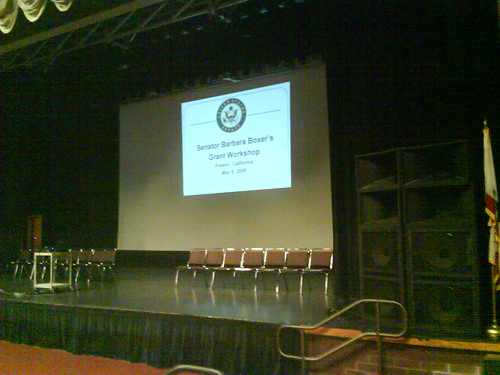
It was time to ramp up the detective-work to find those stimulus grants. I signed up for Grants.gov to receive alerts and began to research the process to get the grants. They were very elusive. Most of the library information about the grants was focused on fiber, most of the others focused on ways to partner with major agencies to receive funding. After attending a conference sponsored by Senator Boxer, I was able to track down several leads. What I did find was an opportunity to renovate some of our branch libraries. The reason why can provide a great explanation of the importance of libraries.

Libraries stimulate the economy
In the end we got the grants, three totalling $165,000. Altogether, we were one of three libraries in the country to receive a USDA stimulus grant and the only one in California. Knowing this about libraries, there should have been more funding to more libraries. I think I will know more about how much libraries received after the October deadline.

We received three stimulus grants from the USDA. The primary reason was that we provided the only public building in some of these areas where unemployment was 19%. In researching the grant, not only was there high rates of unemployment, but almost 80% of the population didn't attain a high school diploma. In rural areas, not only are resources scarce, they are non-existent. There are no buildings or services for the public. There is a school and after-school there is nothing without the library. It's the only public place, a safe place for someone to go where there is nowhere else to go. It's the only chance to get skills to be able to get a high school diploma, to get the skills needed for a job, to be a productive member of society. It starts with the library.

Reblog this post [with Zemanta]

Friday, July 25, 2008

From Awareness to Funding Part III (how to get support)

In this third part, I will wrap up the analysis of the report and provide what I think libraries could do in relation to this report. This section covers p 112 forward. An analysis of Super Supporters, Chronic Non-Voters, Elected Officials perception of libraries, and what to do about the information provided in this report.

Super Supporters

Super Supporters are avid readers with a long-standing relationship with the library.
Although they use the library only a little more than average, their relationship with
the library is strong because their emotional connection to the library transcends the
library’s practical functions. More than any other segment, Super Supporters see the
library as a place where they can better themselves and become the people they always wanted to be. They hold the librarian in high regard and recognize the value that librarians bring to the research process.p 116


Super Supporters use the library to feed their voracious
reading habits and to recommend children’s books p 118


This group supporters the library, ranking it second highest (only behind the Fire Department) for priority support. However, they support EVERYONE very highly. They are big community supporters, are influential (even powerful) figures in the community.

I always think it is interesting when libraries think organizations, groups, or individuals may not fund a library initiative because the particular entity funds another heavily. It seems to me those who fund, fund EVERYTHING well. I have never seen an either or situation. These are the "rah rah" community supporters.

Super Supporters recognize the library’s contribution to a successful community p 123

Super Supporters believe the library helps bring a community together p 124


Chronic Non-Voters

The Chronic Non Voters segment of the Library Supporter Segmentation Pyramid
represents 26.6% of the U.S. population ages 18–69 in communities with
populations of less than 200,000. Chronic Non Voters are the group least likely
to improve funding support for libraries. Chronic Non Voters are not registered to
vote, or they are registered to vote but report a track record of not voting in primary
elections, presidential elections or local elections. Chronic Non Voters are unlikely to
be motivated to vote in the future. This segment represents 0% of respondents who
said they would definitely vote yes in a library referendum. p.128


I can hear it now when I write this. "Boo hiss boooooo!" These people apparently don't care about anything. They are not involved in anything. Their lack of support isn't just for libraries, it's for everything. They have basically dropped out of democracy and don't support their local community. The more disconnected the population feels, the more the support wanes. I would go so far to say that if the general public has a tendency to distrust government, particularly the local government, support for everything wanes. Even if it isn't a problem with library performance, dissatisfaction for local government or for the local community translates to a problem with the library.

Elected Officials (Chapter 3 goes into Elected Officials perspective)

Elected officials have views about the library similar to those of the Probable
Supporters. They appreciate the added value librarians offer and see librarians as
important figures in rallying community support. Elected officials are knowledgeable
about libraries and their value, but they often do not see the library as a necessity
for the community. The library is seen as a community ‘amenity’ rather than a
‘must have.’ p132


This seems to be a balance of non-usage. Most City Councilmen don't need the library, they understand the big value in the community, but if it hasn't touched their life (they don't use it, their family and friends don't use it) that is where the "isn't necessary" comes in. In my opinion, this really goes back to a complaint issue. People will complain if they don't have adequate service and if the library provides good enough service so that people don't complain, than they are doing their job.

The Library consistently ranks below, Police, Fire, Schools, and Streets in that order. (Reality check, more people complain about the lack of these things. If there is a crime, and the cops show up really late, or there is nothing done about the crime, people get angry. If the Fire response is too slow and it is a life or death situation, that's serious. If the schools are failing, everyone takes notice and wants to know what is being done about it. If the streets are in disarray, that will also cause a trip to City Council to complain. Even though the library is used more often than two of the four services (more people visit a library in their community than need to call police for a crime or fire for a medical/fire emergency, but they do send their kids to school every day and drive them there on city streets), they aren't supported more.

Local elected officials (68%) are more likely than voters (59%) to have lived in their community for more than 10 years. Elected officials are more likely to be members of a variety of local organizations, including Friends of the Library groups. Forty percent (40%) of elected officials surveyed were members of Friends of the Library, compared to 9% of voters and 11% of Probable Supporters. p 137

Elected officials are more likely than voters to recognize library financial needs; yet 73% believe the library has sufficient operating funds p 140

I think this goes back to the complaint issue. If people are not complaining about the lack of service, then it is fine.

Advice from elected officials:

  1. Stress the library’s return on investment (ROI) to the community
  2. Build strategic partnerships
  3. Be proactive
  4. Engage voters in the campaign
  5. Stress the broad appeal of the library

Elected officials on library funding campaigns

Elected officials cited a number of important components required of a successful
library funding campaign:
  • Messaging that focuses on the broader value of the library to the community,specifically a community gathering place, access to technology and programs for teenagers and other groups
  • A passionate, committed and active champion(s) who can rally support among the elected officials and community influences
  • Civic engagement, including a commitment to speak with every relevant group in the community to encourage grassroots support
  • A willingness to partner with other public services in a joint effort where strategically advantageous
  • The ability to ask for the right support at the right time:
    • Voter turnout is greater for general elections than local elections
    • It is often easier to campaign for a new building than for operating funds.

The next part focuses on how people vote and awareness. Many people who say they would vote for a bond issue, may not do so.

Furthermore, it states that while the breakdown of support is 37% definitely yes, 37% probably yes, and 26% no the probably part should concern libraries.

Familiarity with the full range of library services was not a determinant of library funding support for the library’s top funding supporters. p 148

Neither was usage

Frequency of library visitation is not a determinant of funding support. p 149

A definite need, the "passionate librarian"

These five attributes can be combined to describe the ‘passionate librarian’:p152
  • True advocate for lifelong learning
  • Passionate about making the library relevant again
  • Knowledgeable about every aspect of the library
  • Well-educated
  • Knowledgeable about the community.
There seems to be a DEFINITE correlation between passionate librarians and support. Sure if your staff doesn't care about the library, why should anyone else? Furthermore, if you are a mover and shaker is it more important that you ARE one rather than what specifically you are doing?

The library is perceived as a service that provides ‘information with a purpose.’ As the framework illustrates, this perceptual territory, ‘information with a purpose,’ is a very crowded space. There are many other information and learning services located in the same quadrant including Wikipedia.com, online bookstores like Amazon.com, search engines and bookstores.
These brands and services are redefining the role and definition of information.
Belief that the library is a transformational force in people’s lives is directly related to their level of funding support.p 156


Rewards Framework:
  • Helps create who you are
  • Makes you feel good about yourself
  • Allows you to appreciate the beauty in life
  • You come away feeling like you really learned something
  • Fills you with hope and optimism
  • Empowers you
  • Helps you seek truth
  • Serves a serious purpose
p 157


The library needs to be transformative. Libraries that are perceived the same as "watching a documentary" is a snoozer. Libraries perceived as taking a class for fun, going to a religious service, or getting a college degree are better. How can I change myself? How can I improve myself? What can I learn today? Rather than functional like reading the newspaper.

Increasing support for libraries may not necessarily mean a trade-off of financial support for other public services. p158

The public library receives just under 1% of the total local operating budget. p 158

A side-by-side comparison of the willingness of a voter segment to increase taxes to
fund local public services, including the public library, shows that a willingness to
fund one service is often similar to their willingness to support other local services. p 158

Elected officials are supportive of the library—but not fully committed to increasing funding. Engaging Super Supporters and Probable Supporters to help elevate library funding needs is required. p160

DING DING DING. Don't go after Mayor and Council, go after the people who have influence over mayor and council. Who are those people? Who do Mayor and Council listen to? Those are the people you need to talk to.

Best Factors for motivation

Early memories, the library as a transformative force (your storytime kids will ensure funding in the future )

Current perceptions are important. The idea of what the library can do and what it represents

“People who’ve been exposed to libraries realize that there are
a lot of other cultures and things out there that a small town of
4,000 doesn’t provide access to. The library is literally
a window on the world.”
(Super Supporter, McPherson, Kansas) p 169

During the course of discussion it surfaced that, even for the most passionate lovers of the library, the library is becoming less relevant. Access to information from other sources, often the Internet, is changing the relative importance of the library. Many assumed that usage of the public library is down as ‘other’ people are increasingly turning to the Internet for information. p 171

“If they close off the libraries, you don’t have to worry about a
Brain Drain. You’ll close off the mental capabilities of the people.”
(Super Supporter, McPherson, Kansas) p 172

I felt the presentation to the population was a bit extreme. You either have libraries or you don't Yes that shows what the impact is, but it doesn't address an unfunded library. I think the extremes here are troubling and unhelpful. No we don't want it to close, but will we allow the library to be underfunded? And what is underfunded in the average community member's mind. What is underfunded? What is the community member willing to accept?


Library's Relevance is questioned
  • Information: The library is one of many sources of information. It could potentially be replaced by a combination of bookstores, schools, coffee shops and the Internet.
  • Institution: The library is an institution sometimes associated with an out-of-date building, aged materials and limited accessibility. (The library has limited hours, the Internet is available 24/7.)
  • Nice to have: Availability of so many other options for information and learning make the library a ‘nice to have’ service, rather than a necessity.
  • Past: The library is an important part of supporters’ lives, but they question whether it is still relevant for their children and grandchildren.
  • Altruism for others: The library is less important to them, but it is important for ‘other people’ in the community.
p 174


Why people vote no

Even though the libraries in that town were closed at the time of the focus group research, the Probable Supporters were planning to vote ‘no’ at a pending library levy to raise the operational funds that would allow the library to open. This was not because they were against the library,
“Feeling good
doesn’t equate to voting ‘yes’ for a library referendum.” but they saw it as a personal statement against the local city council who they felt had mishandled funds that had previously been raised for the library and then placed into the general fund. Even in that situation, the residents believed that ultimately the funding situation would be resolved and the libraries would reopen. p 179

I remember the City of Mesa in Mesa, Arizona when their property tax initiative failed. It was perceived by the public that the city had mishandled funds and that this was a bailout. Some other failed initiatives have the same theme, "We feel you mishandled our funds.", "We feel you are not going to use these funds what you say you will." Track record of previous projects will crop up. Does the library appear to be using its funds adequately? If there are detractors, what are they saying, is it being addressed. If you have a bond or referendum election during an off election year, the no vote becomes that much stronger. If you have that same election during a Presidential or Congressional election cycle, you will have a better chance at success. I wonder if OCLC actually looked at the stats on that?


Probable Supporters and Super Supporters felt that support for libraries
can be improved by increasing the public’s attention to four essential community benefits that the public library uniquely delivers:
  • Equal access: “No kid should have an excuse for not having a book or knowing how to do research. If you don’t have a computer at home, you can go to the public library.” (Probable Supporter, Huntsville, Alabama)
  • Shared community values (or teaches values) “It’s one of the few things that truly can provide a sense of community. It doesn’t belong to anyone but to all of us. It’s a good lesson in respect, being quiet, signing up for Internet time, returning books on time. It’s kind of a good building block in respect.”
  • A sacred place “It’s a gathering place where lots of different people can listen to someone else’s ideas, whether spoken or written.” (Super Supporter, Medford, Oregon)
  • Community stature. “It represents a commitment by the community to cultural and intellectual activities.” (Probable Supporter, Pittsburgh, Pennsylvania)
p 180


Some objectives

Make the library relevant for the 21st century.
Instill a sense of urgency by putting the library in the consideration set
for local funding with other public services, like police, parks and fire.
Activate a conversation about how the library is a vital part of the
community’s infrastructure and future.

General conclusion. This is the same research you can find on getting any bond election passed. They are the same issues for the community as for the library.

The city wants to pass a bond, the perceptions must be the same. You must also time this during a big election with already high turnout. Any negative campaigning can be drown out.

If there has been some scandal in finances or if this is perceived as a bail-out, expect a no vote.

If you have tried a levy, etc, and it failed, and you are going again and haven't changed the package, you will continue to fail.

Most U.S. residents are aware of the traditional ‘informational’ library services, such
as books, newspapers, magazines and Internet access. Far fewer know about the
many value-added and ‘transformational’ services provided by their libraries, such as
teen programs, computer training and ‘English as a second language’ (ESL) classes.p195


The transformative nature. Let's look at activity based costing. The most expensive program is the tutoring program. It is the most transformative, but most costly. These people will be supporters and the people who understand that need will support us supporting them. The person must see the need.

Today’s support comes from those who believe libraries transform lives. I would also state that a library that is perceived to do this, even from people who have not participated in the library, would show support for a library that does this. In fact, the person who sees that the library is doing this will support the library more than the person who is actually using the service for that need. This is generally why libraries that are more successful are action based (strategic plan) versus stats based (your stats went up, so what?). They can also change the perception of the library. If the library is perceived to be old, run-down, and mis-managed, you won't get funding even if you need it. If the library is perceived as modern with modern conveniences, even if the library doesn't need the funding, they could get it if they asked. Is it just a perception issue that libraries can work on with a focus on how the library transforms people rather than provides access to things? There is a great deal to ponder here.

Friday, April 18, 2008

The people who need libraries most use us the least

A quote that caught my eye from the Library Revolution Blog. Emily Clasper covered Computer in Libraries on her blog. This quote (and I am not sure if the first sentence is the presenter and the second is her thought, it seems that way) speaks to the big problem libraries have in serving the public.

Library Revolution » Blog Archive » CIL 2008: Day 1 Keynote: "Education level is a good predictor of library use. Should this make us worried that the people who may be the least likely to use the library may be those who need us the most?"
END


Education and red-lining
When I read this post, it coincided with a piece I heard on NPR about the anniversary of the Fair-Housing Act and Dr. Martin Luther King, Jr.'s assassination.
How has the Fair-Housing Act fared? The piece documented how African-Americans were blocked from living in certain areas. This practice was commonly known as Red-lining. Dr. King spoke in this piece and provided an example. "When a black man goes into a realtor's office, the realtor tells him the only houses that are available are in the ghetto. When a white man goes in, the realtor suddenly has more openings in nice areas."

This practice is heavily detailed in the book Minorities in Phoenix by Brad Luckingham. He discusses how Phoenix was populated. It explains why there is a South Phoenix which has a high density of minorities and is a very poor and crime-filled area. The book is 16 years old now, but not much has really changed in these areas. The reason is that realtors blocked minorities from going into any neighborhood except the one designated for them. Then, these areas had all of their resources sucked out of them. With no businesses willing to locate there and no jobs offered, it is no wonder that these areas are as they are. It wasn't always that way, but it was designed to be so.


This impacts libraries as well. A public library exists because no private entity can provide the same vital service. These public libraries can be established in poor areas. In most cases, it is the only vital link for a depressed area to revitalize and for its population to pull itself out of poverty. In some areas, the situation is hopeless so resources like public libraries aren't used as heavily because "What's the point?" That's something serious libraries have to look at. So when I read the first post from Library Revolution, it rings very true. Those who need us most use us the least. I have looked at the stats for libraries in poor areas and the usage is low.


Consistency and equality supersede efficiency

However, the reality is that it takes a disproportionate amount of effort to make the library heavily used again. If the public can see the library's value and understand what it can do, then they will come. Part of that is faith in the library administrators. It is easy to cut funding where there is little use, it's efficient. It is being a good public steward of funds and allocate resources where it is used the most. Those in poorer areas have less usage, more lost books, and more damage to libraries. Low usage means less hours, less funding. How do you turn this around? An administrator must be dedicated to provide fair and consistent services. Consistency and equality supersede efficiency. If we don't put funding where it is needed most, we are not holding up to our true mission of service.

Place a public library in any affluent community and people will be banging on the door wanting to get in. They understand that libraries are power. That they can provide the resources to leverage anything. That the library's resources only lead to improvements to one's self. In a poor area, the people are so depressed, they don't see the need in trying. They must be convinced otherwise. I remember when Tony Garvey of the City of Phoenix Public Library made the decision to provide consistent hours throughout the city. It was a controversial move, but it provided the same level of service no matter where you went. How did she fair?


SNIP
Phoenix Librarian Toni Garvey Named Librarian of the Year (2004)
During her seven-year tenure at Phoenix Public Library, circulation has increased by more than 100 percent, and visits to library facilities have grown by 26 percent.
According to the latest statistics released by the American Library Association, Phoenix libraries are open more hours per facility per week than almost any other system in the country serving one million people or more.


Librarian of the Year 2004: Toni Garvey
First came expanded hours of service. Every PPL branch, including the central library, is open seven days a week, for 66 hours. This schedule, which provides more hours of service than most city libraries, includes generous Sunday hours. Before budget cuts, PPL offered 75 hours of service a week.

When Garvey arrived, branch library schedules varied widely and hours of service were far fewer. Some branches were open 40 hours, others up to 55. Some opened on Sunday in the school year, others not at all. The fewest hours were often in the neediest neighborhoods.
"It was a fine political message to say, 'We serve everyone equally,'" says Garvey. "In a place like Phoenix, with 13 libraries to serve 1.4 million people, you have to redefine what access means. Lots of hours and uniform schedules are critical to that."


Access also means serving a diverse population. When a librarian visiting a branch in a Hispanic neighborhood found no staff who could speak Spanish, Garvey immediately discovered which staffers had language competencies. She transferred people into branches with gaps and began to recruit people fluent in Spanish. Most remarkably, PPL hired someone to teach Spanish to the whole staff, and now there are basic and intermediate Spanish classes going on all the time, with teaching geared to library situations and vocabulary.
END SNIP


Boost the community
It is true of urban and rural libraries in bad areas. We must provide resources and services consistently to everyone. What message can we send if we don't do that? It is difficult during today's economy to do this. At a time like this, a library's need for additional resources rises. We were able to take advantage of the booming economy. We are building a new library and have money to provide a great opening day collection. We can also continue to purchase new materials and replace damaged and lost materials. It is like the broken windows theory, if we can replace something that is damaged (and in poor areas things are damaged constantly) we can help prevent more problems. It is to provide consistent services that are always available and to be able to boost the community, when it needs us the most.

Monday, December 03, 2007

Library Advocacy or people like to bet on the horse that has already won

Library advocacy is a tricky business. Libraries can often advocate from a crisis perspective, which means "I need money or something bad will happen". A crisis perspective can sometimes work, but like many non-profits, people do not react well to a constant crisis or constant need. In fact, it can often be associated with someone who doesn't manage their money well. What would you say to a dear relative who constantly asked you for money because they were broke? You would want to know how they spent their money and how your donation is going to help them with the caveat that you don't get asked again.

It's an investment
Instead, people want to see their money as an investment in their future. If you were starting a business, you would come up with a business plan, ask a bank for a loan, then ask some investors for money. In this way, advocacy is presented as an investment not a band-aid. They want to invest in something that will benefit them, their community, and makes them look smart. Furthermore, nobody would want to invest in something that would appear as a risk, they want to invest in something that is already successful and will make them money. In short, people like to bet on the horse that has already won.

How would this approach work?
Here are some examples of the use of language from crisis to investment:
Example 1: We're out of space!

The library is out of space for materials, we need more building or we won't be able to add more materials!

The library is planning an expansion to provide an enhanced collection for your needs.

Example 2: Our computers are old and broken!
The library needs more computers to bridge the digital divide, otherwise people will be left without access!

The library is planning to expand its technology access with more computers. This enhancement will ensure that you will be able to get on a computer whenever you want to.

Example 3: We need a new main library!

Our current library is in poor condition. A consultant recently stated that the building was so bad, that it had a terminal lifespan of less than five years.

The library wants to ensure great library services that is always available to them and close-by. This new branch will enhance services for the future.

Good News versus Bad News
Don't get me wrong here, if the library IS in a major crisis, this information shouldn't be hidden. However, if you always lead with the bad story, it doesn't make anyone feel good. It makes the community feel like they don't care about their library. Worse, it makes the budgetary authority look bad, which will make the road for increased funding more difficult in the future. Furthermore, dramatic approaches like closing on Sundays only hurt the users of the library, it doesn't cut across to the right people. Bad news can be overwhelming.

Part of this post was inspired by two things. Walt Crawford's recent rant about non-profits where he talks about what works for him in getting him to donate.

"Somehow, Second Harvest (which gets incredible value for every dollar contributed) manages to get by with one or at most two mailings a year. No unwanted crap. No real guilt trip: They lay out what our money can buy, they lay out–succinctly, without horror stories or grotesque photos–what the problem is. It’s a pleasure to write a good-size check."

When I read that, I thought "That's true, people don't want to hear bad stories, at least, not all the time. In fact, people will begin to filter you out if your story is always the same and always bad." Hence, I wrote this post. I am also reminded of the failed property tax vote in Mesa, Arizona and the failed levy vote in Jackson County, Oregon. They both sold the vote as a bailout. All this demonstrated was that they were incompetent as opposed to providing an enhancement or improvement. Transparency helps in this process. If everybody already knows your situation, bad news doesn't need to be touted. Everybody knows that you are doing all you can to provide good services, therefore, when you ask for funding, it is pretty clear as to why.

Thursday, July 19, 2007

Leadership, openness, and pirates

Three articles today about leadership and transparency. The first one from Fast Company cites a story about Proenza, former director of the National Hurricane Center. The lesson here is openness and building trust:

SNIP
Leadership: Mutiny Before the Hurricane: "Proenza, according to a report on NPR’s All Things Considered , is a highly experienced and competent forecaster who has worked for the National Weather Service for many years. His appointment was endorsed by Mayfield, the well-respected head of the NHC who retired at the end of last year. Courtly and avuncular Mayfield led by consensus. His management style was the exact opposite of Proenza who keeps his own counsel and sometimes “shoots from the hip.” So it seems that when Proenza got into trouble over his remarks, there was no one on his staff to back him up. Proenza had burned his bridges. So what can we learn from the Proenza firing?

Survey the territory. Know the terrain upon which you are treading. If you are following a legend, pay homage to the leader by acknowledging his style and strengths. Defer to his legacy until you establish your own.

Ask for input. Make certain you introduce yourself to everyone. Meet one on one with your key staff. The first meeting, or subsequent meetings, should be spent asking questions and listening. Make it known you want straight talk.

Ask for ideas. New leaders need to ensure the loyalty of staff. They can expect it, but they must earn the trust. You earn it by your example. Asking for ideas and suggestions about how things are

Be your own person. Is this a contradiction? No. You are the leader now. It is appropriate to develop (or continue) the vision and insist on alignment. State your priorities. Allow comment on them but you can, and often should, be firm in what you want to accomplish.

Evaluate the situation. If your new ideas are not met with overwhelming support, find out why. Again, be open to suggestions. You may hold to your mission, but you can allow individuals and teams to set their own strategies and tactics."

END SNIP

Everybody is working toward the common goal. They need to trust that their leader will make the right decision based on the information. People need to be eased into your style and know that you consider their opinion.

SNIP
The Open Door Director from Library Journal, Michael Stephens and Michael Casey

Today's library director can facilitate transparency by building openness within the organization and using the power of communication to reach out to the community. Open organizations, where staff and public feel free (and safe) to contribute new ideas and suggestions and to play a role in their implementation and evaluation, will win more long-term proponents than closed organizations that hide failures and weaknesses.
END SNIP
This is one of my goals. Have everything open where staff feel comfortable to contribute and understand the problems with the organization.

Then, one of my favorites is Execupundit. Here is referring to a New Yorker article about The Pirate's Code:

SNIP
The most powerful check on captains and quartermasters was that they did not hold their positions by natural right or blood or success in combat; the crew elected them and could depose them. And when questions arose about the rules that governed behavior on board, interpretation was left not to the captain but to a jury of crewmen.
END SNIP

This is the more modern management style. Nobody wants to make all the decisions, they prefer to let someone else do it, but make too many mistakes and walk the plan matey ;)

Lastly, a very comprehensive list, 99 Ways to Become a Better Leader:

My favorites:
SNIP

54. As a responsible leader, you must always be aware of what you’re saying.

55. Create responsible employees, but also be responsible for their actions.

56. Assume responsibility, even if something is not your fault.

and

63. Keep a leadership blog to document your learning.

END SNIP

I read many leadership blogs as you can see in the sidebar. My favorite management/leadership blogs are:
Slow Leadership
Reminds me that Rome wasn't built in a day. In order to get from here to there balance must exist. There is even an eightfold path:

1. Right Tempo

2. Right Attention

3. Right Balance

4. Right Perspective

5. Right Direction

6. Right Relationships

7. Right Enjoyment

8. Right Gratitude


Fast Company
Always insightful, it brings lessons from every day situations, sports, business, and more. Posts are quick blasts, memorable, and to the point.

Execupundit
He provides wonderful insights on management, the workplace, and more. The thing I learned the most from him was about getting a coach instead of a mentor. Posts are short, concise, and too the point.


I am always looking to improve my skills and do right by my employees and our patrons. Striving towards that will always lead in the right direction.


Subscribe in a reader

Monday, April 23, 2007

The Naked Library (or Radical Transparency for LJ): Tame the Web and Library Crunch

In a post, here and here, Michael Stephens of Tame the Web and Michael Casey from Library Crunch continue their quest for the transparent library. They have identified a national trend in management change toward a flat, open, or group based decision making instead of the autocratic ""I am the boss and we are doing it this way until we drive off the cliff" approach.

They ask the following questions:
SNIP
"Some points to ponder:
What does it mean to be radically transparent? How closely tied to radical trust is it? Is secrecy dead? What reputation do you want your library to have?"
END SNIP

My response follows:

In many management training courses, they often refer to radical trust as the type of trust you give in which your life depended on the other person. (The example is when a Navy Seal gives it). Its pretty extreme and makes one very reluctant to be trusting if that is the angle to take.

I think the transparent manager has to be able to open the decision making to his or her staff and be able to handle criticism openly. Managers must remember that if they don't open up decision making, often the decision may not be followed.

I would like the library to be as open as possible. When a patron asks why we do a certain thing, or don't have a certain book, I should be able to explain why and be comfortable with showing the patrons the data in the decision-making. I have done this many times in letters to patrons (like why we lock the bathrooms), in open discussions with patrons, and in many other formats. I am ready for any challenge to the status quo and I am willing to change it. Some things I cannot change, but in those cases I need a good reason, as I have explained here. I would like to have the reputation of being open and transparent.

Saturday, March 24, 2007

The Manager Questionaire

Some questions asked of me for a management project from a student at the University of Arizona School of Information Resources and Library Science.

1. Can you give a short account of how you came to be a manager? Was it a
conscious goal of yours to become a manager, something you wanted to do from
the start?

I have always been a reader, but the idea of becoming a librarian came later, management later than that. I have always been interested in management, but it didn’t become a conscious goal until I worked for some terrible bosses. I came into management with the idealistic goal of caring about workers and creating an organization that creates impact on the community. The former is always a moving target and takes constant care and attention, the latter can be done rather easily, but doing both will affect one or the other. For example, a great service for patrons may take a huge amount of staff resources, straining library services, but if you don't change services to meet patron demand, then usage suffers.


2. What traits, skills, and experiences do you feel prepared you for being a
successful manager?

Reading and experiencing bad bosses prepared me for most work situations. The book that had the most impact on me was On a Clear Day You Can See General Motors by John de Lorean. It talked about his experiences at GM and how he turned the Pontiac division of cars around despite management decisions that made it almost impossible to do so. I think this inspired me to think that with persistence, change can occur and in spite of negative forces working against you.

3. What could have prepared you better? (If you could, is there any advice
you would have given your past self when you first became a manager?)

I don’t know if there is more advice I could have given myself. I probably would have told myself to wait on management because of my family. It is hard with all the time commitments that take me away from my family. You have to take opportunities as they come. This was a big opportunity to run this library and I took it. Looking back I don’t know if I would have done anything differently, but my general advice it to make sure your family commitments are in order and that they understand the pressure and the time it will take away from them.

4. What's the most rewarding thing about being a manager? How about the most
difficult thing?

The most positive thing is knowing that you are making an impact on your community and on the organization. I love it when people come to work who are passionate about their jobs and about the library and when the community is just as excited. The most difficult thing is finding enough money to meet both the internal and external needs. Our city is not that wealthy and its priority is not with the library. Luckily, we were able to get a bond initiative for a new library on the ballot and it won by 66% this past November. This guaranteed library support in the community, a branch library, more staff, and more resources to handle our growth.


5. What do you like and dislike about being a manager as opposed to a
frontline staff member?

Any specific field of work is different from management, and management is essentially the same no matter the field. Librarian work is very rewarding as you are providing services right there and get a response from the patron right away. You can see the impact you are making from each patron. As a manager, you don’t directly see the changes you are making, and usually you only hear about the bad decisions. No one states that they liked a change, but you can tell that people do by the increase in usage, statistics, and general chatter.


6. What principles and theories of management have you found most effective
and accurate? How has strategic planning benefited your organization?

Strategic planning has been the most effective approach to demonstrating the library’s impact on the community. The strategic plan was also rolled into performance based budgeting which justifies budget expenditure by how well you are meeting the goals and objectives set by the community. We were the first to do this in our city’s organization and the response has been phenomenal. We have had major increases in usage from a general circulation increase of 20%, to an increase of computer usage by 50%.

7. What is the most difficult situation that you have had to deal with as a
manager? And how did you resolve it?

The most difficult situation was dealing with a major problem employee. In all situations, I would prefer to provide advice and guide the employee back to compliance and to become a productive member of the staff. When they flat out refuse to do so, the process is very stressful and demanding. I think that is why many managers simply refuse to deal with the situation. However, this hurts the organization dearly, and the removal of the employee in the end has helped the organization.

8. What was the most successful change you helped facilitate or implement as
a manager? Was there a least successful?

The most successful change was the re-establishment of adult literacy services at the library. Previously, the library used the Western Pinal County Literacy Council to provide Adult Literacy in the area. In 1998, that program was disbanded leaving hundreds of students to fend for themselves. In 2005, the library began its strategic planning process using PLA’s Planning for Results. This process identified Adult Literacy as the most important service. The establishment of that program took a great deal of creativity and reallocation of resources. Once established, we hit the front page of the local papers stating that Literacy concern Library with a positive article on what we were doing. We received 12 tutors just from the newspaper article. The program recently took the next step in establishing a bookmobile last month. It was a great accomplishment to create something out of nothing and to change the landscape so that Adult Literacy is not only on the radar screen, it is a major concern.

The least successful change has been in staff training. I had some success in December with two training programs on customer service and managing the angry public. I need to do a better job in training staff on technology and the changing world of libraries. We have the double digit growth and changing environment so it is hard to keep on top of all the changes and training staff for them.


9. What kind of relationship do you seek with the employees you manage? What
is your ideal?

I would like to have one that is professional, yet light. I want them to be passionate about their jobs, but not to take things too seriously. I would like their relationship with me to be a good one. In the end, I just want them to be excited to come to work every day and hope that they can approach all situations with a sense of humor. A sense of humor is essential when working for a public library. Some situations can be quite extreme and if you can find a way to laugh it off, it helps dealing with it. I just hope I encourage that.


10. Lastly, what is the key to keeping your team and yourself motivated?

I think they key is rewarding employees for doing a great job. I say thank you and tell them I appreciate them. I try to get treats for them on occasion if it has been a tough week. We have several staff events throughout the year, the Friends of the library provide a volunteer luncheon which staff can partake, they provide a staff appreciation reception, they invite staff to their annual dinner, we have a Pizza party in April for staff (usually indicates the end of the busy period, winter visitor season), and I have an employee of the month program in which the awarded employee receives a certificate, a $20 gift card to Walmart, and eight (8) hours of comp time.


Overall I have really enjoyed running my library. The changes being made in the community and the value the community has placed on the library has been fantastic. I am always excited since there is so much more that can be done and it is within reach.