I don't like lugging laptops to conference so I thought that I would try to rely on my Blackberry, iPod Touch, and Sony Reader. I made a big mistake on the last device; I forgot the power cord for my Reader. There I was foolishly reading my book while listening to music on my Reader (so that I could conserve power on my other devices). Of course this drains the battery like nobody's business. I also brought a digital camera, not thinking about how I would upload those pictures. Luckily the hotel had a business center and I was able to upload pics just fine.
I tried Foursquare with my Twitter account. I felt Foursquare was valuable for the conference, but doubt that I will use it outside of that. Foursquare is a good tool if you already know people and are in close proximity, fostering social connections, especially at a professional conference in a new city. It was a great tool to see who was around and I got to meet people in real life that I only knew on Twitter. I geeked out a bit and put my Twitter handle and picture on my badge as well. It was helpful and fun to associate a photo with the Twitter persona.
Overall, I would say the mobile conferencing was a success.

Showing posts with label twitter. Show all posts
Showing posts with label twitter. Show all posts
Sunday, March 28, 2010


Saturday, March 27, 2010
Changing Course: Leadership for Navigating the New Library

With Luis Herrera, San Francisco Public Library Director

With Susan Hildreth, Seattle Public Library Director
This was a wonderful program that I had the privilege to attend. There were many of my library management heroes there like Susan Hildreth (Seattle), Luis Herrera (San Francisco), and a good friend, Laura Isenstein with Providence Associates. I met some new friends there, some from Twitter, and other brilliant library admin people.
We had homework for this program, four articles that are available online. These are classics in the management profession, one of them by Peter Drucker. I will post the links to my Delicious account.
This session was held over two days during the pre-conference. The main focus was to understand the basic principles of the articles; the community building and building personal networks were the high points for me.
The thing that puzzled me a little is that I feel like I have gone down this road before. I used the Planning for Results model sponsored by PLA. However, even though many libraries went through the strategic planning process, many didn't engage the community in a meaningful way. They grabbed the same people that were already in their circle and asked them what they already knew. As the presenter told me, they didn't expand their sandbox or their social circle, thereby they didn't gather meaningful support. I even discussed a very prominent library and wondered surely they did this, and in fact they didn't. They got complacent.
I can't tell you how meaningful those relationships in the community are. You don't have to be a director to make them. In fact, my library has several staff members who are so embedded. It's amazing what they can accomplish, how "in the know" they are. They are valued and consulted, particularly on non-library issues. This is a big part of what we are talking about. Do you have the relationships that move beyond library and into community? Are you at that point? Great takeaways!
Another concept discussed was the personal board of directors concept- trying to establish a network of coaches and mentors that you can speak freely with and that can guide you in any aspect of your life. This is a circle that will inoculate your decision-making so that the first person telling you an idea is stupid isn't a staff member or a board member. Another point of emphasis is to not limit this circle just to librarians. I would think non-librarians would be particularly valuable, as you don't get too tunnel visioned. Library organizational issues are almost never unique to libraries, and we shouldn't treat them as such.
Overall, it was a great program. Our moderator understands our profession needs to change and to accomplish that he needed to change the people in the room, a tough sell. I think we can change and be the center, the Mecca of our communities. Surprisingly, it only takes one phone call.
- Posted using BlogPress from my iPhone
Thursday, November 06, 2008
Who's talking about your library?
There were several great presentations from Internet Librarian 2008. I didn't even have to be there to enjoy them! IL is certainly one of the best for providing presentations online.
Two presentations that caught my eye were Greg Schwartz's Branding: not just for cows anymore and a combined presentation by Sarah Houghton-Jan and Aaron Schmidt's Digital Marketing. After viewing them, I began thinking about how our library shows up online, the conversations that happen, and how we present ourselves.
Branding
Greg Schwartz states that your online reputation is more dependent upon what other's say about you, but that you do have influence over that. He has six tips on how to manage your identity. Keep in mind that his presentation is really focused on your personal brand, rather than your library brand. I am making the distinction of using examples from a library's perspective.
SNIP
1. Have a Homebase
2. Own your username
3. Aggregate your lifestream
4. Join the Conversation
5. Follow what others are saying about you
6. Be Authentic
END SNIP
Homebase/Username
For a library, the homebase would obviously be the library homepage. It would be nice to have a library url that is very friendly, as opposed to the many that are still stuck with a .ci/.us url. We use cglibrary often since it is short and easy to remember. In hindsight, I should have been more consistent with our various accounts. For instance:
http://twitter.com/cglibrary
http://www.slideshare.net/cglibrary
http://flickr.com/photos/casagrandelibrary
http://youtube.com/user/jdscott50
www.splicemusic.com/people/cglibrary (used this to put background music in podcasts, before I knew about Audacity)
http://odeo.com/channels/144553-City-of-Casa-Grande-Public-Library-News-and-Events
http://www.librarything.com/venue/1220/Casa-Grande-Public-Library
http://cglibrary.blogspot.com/
 When you search for our library, our library (map included, shows up with our various accounts. Since I have online video, pictures, and other content, that can show up as well. When I search using technorati instead of google, more of the library produced content shows up. It looks good for your library and your community to see great events and programs happening. I was talking about our J.A. Jance program to a new resident and she said she knew all about it, she saw it on our Flickr page.
Aggregate your lifestream
We aggregate our lifestream through Twitter. We also use all of our services in our weekly email blast newsletter. I have played a bit with twitter and sent our new books feed, library events, and library photos through it. According to the report by Rubicon Consulting (Online Communities and Their Impact on Business: Ignore at Your Peril), Twitter is a smaller aspect of social networking, with MySpace and Facebook the biggies.
What's neat about twitter is what it does to RSS feeds. If the marc record of the new book has a notes field that describes the book, it provides it in the 140 character limit. You can also directly link to the catalog entry and place the book on hold, or be the first to pick it up. There's a great article in School Library Journal by Ellyssa Kroski that talks about what we are doing with it, as well as other libraries (46 libraries in all).
People are talking on Twitter
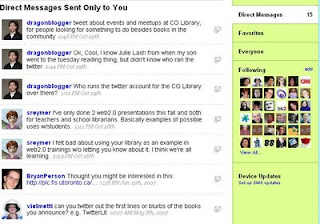 Twitter seems to be a good source of what people are saying about you online. Twitter Search is a service where you can search for what people are saying about your on twitter. This is how I was able to find out some feedback about the library's twitter service. It wasn't a positive comment, but I was able to respond to the person just a day after it was posted. LinkedIn uses a similar service called Company Buzz where it uses twitter and your work search terms to see what people are saying about your company.
For twitter, joining the conversation would involve either direct messaging another twitter user, replying to a twitter user with an @ symbol, or replying to any questions. I do get great feedback from it as well as some complaints. Good feedback are those that know about our books and events faster and we show up where you wouldn't expect libraries. The complaints are usually that there are too many tweets. When there is an rss dump, it can take up 10 spaces all at once. It's always a work in progress.
Your Library Needs to show up
Digital Marking by Sarah Houghton-Jan and Aaron Schmidt's. is more specific to libraries. I will highlight points of interest:
SNIP
Make your library website two-way
Show up in searches whether they are library directories, search engines, wifi finders, community sites, library thing local and community sites.
What are people saying about you? Search social sites to look for reviews.
Find Local Blogs and intereact in a human way.
We're experts too, library staff can show up at answer sites.
Push the information out: newsletter software, email addresses, etc.
END SNIP
Free Wi-fi Directories
The first thing I did when our library provided wi-fi access was to place our library in every single wi-fi directory. People should be able to google and know if you have wifi access. We are still one of the few institutions in our community even providing wi-fi access.
Social Networking Sites
Most social sites aren't providing any feedback. We are either too small of a community, or those that use those sorts of sites aren't using the library. I have often thought there is probably a correlation between the circulation of Science Fiction books and the amount of library digital services being used. We don't have a high science fiction circulation. If we did, perhaps feedback would show up more often on those sites.
Local Blogs
As far as local blogs go, there are over 156 people in our community that have a blog, of those, only 24 are active. For those that are active, they do provide good feedback about the community. I have only had one mention the library and that was many years ago.
Email is king
We have found the greatest success in digital marketing through our email newsletters. Recently, we have been experimenting with different types of newsletters. We were able to market the newsletter service and also harvesting our database off email addresses. Currently, we have over 3300 subscribers to our newsletter. It's almost 10% of the community. We provide our library news (like food for fines), tutorial via youtube (like how to download books from overdrive), events, and a list of top ten books that provide links to the catalog. We tried the fee based newsletters, but we are just beginning to utilize the email features in our CMS. It's free, and seems to work just as well (we are currently using Liferay).
Overall, most of the sites we have used have been good for promotions and demonstrated that we can do innovative things. The more successful pieces were more practical; not everyone has rss (in the Rubicon report, it's only 11%), but almost anyone has an email address.
More people have mentioned the email newsletter as a factor when they came into the library for a program or found out about a service. We are sending them a personal email, a personal invitation, to come see us.
Your patrons should see your library like Mecca. They should rise and think about how we connect today.
Too often, a patron gets a card, and they don't hear from the library unless they have a book overdue, a hold, or a fine. This way, we can make a connection about everything we do.
Our cost of service for marketing is about 17 cents per person. That's how much time it takes for a library staff member to get a newsletter together, send it out, and copy and paste that information into the email newsblast, the local newspaper, the local magazine (that goes to everyone in the county for free), and any other agency that tracks local news and events. It's the best way to scale and to show up everywhere for a library.
Two presentations that caught my eye were Greg Schwartz's Branding: not just for cows anymore and a combined presentation by Sarah Houghton-Jan and Aaron Schmidt's Digital Marketing. After viewing them, I began thinking about how our library shows up online, the conversations that happen, and how we present ourselves.
Branding
Greg Schwartz states that your online reputation is more dependent upon what other's say about you, but that you do have influence over that. He has six tips on how to manage your identity. Keep in mind that his presentation is really focused on your personal brand, rather than your library brand. I am making the distinction of using examples from a library's perspective.
SNIP
1. Have a Homebase
2. Own your username
3. Aggregate your lifestream
4. Join the Conversation
5. Follow what others are saying about you
6. Be Authentic
END SNIP
Homebase/Username
For a library, the homebase would obviously be the library homepage. It would be nice to have a library url that is very friendly, as opposed to the many that are still stuck with a .ci/.us url. We use cglibrary often since it is short and easy to remember. In hindsight, I should have been more consistent with our various accounts. For instance:
http://twitter.com/cglibrary
http://www.slideshare.net/cglibrary
http://flickr.com/photos/casagrandelibrary
http://youtube.com/user/jdscott50
www.splicemusic.com/people/cglibrary (used this to put background music in podcasts, before I knew about Audacity)
http://odeo.com/channels/144553-City-of-Casa-Grande-Public-Library-News-and-Events
http://www.librarything.com/venue/1220/Casa-Grande-Public-Library
http://cglibrary.blogspot.com/
 When you search for our library, our library (map included, shows up with our various accounts. Since I have online video, pictures, and other content, that can show up as well. When I search using technorati instead of google, more of the library produced content shows up. It looks good for your library and your community to see great events and programs happening. I was talking about our J.A. Jance program to a new resident and she said she knew all about it, she saw it on our Flickr page.
Aggregate your lifestream
We aggregate our lifestream through Twitter. We also use all of our services in our weekly email blast newsletter. I have played a bit with twitter and sent our new books feed, library events, and library photos through it. According to the report by Rubicon Consulting (Online Communities and Their Impact on Business: Ignore at Your Peril), Twitter is a smaller aspect of social networking, with MySpace and Facebook the biggies.
What's neat about twitter is what it does to RSS feeds. If the marc record of the new book has a notes field that describes the book, it provides it in the 140 character limit. You can also directly link to the catalog entry and place the book on hold, or be the first to pick it up. There's a great article in School Library Journal by Ellyssa Kroski that talks about what we are doing with it, as well as other libraries (46 libraries in all).
People are talking on Twitter
 Twitter seems to be a good source of what people are saying about you online. Twitter Search is a service where you can search for what people are saying about your on twitter. This is how I was able to find out some feedback about the library's twitter service. It wasn't a positive comment, but I was able to respond to the person just a day after it was posted. LinkedIn uses a similar service called Company Buzz where it uses twitter and your work search terms to see what people are saying about your company.
For twitter, joining the conversation would involve either direct messaging another twitter user, replying to a twitter user with an @ symbol, or replying to any questions. I do get great feedback from it as well as some complaints. Good feedback are those that know about our books and events faster and we show up where you wouldn't expect libraries. The complaints are usually that there are too many tweets. When there is an rss dump, it can take up 10 spaces all at once. It's always a work in progress.
Your Library Needs to show up
Digital Marking by Sarah Houghton-Jan and Aaron Schmidt's. is more specific to libraries. I will highlight points of interest:
SNIP
Make your library website two-way
Show up in searches whether they are library directories, search engines, wifi finders, community sites, library thing local and community sites.
What are people saying about you? Search social sites to look for reviews.
Find Local Blogs and intereact in a human way.
We're experts too, library staff can show up at answer sites.
Push the information out: newsletter software, email addresses, etc.
END SNIP
Free Wi-fi Directories
The first thing I did when our library provided wi-fi access was to place our library in every single wi-fi directory. People should be able to google and know if you have wifi access. We are still one of the few institutions in our community even providing wi-fi access.
Social Networking Sites
Most social sites aren't providing any feedback. We are either too small of a community, or those that use those sorts of sites aren't using the library. I have often thought there is probably a correlation between the circulation of Science Fiction books and the amount of library digital services being used. We don't have a high science fiction circulation. If we did, perhaps feedback would show up more often on those sites.
Local Blogs
As far as local blogs go, there are over 156 people in our community that have a blog, of those, only 24 are active. For those that are active, they do provide good feedback about the community. I have only had one mention the library and that was many years ago.
Email is king
We have found the greatest success in digital marketing through our email newsletters. Recently, we have been experimenting with different types of newsletters. We were able to market the newsletter service and also harvesting our database off email addresses. Currently, we have over 3300 subscribers to our newsletter. It's almost 10% of the community. We provide our library news (like food for fines), tutorial via youtube (like how to download books from overdrive), events, and a list of top ten books that provide links to the catalog. We tried the fee based newsletters, but we are just beginning to utilize the email features in our CMS. It's free, and seems to work just as well (we are currently using Liferay).
Overall, most of the sites we have used have been good for promotions and demonstrated that we can do innovative things. The more successful pieces were more practical; not everyone has rss (in the Rubicon report, it's only 11%), but almost anyone has an email address.
More people have mentioned the email newsletter as a factor when they came into the library for a program or found out about a service. We are sending them a personal email, a personal invitation, to come see us.
Your patrons should see your library like Mecca. They should rise and think about how we connect today.
Too often, a patron gets a card, and they don't hear from the library unless they have a book overdue, a hold, or a fine. This way, we can make a connection about everything we do.
Our cost of service for marketing is about 17 cents per person. That's how much time it takes for a library staff member to get a newsletter together, send it out, and copy and paste that information into the email newsblast, the local newspaper, the local magazine (that goes to everyone in the county for free), and any other agency that tracks local news and events. It's the best way to scale and to show up everywhere for a library.
Tuesday, March 04, 2008
Mind the Gap or Turning a weakness into a strength
I have really enjoyed the rounds of "tech-nos" that have gone around numerous library blogs. It is always good to be honest about abilities. In contrast, I remember a discussion many months ago talking about a technology competency list for librarians.
This brought out a thought. On one hand, we are talking about our gaps in knowledge, and in the other, we are punishing each other for those gaps. Both of these conversations discuss technology gaps and technology needs. If we don't understand that our abilities are far in advance of our users, we may not realize that the technology applications (in the name of convenience) that we provide may be creating more barriers.
If I don't realize the gap between my ability and the ability of the public, it will result in having services that are too advanced for the average person. If I don't realize the gap between myself and staff, it can be even worse.
I was listening to LISTen Podcast this week and heard a very interesting piece about the average person in the United States and their interaction with technology. The host (Stephen) was speaking with Don Reisinger of the Digital Home Blog. Even as tech savvy as he is, when asked how many people are using applications like Facebook or Myspace, he said less than 10%. Furthermore, he goes on to say that the average John Q. Public is not on Facebook. Providing overdue notices or other interactions by libraries via facebook would not be an effective way to communicate with your users. It is easier for someone from the library to make a phone call about that overdue notice than to send an alert via facebook. Furthermore, it is difficult to predict this behavior. What is popular today in social networking won't be popular tomorrow. The key is not necessarily going where these users are, but just making it more convenient to use the existing services the library provides.
This brought up the question, am I making the library more convenient with technology. In some cases yes, the computer reservation system and self-check work well, but constant need for assistance at the public access computers or for the wireless internet is a constant grind. This necessitated training for staff.
I provided a six month training program for library basic training. I mentioned it over here. All of the surveys on technology competencies were the same. People needed to know how to operate the technology at the library. They understood Word the basics of computers, but they were not very interested beyond that. Teaching them how to use the computer reservation system, or to repair the self-check were more interesting.
So, at the brink of implementing a library 2.0 training program, I pulled back. Mostly from an aversion by staff to new technology items. They felt that they were at their limit. We had implemented many technology pieces, from self-check, to computer reservation, and wireless internet. We trained them on how to use all of it. (AND they remembered it because they have to do it as part of their jobs. ) However, too much technology can result in just as much work as having no technology. Furthermore, reliance on technology in place of people can result in catastrophe. If the technology breaks often, it is ineffective. As a result, we held off a bit on any technology push, even the advertisement of overdrive, so that staff could feel more comfortable moving forward. If staff aren't prepared for the technology that currently exists in libraries, they won't be able to handle new stuff thrown at them. For that matter, neither will our users.
The "Tech-no" conversation was a good conversation because it demonstrated our shortfalls. Many librarians would view themselves in this way, even though their general competencies are still well above the average person. We need to remember that and we also need to capitalize on the feeling we get when we run into our own technology gaps. If we remember all the times where we were stuck on something because we fell into our gaps when helping a patron, we will make that person more comfortable and more able to learn something new.
I can't follow directions very well. I even have trouble with the IKEA instructions and those don't even have words! I turned this learning gap into a strength because I now write instructions so that even I could understand it. That means that each step is very clearly defined, demonstrates indications that you are still on the right course, and what you should see when you are finished. When I worked reference, my guides were very detailed. When I try to describe how I did something, it is detailed to the point of painful. We should always remember our gaps and when we help people. Remember what it feels like to be stumped, and proceed as if we are helping ourselves. That's why these conversations are so important to me.
This brought out a thought. On one hand, we are talking about our gaps in knowledge, and in the other, we are punishing each other for those gaps. Both of these conversations discuss technology gaps and technology needs. If we don't understand that our abilities are far in advance of our users, we may not realize that the technology applications (in the name of convenience) that we provide may be creating more barriers.
If I don't realize the gap between my ability and the ability of the public, it will result in having services that are too advanced for the average person. If I don't realize the gap between myself and staff, it can be even worse.
I was listening to LISTen Podcast this week and heard a very interesting piece about the average person in the United States and their interaction with technology. The host (Stephen) was speaking with Don Reisinger of the Digital Home Blog. Even as tech savvy as he is, when asked how many people are using applications like Facebook or Myspace, he said less than 10%. Furthermore, he goes on to say that the average John Q. Public is not on Facebook. Providing overdue notices or other interactions by libraries via facebook would not be an effective way to communicate with your users. It is easier for someone from the library to make a phone call about that overdue notice than to send an alert via facebook. Furthermore, it is difficult to predict this behavior. What is popular today in social networking won't be popular tomorrow. The key is not necessarily going where these users are, but just making it more convenient to use the existing services the library provides.
This brought up the question, am I making the library more convenient with technology. In some cases yes, the computer reservation system and self-check work well, but constant need for assistance at the public access computers or for the wireless internet is a constant grind. This necessitated training for staff.
I provided a six month training program for library basic training. I mentioned it over here. All of the surveys on technology competencies were the same. People needed to know how to operate the technology at the library. They understood Word the basics of computers, but they were not very interested beyond that. Teaching them how to use the computer reservation system, or to repair the self-check were more interesting.
So, at the brink of implementing a library 2.0 training program, I pulled back. Mostly from an aversion by staff to new technology items. They felt that they were at their limit. We had implemented many technology pieces, from self-check, to computer reservation, and wireless internet. We trained them on how to use all of it. (AND they remembered it because they have to do it as part of their jobs. ) However, too much technology can result in just as much work as having no technology. Furthermore, reliance on technology in place of people can result in catastrophe. If the technology breaks often, it is ineffective. As a result, we held off a bit on any technology push, even the advertisement of overdrive, so that staff could feel more comfortable moving forward. If staff aren't prepared for the technology that currently exists in libraries, they won't be able to handle new stuff thrown at them. For that matter, neither will our users.
The "Tech-no" conversation was a good conversation because it demonstrated our shortfalls. Many librarians would view themselves in this way, even though their general competencies are still well above the average person. We need to remember that and we also need to capitalize on the feeling we get when we run into our own technology gaps. If we remember all the times where we were stuck on something because we fell into our gaps when helping a patron, we will make that person more comfortable and more able to learn something new.
I can't follow directions very well. I even have trouble with the IKEA instructions and those don't even have words! I turned this learning gap into a strength because I now write instructions so that even I could understand it. That means that each step is very clearly defined, demonstrates indications that you are still on the right course, and what you should see when you are finished. When I worked reference, my guides were very detailed. When I try to describe how I did something, it is detailed to the point of painful. We should always remember our gaps and when we help people. Remember what it feels like to be stumped, and proceed as if we are helping ourselves. That's why these conversations are so important to me.
Thursday, January 24, 2008
The jig's up, we cheated: Library 2.0 recanted
Funny how we all follow trends so tightly. After John Blyberg and others come out and said that library 2.0 didn't work and neither did tagging, etc. , the flood gates open. Yes, it's not working. One library myspace just gets spam; only librarians visit flickr pages, etc. The library users are no more inclined to use the library than they did before. In fact, they hate us more for being in their splaces! Every time they see a library in their space, we really just look like businesses trying to market to them or like spammers. They look at us and think, "What are you doing here?"
The problem is that we didn't wait for the users to do this; we did this for them thinking they wanted it. It is a typical problem for many libraries. We are guessing and have a tendency to do so with our users. We think they want Facebook, or we order a literary classic, and they turn around and ask for the latest bestseller.
We tried to get their attention using these tools, but we don't utilize them in a way that works. I try to use any video or photos to help patrons see something they may have missed. The reality is, if they wanted to be there, they would have made the time. It just ends up being cute, not essential.
Much of the web 2.0 concept came from complaints about big organizations like Dell and the burning laptops. Dell says, "It's an isolated incident." The public shows them it is not through all these web 2.0 tools, and it works! It sparked the biggest recall in history. Sony loses billions on this and changes an industry.
We aren't Dell; no one feels that way about us. We are not seen as some overarching faceless oppressor. Library 2.0 is about changing our systems and providing more interaction with our public and gathering feedback. Good libraries were doing that anyway. They are open to change and make the change based on the need. It isn't that difficult. The technology affords another tool.
The reality is that most people love their libraries. They don't typically have a big enough issue so that it ends up in a blog or is spread around, only librarians do.
The problem is that we didn't wait for the users to do this; we did this for them thinking they wanted it. It is a typical problem for many libraries. We are guessing and have a tendency to do so with our users. We think they want Facebook, or we order a literary classic, and they turn around and ask for the latest bestseller.
We tried to get their attention using these tools, but we don't utilize them in a way that works. I try to use any video or photos to help patrons see something they may have missed. The reality is, if they wanted to be there, they would have made the time. It just ends up being cute, not essential.
Much of the web 2.0 concept came from complaints about big organizations like Dell and the burning laptops. Dell says, "It's an isolated incident." The public shows them it is not through all these web 2.0 tools, and it works! It sparked the biggest recall in history. Sony loses billions on this and changes an industry.
We aren't Dell; no one feels that way about us. We are not seen as some overarching faceless oppressor. Library 2.0 is about changing our systems and providing more interaction with our public and gathering feedback. Good libraries were doing that anyway. They are open to change and make the change based on the need. It isn't that difficult. The technology affords another tool.
The reality is that most people love their libraries. They don't typically have a big enough issue so that it ends up in a blog or is spread around, only librarians do.
Wednesday, October 17, 2007
Viral marketing in libraries
Public libraries have always been information hubs. Before the internet, most people would agree that going to the local public library for information was a sure bet to get the answers. Today, the answer is not in the local library, or even the internet; the source for many is someone they know.
People will always trust their friends over an organization. A friend is someone they spend time with and trust. An organization is something that can be treated that way, but it is not the organization that is trusted, but rather the people who work there.
Over at the Church of the Customer Blog, they reflect on a recent Nielsen study that states 78% of people trust their friends over any other source for information.
SNIP
Despite an ever-expanding array of advertising platforms and sources, consumers around the world still place their highest levels of trust in other consumers, according to a recent global Nielsen Internet survey.
END SNIP
As a library, or for any organization, every transaction with a customer has to be so fantastic that people will talk about it afterward. That is how a reputation is established. If your customer service is bad, everyone will know by asking their friends. If the service is fantastic, you will see a usage jump. A great marketing plan means nothing if people walk into the building and get terrible service. There is long term planning that goes into a successful marketing plan.
Training in Basic Competencies
All library staff should be able to handle 90% of questions and issues. If a patron walks into the library and staff don't have a clue how to serve, then they walk out of the building and then tell their friends how bad you are. Many librarians have experienced this and blogged about it.
Training in Customer Service
Library staff must be placed in the patrons' shoes. They have to understand what it is like to walk into the library for the first time and get what they need. This type of empathy is crucial to good customer service (and consequently management). In this area, advanced classes are often needed in dealing with the angry or dangerous patron. The angry patron training helps staff diffuse situations and pull back out of the circle of anger. This actually helps staff understand a person objectively and without getting personal or let their emotions get the better of them. Furthermore, if you have library staff who are perpetually cranky, a group class dealing in customer service brings across the point of what is expected. Get on board, fake it, or leave.
Training in Technology
Learning 2.0 is all the rage. It is important to cover the basics first. One thing about technology training is that the ones who want to learn have a desire to learn. It can be a personal desire, or a desire to be the best they can at their job. To be able to handle everything thrown at them. Technology training covers both of them. However, if the seed has been sown in basic training and customer service, there is a higher chance for everyone to be on board for training. The reason from management must be there (providing better service), and the desire from staff must be there (lifelong learner or wants to be the best).
There is one thing you may be thinking at this point, "I thought this was a post about marketing?" It is, but it is about viral and word of mouth marketing. If you give someone fantastic service, you are marketing. People will know that they can get friendly, helpful people that will work with them to get what they need and will actually feel bad if they don't achieve their goal. This is the best type of marketing one can do and provides groundwork to achieve bigger and better things.
A brief Story
When we created and enacted our strategic plan, we made the assumption that we need to create a new level of service with new programs and service. Then we can market those services. Sometimes these service market themselves. If the service is that good, and you are on target with a strategic plan, then the service will spread through word of mouth. That is what happened to us. Usage went through the roof almost immediately. New library cards doubled each month. Currently, 90% of our community owns a library card. Consequently, new library cards are flat or down since there are not many more people to get a library card. We were concerned about this since our strategic plan stated that we need to increase library card ownership by 10% by marketing. Now that 90% have a card, we won't hit that mark. However, our new plan is to advertise the fact that 90% of the population owns a library card. It will be something to the extent of "Don't be 1 in 10" with a statement that 90% of our community owns a library card. Then talk about all the great things the library does. We might make shirts or bags to promote this as part of our library card sign up campaign in January.
How to become ubiquitous:RSS Feeds
Now that the groundwork has been lain, the library can now begin expanding its realm and appear ubiquitous. The library can show up everywhere if you choose to do so and it doesn't take any staff time to do so. Just some set-up time. This can easily be done with rss feeds. Most Integrated Library Systems have or are starting to produce RSS feeds.
Why would you library want to do this? Imagine standing on a corner of a busy street. You have lots of books you want to sell. You stand there displaying your books, thinking everyone will just come to you because you are so fantastic. You don't get the traffic you anticipated.
Why? You are not shouting out what you have. You just let people pass by and rely on the fact that you are so fantastic to speak for itself. This is the wrong approach. RSS feeds (really simple syndication) shouts out your information. You may think at this point that not many people use News Readers to read these feeds, but you can produce an email distribution list from these feeds using Feedburner. Feedburner is not the only service that can transmit an rss feed into email. Everyone has email so by producing this feed in this way, everyone can sign up to get the latest books, music, and movies available.
I love these feeds because I am the first to find out when a new book is available. I can be the first in the library to grab a book off the shelf because only I know it is there. This of course helps internally with library staff as they are also aware of what is available as soon as it is available. I once had a patron come in and ask for United 93. We searched everywhere for it, but couldn't find it. We called upstairs to Technical Services and they had it. They stated, "I just put that in the system, how did you know I had it so fast?" She had only put the dvd in the system five minutes before. That's how fast someone can get an item.
These feeds can also be dumped anywhere, twitter, myspace, facebook, google homepage, the list goes on. Your library can be everyone online with rss feeds. You don't necessarily need a presence on all of these social networking sites. However, you can keep them updated with rss feeds that require no additional staff time.
It takes staff time to be everywhere with traditional marketing
It must be written into one or more job positions and time must be given for marketing. Currently, we have one librarian dedicating 20% of their time to marketing. They need to be allowed off desk time or whatever that needs to be done to do this. This involves creating a weekly news blast to the local newspaper, chamber of commerce, our email listserv, it goes on our website, it goes to a monthly magazine that is delivered to every household in the county, our friends newsletter, the county visitor's bureau, and anywhere else we can squeeze in. This takes a lot of time. In reality, all of the events are planned out six months in advance. So it mostly involves grabbing what is happening this week, adding library news (such as advertising our flash drives for sale, our food for fines, library closures, and other non-programming events) and adding our top ten list. Our top ten list is the top ten books our community is reading at any one time. For instance, we put in the top ten circulating books for fiction, non-fiction, juvenile, teens, and then pick different subject (like gardening or cooking for diabetics) or genre areas (like romance or mystery).
We also cheat a bit with the list. We don't just put out the most circulating items, we put out the hotlist. Most circulating will only provide older titles and give the impression the library only has old titles. We get a hotlist by subtracting the date entered from the date it was checked out. This then predicts what the circulation will be for one year. For instance, if a book was only in three days and was checked out, it would predicted it would be checked out every three days, giving it a circulation of over 100. So instead of the Da Vinci Code showing up at the top fiction books, A Thousand Splendid Suns shows up first instead. People reading the paper for library news may be surprised that we have the latest fiction. This helps promote that.
The actual viral piece/Our plan
To actually get viral, you must have a particular service or services that is so great people are always prompted to talk about it. As a library director once told me, people need to see their library like mecca, how do we connect today? Here are some things we have done and will be planning:
We gave away free gold bookmarks and canvas bags with the library's logo on it for a library card sign-up month. Not terribly exciting, but new cards went up.
We upgraded everyone's library card from a red piece of plastic, to a dual card with a wallet card and a keychain card with the library's picture, website, hours of operation, and phone number on the back. This prompted conversation because the picture was attractive, and anytime someone pulled out their keys, a conversation could occur. (hey what's that, this is my new library card, they are giving them away free at the library.)
We sell flash drives with the library's logo and website address. This has been the most successful viral campaign as we were able to penetrate the schools with it. If a teacher can fit you into their busy schedule, then you are truly successful. Read more here
We bought into the Greater Phoenix Digital Library consortium. We plan to wrap our library card campaign with marketing for this service. Our plan it to give away 2gb mp3 players and show people how to use them. The first 50 who sign up for the service will get a free player and instructions on how to download an audiobook or music to their player. All library staff will each get a player first so they can see how it works. We will also issue an fm transmitter with it so that it can be played in any car. This gets over several compatibility issues. The mp3 player can play everything, can be placed in any car, and has enough storage to play 40 hours of audiobook, which is the largest capacity of audio.
We plan to expand our bandwidth once our e-rate application is resolved. We will expand from 1.5 mbps to 6mbps. We plan to have a campaign to the extent of, be careful, speed this fast can be dangerous. We will probably have a video launch to demonstrate the speed.
We plan to renovate the library by replacing the dvd shelving with videostore shelving, replace the new bookshelving with clear face-out shelving, create a greeting desk, clean the front of the library, and put out a new security system that will enable more self-service. This will change the entire look of the library for very little cost. If all goes exactly, it will create an entirely different effect when one walks through the library. It is my hope that this will further get the public to talk about our library.
This should all result in increased traffic in all user points. We should see double digit jumps in circulation (with particular notice to how fast an item is checked out and particular higher marketed collections), computer usage, walk-in business.
This takes an incredible amount of back work, training, and planning. I have done this before with a renovation. It is why all of our service usage has increased the last two years. We are almost always looking to improve and change services to make them better. We want to be the best and that involves change.
People will always trust their friends over an organization. A friend is someone they spend time with and trust. An organization is something that can be treated that way, but it is not the organization that is trusted, but rather the people who work there.
Over at the Church of the Customer Blog, they reflect on a recent Nielsen study that states 78% of people trust their friends over any other source for information.
SNIP
Despite an ever-expanding array of advertising platforms and sources, consumers around the world still place their highest levels of trust in other consumers, according to a recent global Nielsen Internet survey.
END SNIP
As a library, or for any organization, every transaction with a customer has to be so fantastic that people will talk about it afterward. That is how a reputation is established. If your customer service is bad, everyone will know by asking their friends. If the service is fantastic, you will see a usage jump. A great marketing plan means nothing if people walk into the building and get terrible service. There is long term planning that goes into a successful marketing plan.
Training in Basic Competencies
All library staff should be able to handle 90% of questions and issues. If a patron walks into the library and staff don't have a clue how to serve, then they walk out of the building and then tell their friends how bad you are. Many librarians have experienced this and blogged about it.
Training in Customer Service
Library staff must be placed in the patrons' shoes. They have to understand what it is like to walk into the library for the first time and get what they need. This type of empathy is crucial to good customer service (and consequently management). In this area, advanced classes are often needed in dealing with the angry or dangerous patron. The angry patron training helps staff diffuse situations and pull back out of the circle of anger. This actually helps staff understand a person objectively and without getting personal or let their emotions get the better of them. Furthermore, if you have library staff who are perpetually cranky, a group class dealing in customer service brings across the point of what is expected. Get on board, fake it, or leave.
Training in Technology
Learning 2.0 is all the rage. It is important to cover the basics first. One thing about technology training is that the ones who want to learn have a desire to learn. It can be a personal desire, or a desire to be the best they can at their job. To be able to handle everything thrown at them. Technology training covers both of them. However, if the seed has been sown in basic training and customer service, there is a higher chance for everyone to be on board for training. The reason from management must be there (providing better service), and the desire from staff must be there (lifelong learner or wants to be the best).
There is one thing you may be thinking at this point, "I thought this was a post about marketing?" It is, but it is about viral and word of mouth marketing. If you give someone fantastic service, you are marketing. People will know that they can get friendly, helpful people that will work with them to get what they need and will actually feel bad if they don't achieve their goal. This is the best type of marketing one can do and provides groundwork to achieve bigger and better things.
A brief Story
When we created and enacted our strategic plan, we made the assumption that we need to create a new level of service with new programs and service. Then we can market those services. Sometimes these service market themselves. If the service is that good, and you are on target with a strategic plan, then the service will spread through word of mouth. That is what happened to us. Usage went through the roof almost immediately. New library cards doubled each month. Currently, 90% of our community owns a library card. Consequently, new library cards are flat or down since there are not many more people to get a library card. We were concerned about this since our strategic plan stated that we need to increase library card ownership by 10% by marketing. Now that 90% have a card, we won't hit that mark. However, our new plan is to advertise the fact that 90% of the population owns a library card. It will be something to the extent of "Don't be 1 in 10" with a statement that 90% of our community owns a library card. Then talk about all the great things the library does. We might make shirts or bags to promote this as part of our library card sign up campaign in January.
How to become ubiquitous:RSS Feeds
Now that the groundwork has been lain, the library can now begin expanding its realm and appear ubiquitous. The library can show up everywhere if you choose to do so and it doesn't take any staff time to do so. Just some set-up time. This can easily be done with rss feeds. Most Integrated Library Systems have or are starting to produce RSS feeds.
Why would you library want to do this? Imagine standing on a corner of a busy street. You have lots of books you want to sell. You stand there displaying your books, thinking everyone will just come to you because you are so fantastic. You don't get the traffic you anticipated.
Why? You are not shouting out what you have. You just let people pass by and rely on the fact that you are so fantastic to speak for itself. This is the wrong approach. RSS feeds (really simple syndication) shouts out your information. You may think at this point that not many people use News Readers to read these feeds, but you can produce an email distribution list from these feeds using Feedburner. Feedburner is not the only service that can transmit an rss feed into email. Everyone has email so by producing this feed in this way, everyone can sign up to get the latest books, music, and movies available.
I love these feeds because I am the first to find out when a new book is available. I can be the first in the library to grab a book off the shelf because only I know it is there. This of course helps internally with library staff as they are also aware of what is available as soon as it is available. I once had a patron come in and ask for United 93. We searched everywhere for it, but couldn't find it. We called upstairs to Technical Services and they had it. They stated, "I just put that in the system, how did you know I had it so fast?" She had only put the dvd in the system five minutes before. That's how fast someone can get an item.
These feeds can also be dumped anywhere, twitter, myspace, facebook, google homepage, the list goes on. Your library can be everyone online with rss feeds. You don't necessarily need a presence on all of these social networking sites. However, you can keep them updated with rss feeds that require no additional staff time.
It takes staff time to be everywhere with traditional marketing
It must be written into one or more job positions and time must be given for marketing. Currently, we have one librarian dedicating 20% of their time to marketing. They need to be allowed off desk time or whatever that needs to be done to do this. This involves creating a weekly news blast to the local newspaper, chamber of commerce, our email listserv, it goes on our website, it goes to a monthly magazine that is delivered to every household in the county, our friends newsletter, the county visitor's bureau, and anywhere else we can squeeze in. This takes a lot of time. In reality, all of the events are planned out six months in advance. So it mostly involves grabbing what is happening this week, adding library news (such as advertising our flash drives for sale, our food for fines, library closures, and other non-programming events) and adding our top ten list. Our top ten list is the top ten books our community is reading at any one time. For instance, we put in the top ten circulating books for fiction, non-fiction, juvenile, teens, and then pick different subject (like gardening or cooking for diabetics) or genre areas (like romance or mystery).
We also cheat a bit with the list. We don't just put out the most circulating items, we put out the hotlist. Most circulating will only provide older titles and give the impression the library only has old titles. We get a hotlist by subtracting the date entered from the date it was checked out. This then predicts what the circulation will be for one year. For instance, if a book was only in three days and was checked out, it would predicted it would be checked out every three days, giving it a circulation of over 100. So instead of the Da Vinci Code showing up at the top fiction books, A Thousand Splendid Suns shows up first instead. People reading the paper for library news may be surprised that we have the latest fiction. This helps promote that.
The actual viral piece/Our plan
To actually get viral, you must have a particular service or services that is so great people are always prompted to talk about it. As a library director once told me, people need to see their library like mecca, how do we connect today? Here are some things we have done and will be planning:
We gave away free gold bookmarks and canvas bags with the library's logo on it for a library card sign-up month. Not terribly exciting, but new cards went up.
We upgraded everyone's library card from a red piece of plastic, to a dual card with a wallet card and a keychain card with the library's picture, website, hours of operation, and phone number on the back. This prompted conversation because the picture was attractive, and anytime someone pulled out their keys, a conversation could occur. (hey what's that, this is my new library card, they are giving them away free at the library.)
We sell flash drives with the library's logo and website address. This has been the most successful viral campaign as we were able to penetrate the schools with it. If a teacher can fit you into their busy schedule, then you are truly successful. Read more here
We bought into the Greater Phoenix Digital Library consortium. We plan to wrap our library card campaign with marketing for this service. Our plan it to give away 2gb mp3 players and show people how to use them. The first 50 who sign up for the service will get a free player and instructions on how to download an audiobook or music to their player. All library staff will each get a player first so they can see how it works. We will also issue an fm transmitter with it so that it can be played in any car. This gets over several compatibility issues. The mp3 player can play everything, can be placed in any car, and has enough storage to play 40 hours of audiobook, which is the largest capacity of audio.
We plan to expand our bandwidth once our e-rate application is resolved. We will expand from 1.5 mbps to 6mbps. We plan to have a campaign to the extent of, be careful, speed this fast can be dangerous. We will probably have a video launch to demonstrate the speed.
We plan to renovate the library by replacing the dvd shelving with videostore shelving, replace the new bookshelving with clear face-out shelving, create a greeting desk, clean the front of the library, and put out a new security system that will enable more self-service. This will change the entire look of the library for very little cost. If all goes exactly, it will create an entirely different effect when one walks through the library. It is my hope that this will further get the public to talk about our library.
This should all result in increased traffic in all user points. We should see double digit jumps in circulation (with particular notice to how fast an item is checked out and particular higher marketed collections), computer usage, walk-in business.
This takes an incredible amount of back work, training, and planning. I have done this before with a renovation. It is why all of our service usage has increased the last two years. We are almost always looking to improve and change services to make them better. We want to be the best and that involves change.
Saturday, July 28, 2007
Seth's Blog: Bobcasting (and Google Reader)
The right information to the right people is something I would love to accomplish. In Seth's Blog, he comments on how marketers should tailor the message to each individual user.
SNIP
Seth's Blog: Bobcasting (and Google Reader): "I want to suggest something that takes no new technology but could have a big impact on the way you do business: Bobcasting.
I call it that because instead of reaching the masses, it's just about reaching Bob. Or Tiasha. Or any individual or small group.
The future of online communication is micro-pockets of people getting RSS feeds in their Google Reader or on their Google home page. Amazon updates? Bobcast em to me. Fogbugz summaries for the customer service manager? Bobcast her three times a day."
END SNIP
Right now, my library has dozens of RSS feeds, email subscriptions, and a twitter account. However, it is just a bunch of noise unless I can filter it to the individual user. I know I have lost a few people on my twitter feed because it is much too noisy. Here is a perfect example from Siegel's Droppings, Too Much Twittering :
SNIP
They provide nice links to the catalog records for the material. But they blast out way too many tweets. Just this morning they updated 17 times. I'm going to remove them as it is making it difficult to follow my librarian friends.
END SNIP
It is just like every reader his or her book, but instead, every reader his or her feed. I am working with feedburner to set up individual feeds that have categories for people, parents, adults, children, the techs. Having those options are great if someone takes the initiative to create their own piece out of the mess, but if I can spoon feed it, then I have Bobcasting.
SNIP
Seth's Blog: Bobcasting (and Google Reader): "I want to suggest something that takes no new technology but could have a big impact on the way you do business: Bobcasting.
I call it that because instead of reaching the masses, it's just about reaching Bob. Or Tiasha. Or any individual or small group.
The future of online communication is micro-pockets of people getting RSS feeds in their Google Reader or on their Google home page. Amazon updates? Bobcast em to me. Fogbugz summaries for the customer service manager? Bobcast her three times a day."
END SNIP
Right now, my library has dozens of RSS feeds, email subscriptions, and a twitter account. However, it is just a bunch of noise unless I can filter it to the individual user. I know I have lost a few people on my twitter feed because it is much too noisy. Here is a perfect example from Siegel's Droppings, Too Much Twittering :
SNIP
They provide nice links to the catalog records for the material. But they blast out way too many tweets. Just this morning they updated 17 times. I'm going to remove them as it is making it difficult to follow my librarian friends.
END SNIP
It is just like every reader his or her book, but instead, every reader his or her feed. I am working with feedburner to set up individual feeds that have categories for people, parents, adults, children, the techs. Having those options are great if someone takes the initiative to create their own piece out of the mess, but if I can spoon feed it, then I have Bobcasting.
Thursday, July 19, 2007
The future of libraries or getting them what they want
Of all the technology initiatives that go through, the only ones that are noticed are those that are most dear to the users.
Libraries, overall, are still centers for books, information, and internet access points. The top reasons someone doesn't use a library is lack of time, money, or interest.
The first is having the library open at convenient hours. 24 hours sounds great, but not feasible.
The second relates to fines, once accrued, blocks users. The last relates to those who simply don't want to use the library. It could mean that they are not big readers, or that they prefer to buy their books. It is usually the former.
Therefore, there will always be a set population that won't enter the library even with free incentives. I liked the Unshelved strip that stated going after non-readers is like trying to turn someone into a sports fan.
So for the others, just extend hours and get the stuff they want. Isn't that simple enough?
Let's look at several reports and news clips talking about the future of libraries and the future of the book. The first is one already mentioned at Jessmyn's Librarian.net, Do Users Care about our New Initiatives. In it she provides an excellent examination of a new study by the Wisconsin Public Library Consortium
and examines the conclusion that states it is not the technology that fails, but lack of marketing.
SNIP
"Do they realy think that the solution to getting more people to perceive value from the libraries technology initiatives is to just find a more effective way to market them? Aren’t there questions they could have asked about the services that would have helped nail this down more effectively such as “Are you aare that the library offers downloadable audio books?” “Do you use this service, why or why not?”
In the future, the library may no longer house books, they may create access points. In the O'reilly blog, it talks states If Libraries had shareholders, would they be making an about face much like the newspaper industry. Here is an example from that:
SNIP
END SNIP
The last paper book will probably die in a library. People will still have their private collections, but libraries will be the last to hold them. Over time, libraries will become access points to basic services such as the internet, information, and reading, but these will be available online. The users will use the library for its space, but also use it at home for its access. The dual nature of libraries.
 Subscribe in a reader
Libraries, overall, are still centers for books, information, and internet access points. The top reasons someone doesn't use a library is lack of time, money, or interest.
The first is having the library open at convenient hours. 24 hours sounds great, but not feasible.
The second relates to fines, once accrued, blocks users. The last relates to those who simply don't want to use the library. It could mean that they are not big readers, or that they prefer to buy their books. It is usually the former.
Therefore, there will always be a set population that won't enter the library even with free incentives. I liked the Unshelved strip that stated going after non-readers is like trying to turn someone into a sports fan.
So for the others, just extend hours and get the stuff they want. Isn't that simple enough?
Let's look at several reports and news clips talking about the future of libraries and the future of the book. The first is one already mentioned at Jessmyn's Librarian.net, Do Users Care about our New Initiatives. In it she provides an excellent examination of a new study by the Wisconsin Public Library Consortium
and examines the conclusion that states it is not the technology that fails, but lack of marketing.
SNIP
"Do they realy think that the solution to getting more people to perceive value from the libraries technology initiatives is to just find a more effective way to market them? Aren’t there questions they could have asked about the services that would have helped nail this down more effectively such as “Are you aare that the library offers downloadable audio books?” “Do you use this service, why or why not?”
As I’ve said before, I think that before we can fully immerse ourselves in a 2.0 initiative as librarians, we have to make sure we’re counting the right things. If you only collect internal statistics on reference interactions that happen in-person or on the phone, it’s no wonder that IM reference seems like a “flavor of the month” thing for the library to do. And, after the fact, if you can’t show that people are really using the new techie things that you do provide it’s harder to stress that those things that should be part of what your library is and does. Many of these things are countable — website stats, flickr photostream views, IM interactions — the question is: are we counting them?
END SNIP
I provided a review of my library's 2.0 stats here. They are certainly not off the charts for technology usage. I could incorporate these stats into my monthly report, but it would just be another stat that my funders would ignore. Impact is from action, not necessarily from usage of technology. Performance based budgeting is all the rage and if it doesn't show up in a strategic plan, then no one cares.
I would say this report confirms that many of these technology tricks are not going anywhere. Even marketing won't work. I have had a twitter feed from the library for some time, but I only have one user that is actually from the city. There is no way to hit this crowd or go to them since online, they are invisible. Too often, a library puts out a great website that uses social networking sites, only to have other librarians say how great and progressive it is. However, most people who are resistant to 2.0 say, "Does this initiative help check-out a book, or increase a core stat?" Usually, the answer is no. I have had more success in getting non-users by expanding the print sources of the library's news. The best way to get users in the library is word of mouth. They can come once to find bad service and never come back. If you have fantastic service, enough for people to talk about, then you don't need any marketing for that.
Here is a snippet from the Report:
SNIP
P. 16
Section Four: New Initiatives
In the 2003 survey, the new initiatives targeted very specific technology projects (i.e. netLibrary), and had a very low response rate. The goal of the current new initiatives section is to examine more general ideas or potential initiatives of interest to public libraries. The following table examines these new initiatives in terms of library users and non-users.
p 17
Section Five: What Would Increase Library Use?
The previous section of the report suggests that technology may not be a way to increase library use, but is there anything else that could?
What is particularly interesting about this table is that non-library users more readily agree that they would use the library more if it were easier to get to than users do. This item is the only one where non-users agreed more than users did, though both groups still somewhat disagree with the statement.
The general trend is that no item appears to be a strong indicator to increase use among users or non-users. The means for all cases are tending negatively, suggesting little interest from both users and non-users in the proposed initiatives. The only initiative with a positive reaction is wireless Internet access, and even this response is effectively neutral for library users. Library users are more moderate in their degree of disinterest with the proposed initiatives, but are still disinterested in most initiatives.
END SNIP
In my community, a recent study showed the two of the top three things our citizens love is the library's collection and hours of availability. So in reality, I can create a myspace page for the library, but ordering the right books, being open the right hours are the real key to get users and non-users. That's it, no magic bullet.
The funny thing about 2.0 is that it reinvents the wheel. Libraries have always been focused on getting what the users want. We listen to recommendations for books and services and adjust. It isn't totally user controlled, but in most libraries, it practically is. Users build the collection, if a library is paying attention, it is totally in the hands of users since they vote with their library card. Watch the stats and react.
In the future, the library may no longer house books, they may create access points. In the O'reilly blog, it talks states If Libraries had shareholders, would they be making an about face much like the newspaper industry. Here is an example from that:
SNIP
Undergraduates entering universities in the United States use the library as a study space, a socializing space, but to a shocking and frightening extent, they do not use library services or library materials. [...] We're losing clientele; students may come in the library to study, to socialize, to hit the newly installed cafe designed to lure them in, but they're not using library materials, or library services, at anything like the rate they did even ten years ago.
END SNIP
So the library is being used, but not in its traditional way. It is a space issue and the future of libraries are two fold, a space to be that is non-directed, and advanced information and collections that can go to the user whenever they want them. Ironically, one could see a library that is used for its public space, but its collections used from home. Interesting phenomenon.
As books become more digital, their access online can mimic a book. As mentioned in If:Book:
Imagine a library that collected all the world's information about all the world's books and made it available for everyone to view and update. We're building that library.
The official opening of Open Library isn't scheduled till October, but they've put out the demo now to prove this is more than vaporware and to solicit feedback and rally support. If all goes well, it's conceivable that this could become the main destination on the Web for people looking for information in and about books: a Wikipedia for libraries. On presentation of public domain texts, they already have Google beat, even with recent upgrades to the GBS system including a plain text viewing option. The Open Library provides TXT, PDF, DjVu (a high-res visual document browser), and its own custom-built Book Viewer tool, a digital page-flip interface that presents scanned public domain books in facing pages that the reader can leaf through, search and (eventually) magnify.
Page turning interfaces have been something of a fad recently, appearing first in the British Library's Turning the Pages manuscript preservation program (specifically cited as inspiration for the OL Book Viewer) and later proliferating across all manner of digital magazines, comics and brochures (often through companies that you can pay to convert a PDF into a sexy virtual object complete with drag-able page corners that writhe when tickled with a mouse, and a paper-like rustling sound every time a page is turned).
This sort of reenactment of paper functionality is perhaps too literal, opting for imitation rather than innovation, but it does offer some advantages.END SNIP
The last paper book will probably die in a library. People will still have their private collections, but libraries will be the last to hold them. Over time, libraries will become access points to basic services such as the internet, information, and reading, but these will be available online. The users will use the library for its space, but also use it at home for its access. The dual nature of libraries.
Subscribe in a reader
Saturday, June 30, 2007
I am indeed honored
When I first began blogging, I had set some goals for myself to test my relevancy. At the beginning, I said if I can't sustain my blog, I would delete it. I had some close calls, but was able to stick with it. This week was very fulfilling as I accomplished some of my goals.
The most important to me was to show up in Walt Crawford's Cites and Insights (corrected) for July 2007.
It is in the section titled Making it Work - Commentary on personal balance and library service balance, p. 14 and 15 (mentions my post about libraries, good cheap, but not fast)
civ7i8.pdf (application/pdf Object
This was personally important since I remember reading Walt's analysis of blogs before I began blogging. I always wondered if once I started blogging, my blog would show up there. It was very exciting to read that this week, thank you Walt!
The next important was This Week in LibraryBlogLand. Again, I remember reading this blog as a connection to other great blogs. I wondered if my blog would ever show up. A few weeks ago, it did.
http://twil.lisnews.org/TWiL/07/06/04/1611235.shtml
(Under Librarian Education for my post on What I learned in Library School)
I also contributed to a technology "cookbook" for rural libraries. This was from my technology handbook I created for my library I mention on this post.
The Joy of Computing
http://maintainitproject.org/files/TheJoyofComputing-061807.pdf
Last, I was included in David Free's Presentation on Twitter at the ALA Unconference. Unfortunately, I have never been able to go to ALA Conference, so to have my library mentioned for my twitter efforts was very exciting. Thank you to David for the mention.
So a big thank you is due to all those who think this blog is relevant. I am indeed honored.
The most important to me was to show up in Walt Crawford's Cites and Insights (corrected) for July 2007.
It is in the section titled Making it Work - Commentary on personal balance and library service balance, p. 14 and 15 (mentions my post about libraries, good cheap, but not fast)
civ7i8.pdf (application/pdf Object
This was personally important since I remember reading Walt's analysis of blogs before I began blogging. I always wondered if once I started blogging, my blog would show up there. It was very exciting to read that this week, thank you Walt!
The next important was This Week in LibraryBlogLand. Again, I remember reading this blog as a connection to other great blogs. I wondered if my blog would ever show up. A few weeks ago, it did.
http://twil.lisnews.org/TWiL/07/06/04/1611235.shtml
(Under Librarian Education for my post on What I learned in Library School)
I also contributed to a technology "cookbook" for rural libraries. This was from my technology handbook I created for my library I mention on this post.
The Joy of Computing
http://maintainitproject.org/files/TheJoyofComputing-061807.pdf
Last, I was included in David Free's Presentation on Twitter at the ALA Unconference. Unfortunately, I have never been able to go to ALA Conference, so to have my library mentioned for my twitter efforts was very exciting. Thank you to David for the mention.
So a big thank you is due to all those who think this blog is relevant. I am indeed honored.
Monday, June 04, 2007
Amazon Comes to Twitter
Amazon Comes to Twitter
Hey someone figured out another good use for twitter. This is essentially the same thing my library is doing with twitter. Sending out notices for events, sales, new information to the public. Whenever a new book is released, twitter knows about it. Amazon and organizations like Woot are doing the same thing, releasing information and sales through twitter. This is about marketing people!
Take a look at this:
SNIP


Hey someone figured out another good use for twitter. This is essentially the same thing my library is doing with twitter. Sending out notices for events, sales, new information to the public. Whenever a new book is released, twitter knows about it. Amazon and organizations like Woot are doing the same thing, releasing information and sales through twitter. This is about marketing people!
Take a look at this:
SNIP
This is a great example of how instant communication tools like Twitter are being used for commercial means. Basically the Amazon and Woot deals are feeds of offers, pushed out via Twitter. These kind of feeds could also be received in your RSS Reader, or email.
The next step for Amazon and Woot is to allow personalized Twitter feeds - e.g. you could sign up to an Amazon Twitter feed of just music deals (if music is what you want to buy). This would equate the "followers" of Amazon's Twitter feed to leads for the company - very fine grained ones, because Amazon knows what their "followers" want, based on which e-commerce deals they sign up for via Twitter.
END SNIP
The next phase for Amazon is EXACTLY what I am trying to do with twitter. Establish customized feeds so that specific patrons can sign up for their particular interests. Parents can sign up for new kids books, kids events, and other information. There is so much more that can be done with this. Very cool stuff.
Saturday, May 12, 2007
New Comm Road Podcast Available
Bryan Person's interview with me about my library's use of 2.0 technologies, including twitter, is now up and available. In the interview, I am crediting the 2.0 model as increasing the library circulation by 30%. 2.0 is not just about technology, but about being reactive to your users and allowing your users to take control.
Here is the podcast information:
http://www.bryper.com/2007/05/07/ncr-030-libraries-and-new-media/
SNIP
What I found most interesting about the interview, and sometimes the point of library 2.0, is that he would have never of thought about libraries doing these sorts of things. It's not a question of what the results are necessarily, but how perceptions are changed in your community, across the nation, and around the world. I remember the words David Keeber from Sedona Public Library told me during my library's planning for results process. "Your users must always think about the library. They must wake up and think of it as Mecca, how are we going to connect today?" That statement has always stayed with me.
Here is the podcast information:
http://www.bryper.com/2007/05/07/ncr-030-libraries-and-new-media/
SNIP
IN TODAY’S SHOW:
Feature interview
- Twitter will help library reach its audience more effectively.
- Library 2.0 — engaging community members in the media that they use.
- Library’s marketing efforts have paid off — book checkouts are up 30% this year.
- Casa Grande Library’s Web 2.0 resources:
- Twitter page
- RSS feeds and podcasts
- Flickr page
- Videos through Photobucket
- Jeff’s personal blog — Gather No Dust
What I found most interesting about the interview, and sometimes the point of library 2.0, is that he would have never of thought about libraries doing these sorts of things. It's not a question of what the results are necessarily, but how perceptions are changed in your community, across the nation, and around the world. I remember the words David Keeber from Sedona Public Library told me during my library's planning for results process. "Your users must always think about the library. They must wake up and think of it as Mecca, how are we going to connect today?" That statement has always stayed with me.
Monday, May 07, 2007
Library 2.0 Usage Results
We have several library 2.0 uses at the library. This is a result of our efforts. We began developing these new services in September 2006, but the full roll-out of services didn't begin until January 2007. This is a report on usage from January to April and a comparison on usage between traditional methods and using library 2.0 methods.
AUDIO
Podcasting versus Phone Tree
Our progams are placed on our phone tree and they are also podcasted on our website.
Number of patrons who listened to the telephone program list:
5 Adult
5 Youth
5 Technology
So in the past four months, 15 different people listened to the automated phone message about programs.
Number of patrons who listed to the program podcast:
4 may technology (I posted May on April 30th)
3 mayyouth
5 may adult
23 april tech
12 APRIL YOUTH
14 ADULT APRIL
6 MARCH ADULT PROGRAMS
6 MARCH YOUTH
36 MARCH TECHNOLOGY
7 FEBRUARY ADULT
22 FEBRUARY YOUTH
7 FEBRUARY TECHNOLOGY
So in the same time period, we had 145 downloads of all podcasts.
PHOTOS
Patrons who viewed the library photo album on the library webpage:
12 photos, viewed 125 times
Flickr views
Your photos 169 photos / 638 views
Engaging Teens with Technology
Recently received a grant from the Arizona State Library to provide opportunities for teens to create, blogs, podcasts, and vodcasts about stuff that interests them in our community. We also allow myspace, chatting, game playing, etc. on our public access computers. As long as you don't want to download anything onto the computer (because it will get wiped) you can do pretty much whatever you want. We do engage a filter, but it is fairly light and literal so we don't have any issues with it blocking ok sites. One out of every three computer users is a teen, right in line with our strategic plan.
Here is a description of the grant:
Grant person would help guide the SPARC group under the direction of Youth Librarian. This person would develop news information for teens in the area using blogs, podcasting, and other formats working with our teen group, SPARC (Students Participating in an Advisory Reading Committee). The grant person would meet with the group once a week for 4 hours to help develop the project. This will take a year to develop. Cost would be $5,500, ($4500 for three laptops for the group, $1000 for recording equipment).
Staff WIKI
wiki busted never took off with staff, trying the library technology handbook in google docs. Right now, its use is mostly in the paper format.
Blog versus email versus web versus paper
Number of bookletters email subscribers: 442
Number of patrons on email distribution list: 598
Number of blog subscribers: 10
Number of people who look at content via the web: 48,989 from January to April
Number of people who read our events via the Community Services Brochure: 30,000 (mailed to each home during the summer and sent in each newspaper in the Fall and Spring, effectively canvassing every home in my community.)
From this I can gather that more people would prefer to receive information via email after they check the website. I think paper and people trump everyone.
In a recent survey, the library wanted to find out how people heard about the library.
Here are some of the results:
Newspaper, 66%
Community Services Brochure, 47%
Word of Mouth 45%
Visited/Call the library, 28%
Flier/program at schools 23%
website 13%
For communication via mobile phone, twitter and library elf, I only have two library elf subscribers. Twitter is more popular, but the problem is a local one. I don't think we have any local subscribers yet. We plan to advertise the service through our library news on the website and in the local paper. I will report on the effectiveness of the campaign. I would say the most successful techniques we have used to advertise our services have been getting a library news section in the newspaper and word of mouth. I know word of mouth since people are talking about the new computers and it spread like wildfire. Also, when we had a new library card campaign, people were talking about how great the new cards were. A board member pratically created her own psa. When pulling out her keys a co-worker noticed the keychain library card. She mentioned how neat it was, and the board member said that you can pick one up for free at the local library all this month for library card sign-up month. Sold American!
AUDIO
Podcasting versus Phone Tree
Our progams are placed on our phone tree and they are also podcasted on our website.
Number of patrons who listened to the telephone program list:
5 Adult
5 Youth
5 Technology
So in the past four months, 15 different people listened to the automated phone message about programs.
Number of patrons who listed to the program podcast:
4 may technology (I posted May on April 30th)
3 mayyouth
5 may adult
23 april tech
12 APRIL YOUTH
14 ADULT APRIL
6 MARCH ADULT PROGRAMS
6 MARCH YOUTH
36 MARCH TECHNOLOGY
7 FEBRUARY ADULT
22 FEBRUARY YOUTH
7 FEBRUARY TECHNOLOGY
So in the same time period, we had 145 downloads of all podcasts.
PHOTOS
Patrons who viewed the library photo album on the library webpage:
12 photos, viewed 125 times
Flickr views
Your photos 169 photos / 638 views
Engaging Teens with Technology
Recently received a grant from the Arizona State Library to provide opportunities for teens to create, blogs, podcasts, and vodcasts about stuff that interests them in our community. We also allow myspace, chatting, game playing, etc. on our public access computers. As long as you don't want to download anything onto the computer (because it will get wiped) you can do pretty much whatever you want. We do engage a filter, but it is fairly light and literal so we don't have any issues with it blocking ok sites. One out of every three computer users is a teen, right in line with our strategic plan.
Here is a description of the grant:
Grant person would help guide the SPARC group under the direction of Youth Librarian. This person would develop news information for teens in the area using blogs, podcasting, and other formats working with our teen group, SPARC (Students Participating in an Advisory Reading Committee). The grant person would meet with the group once a week for 4 hours to help develop the project. This will take a year to develop. Cost would be $5,500, ($4500 for three laptops for the group, $1000 for recording equipment).
Staff WIKI
wiki busted never took off with staff, trying the library technology handbook in google docs. Right now, its use is mostly in the paper format.
Blog versus email versus web versus paper
Number of bookletters email subscribers: 442
Number of patrons on email distribution list: 598
Number of blog subscribers: 10
Number of people who look at content via the web: 48,989 from January to April
Number of people who read our events via the Community Services Brochure: 30,000 (mailed to each home during the summer and sent in each newspaper in the Fall and Spring, effectively canvassing every home in my community.)
From this I can gather that more people would prefer to receive information via email after they check the website. I think paper and people trump everyone.
In a recent survey, the library wanted to find out how people heard about the library.
Here are some of the results:
Newspaper, 66%
Community Services Brochure, 47%
Word of Mouth 45%
Visited/Call the library, 28%
Flier/program at schools 23%
website 13%
For communication via mobile phone, twitter and library elf, I only have two library elf subscribers. Twitter is more popular, but the problem is a local one. I don't think we have any local subscribers yet. We plan to advertise the service through our library news on the website and in the local paper. I will report on the effectiveness of the campaign. I would say the most successful techniques we have used to advertise our services have been getting a library news section in the newspaper and word of mouth. I know word of mouth since people are talking about the new computers and it spread like wildfire. Also, when we had a new library card campaign, people were talking about how great the new cards were. A board member pratically created her own psa. When pulling out her keys a co-worker noticed the keychain library card. She mentioned how neat it was, and the board member said that you can pick one up for free at the local library all this month for library card sign-up month. Sold American!
How to sell library 2.0 concepts to management
How to sell library 2.0 concepts to management
Best posts are here:
Five Weeks to a Social Library (Selling social software)
http://www.sociallibraries.com/course/week5
here:
Public Library of Charlotte and Mecklenberg County Learning 2.0 project
http://plcmcl2-about.blogspot.com/
(read the coverage in wired magazine:
Public Library Geeks Take Web 2.0 to the Stacks
http://www.wired.com/culture/education/news/2007/03/learning2_0
Here is my quick and dirty take:
Three rules: what does it cost, how much time, is it sustainable?
Blog: Easy way to communicate to staff abd public. Go where users are, organize out press releases by date or subject. Other ways to communicate new library events, newsletters, new stuff. Automatically creates rss feed, multiple ways to create and organize content. No code knowledge, no constant changing webpage, post and go.
Flickr: photos used in board reports to demonstrate impact, upload to flickr. Show and share with people what we are doing. A way to directly communicate with our users, go where they go, find members and join their groups. It helps talk about the town. Also great marketing.
Myspace: more controversial, but with so many users, this is a way to communicate with our users. Patrons may not read signs, but they will read a bulletin sent through myspace. Creates a web prescence where users are, instead of only entici them to come to us, we can go to them.
Youtube/Twitter: a way for people to keep track of library stuff via their cell phone, the increased mode of choice for communication.
Best posts are here:
Five Weeks to a Social Library (Selling social software)
http://www.sociallibraries.com/course/week5
here:
Public Library of Charlotte and Mecklenberg County Learning 2.0 project
http://plcmcl2-about.blogspot.com/
(read the coverage in wired magazine:
Public Library Geeks Take Web 2.0 to the Stacks
http://www.wired.com/culture/education/news/2007/03/learning2_0
Here is my quick and dirty take:
Three rules: what does it cost, how much time, is it sustainable?
Blog: Easy way to communicate to staff abd public. Go where users are, organize out press releases by date or subject. Other ways to communicate new library events, newsletters, new stuff. Automatically creates rss feed, multiple ways to create and organize content. No code knowledge, no constant changing webpage, post and go.
Flickr: photos used in board reports to demonstrate impact, upload to flickr. Show and share with people what we are doing. A way to directly communicate with our users, go where they go, find members and join their groups. It helps talk about the town. Also great marketing.
Myspace: more controversial, but with so many users, this is a way to communicate with our users. Patrons may not read signs, but they will read a bulletin sent through myspace. Creates a web prescence where users are, instead of only entici them to come to us, we can go to them.
Youtube/Twitter: a way for people to keep track of library stuff via their cell phone, the increased mode of choice for communication.
Cell Phone is computer of future
The cell phone is perceived as something that has practical and entertainment value. Even people who can't afford much can get a cell phone. The same can't be said about the computer. Many don't see the computer as a high priority and not an investment they can afford. In situations where it is a choice between a car and a computer, the computer is not always the top priority. The cell phone has a practical advantage as a way to communicate and also entertain. Now phones are coming out with the same praticality of a desktop computer.
The IPhone is the answer to that, now they get the entertainment and the information all in one device. The entertainment piece brings them to the pratical piece of a way to communicate and gather information. The cell phone will be the major communication device that will help bridge the digital divide. The IPhone is the first major step.
Now libraries must think of ways to engage using the cell phone. Library elf is one (even though it is not a library service, but an ad supported agency that runs it), twitter and jaiku are other ways. Find a way to notify library activities, collections, and reference by cell phone. This is the future. It will get easier over time and it won't be so expensive to text nor will it be restricted to just text.
Here are some articles:
Is It Time To Call It Quits On The PC?
http://techdirt.com/articles/20070430/072706.shtml
With Vista having failed to ignite a boom in the computer industry, some analysts are starting to turn dour on the future of the PC. David Daoud, an analyst at IDC, thinks it's time for computer makers to rethink the traditional PC, and to work on developing more innovative products. He notes that the basic PC (with its big monitor and QWERTY keyboard) has basically been the same since its inception, and that things like ultra mobile PCs, tablets and other forms that have yet to be invented will come to play an important part role in the industry. Of course, people have been talking about all of these things before, and despite grandiose ambitions, nothing has made a dent in the market. The latest, the ultra mobile PC (UMPC) has pretty much been a dud, despite plenty of backing and hype. This isn't to say that manufacturers shouldn't be exploring alternatives, but as Apple has shown with its resurgent computer business, there's plenty of room for innovation and growth within the traditional confines of the PC.
END SNIP
AND
Mobile minitablets still grounded despite new tech
http://news.com.com/2100-1041_3-6180026.html?part=rss&tag=2547-1_3-0-5&subj=news
By Tom Krazit
Staff Writer, CNET News.com
Published: April 30, 2007, 4:00 AM PDT
PDAs (personal digital assistants) are pretty much dead; smart phones are the domain of the cellular industry; and the newest push, the ultramobile PC, hasn't met with much early success. Of course, new technology isn't always embraced by the masses, especially when it's expensive and people don't understand why they need it.
....
Yet, mobile smart phones are precisely where Intel's eyes are trained. "When you look at the high end of the smart-phone category, that will likely get replaced by the UMPC," Chandrasekher said in comments after his keynote speech in Beijing.
A lot of dominoes will have to fall in the right places for that to happen: Intel will have to deliver its low-power chips, get its hardware partners to build compelling devices, convince developers to write software with a mobile experience in mind, and figure out a way to deliver an always-on Internet connection. And the final product has got to cost around $400.
END SNIP
I didn't know the ultra-mobile PC would be such a bust. Probably just as successful as the sony reader, and now the Dell Axim. (I own a dell axim. In my opinion, this is the best alternative to a smart phone if you don't want a RIDICULOUS phone bill, wi-fi is free.) People want technology in their pocket and there has to be incentive in using it beyond just practical applications, like doing homework or working on a resume. People make purchases largely based on entertainment. So when a practical product comes out that looks like entertainment, good things can happen.
SNIP
Over a year ago, Microsoft began the big move to put the poor online via cell phone:
Microsoft Would Put Poor Online by Cellphone
By JOHN MARKOFF
Published: January 30, 2006
http://www.nytimes.com/2006/01/30/technology/30gates.html
Craig J. Mundie, Microsoft's vice president and chief technology officer, said in an interview here that the company was still developing the idea, but that both he and Mr. Gates believed that cellphones were a better way than laptops to bring computing to the masses in developing nations. "Everyone is going to have a cellphone," Mr. Mundie said, noting that in places where TV's are already common, turning a phone into a computer could simply require adding a cheap adaptor and keyboard. Microsoft has not said how much those products would cost.
END SNIP
Of course, not sure if Microsoft ever came out with something. Steve Jobs must of understood the same thing, since he pushed the product faster.
Why Apple shifted coders to iPhone
Written by Om Malik
Thursday, April 12, 2007 at 6:37 PM PT
http://gigaom.com/2007/04/12/why-apple-shifted-coders-to-iphone/
Anyone looking for proof of the strategic importance of iPhone to Apple doesn’t have to look beyond Apple’s press release page — the company is delaying the next version of its Operating System, code-named Leopard, by four months, and instead shifting resources to iPhone, now slated for late June 2007 release.
END SNIP
He will make more money on the IPhone than on any other product Apple could put out this year. Once a new version comes out, the masses will really have access to this powerful device. Of course, power may still be an issue. We don't have to wait for the IPhone to stay connected either.
Social Networking Leaves Confines of the Computer
By BRAD STONE and MATT RICHTEL
Published: April 30, 2007
http://www.nytimes.com/2007/04/30/technology/30social.html?ex=1335672000&en=980ae5cc2c0428b9&ei=5124&partner=permalink&exprod=permalink
This becomes critical because it is another avenue businesses, organizations, and libraries need to get into to get to their users. The cell phone is taking over the laptop and the pc and to get the message across, we need to go there too. This is why the use of twitter becomes important. People can be just as connected to your organization and what it is doing as they are connected to their friends. They can see the benefits of what you have to offer through a free subscription service.
The future of computing is online and mobile. I never thought I would see the laptop as the heavy one. I remember teaching classes about computer stating the advantages of the laptop is its mobility. Things are changing.
Ultramobile Geek:How much mobile internet do you need?
http://www.ultramobilegeek.com/2007/05/how-much-mobile-internet-do-you-need.html
A doctor can take his smartphone with him everywhere and have his schedule of upcoming appointments at hand and get text messages, Email, and reminders without added bulk. However, a doctor on call may want an ultra-mobile PC to carry around encrypted patient histories and pull them up on demand.
END SNIP
The article categorizes the laptop as large and heavy. Not as mobile as a smart phone which looks like the way things are going.
Lastly:
Seeing No Progress, Some Schools Drop Laptops
http://www.nytimes.com/2007/05/04/education/04laptop.html?ex=1336017600&en=0da7ad13de3693ef&ei=5124&partner=permalink&exprod=permalink
Yet school officials here and in several other places said laptops had been abused by students, did not fit into lesson plans, and showed little, if any, measurable effect on grades and test scores at a time of increased pressure to meet state standards. Districts have dropped laptop programs after resistance from teachers, logistical and technical problems, and escalating maintenance costs.
Such disappointments are the latest example of how technology is often embraced by philanthropists and political leaders as a quick fix, only to leave teachers flummoxed about how best to integrate the new gadgets into curriculums. Last month, the United States Department of Education released a study showing no difference in academic achievement between students who used educational software programs for math and reading and those who did not.
Those giving up on laptops include large and small school districts, urban and rural communities, affluent schools and those serving mostly low-income, minority students, who as a group have tended to underperform academically.
Matoaca High School just outside Richmond, Va., began eliminating its five-year-old laptop program last fall after concluding that students had failed to show any academic gains compared with those in schools without laptops. Continuing the program would have cost an additional $1.5 million for the first year alone, and a survey of district teachers and parents found that one-fifth of Matoaca students rarely or never used their laptops for learning. “You have to put your money where you think it’s going to give you the best achievement results,” said Tim Bullis, a district spokesman.
END SNIP
We see this in our library too. Many students wasting too much time on Myspace instead of getting their assignments done. Of course, when they are short on time, they pull the old "I am a student working on a research project, can I get more time?"
Some advice to not get too deep into the next new technology. Yes we need to keep up, but going too far can just end up blowing up in your face. The right piece of technology at the right time can connect with your users or blow them away. It is more the analysis of how effective an organization can be in making the connection using web 2.0 products. In most cases, it can't trump traditional services, especially in rural areas. The cell phone has its advantage, but knowing how to make the right connection is much more difficult than just dumping rss feeds into twitter.
The IPhone is the answer to that, now they get the entertainment and the information all in one device. The entertainment piece brings them to the pratical piece of a way to communicate and gather information. The cell phone will be the major communication device that will help bridge the digital divide. The IPhone is the first major step.
Now libraries must think of ways to engage using the cell phone. Library elf is one (even though it is not a library service, but an ad supported agency that runs it), twitter and jaiku are other ways. Find a way to notify library activities, collections, and reference by cell phone. This is the future. It will get easier over time and it won't be so expensive to text nor will it be restricted to just text.
Here are some articles:
Is It Time To Call It Quits On The PC?
http://techdirt.com/articles/20070430/072706.shtml
With Vista having failed to ignite a boom in the computer industry, some analysts are starting to turn dour on the future of the PC. David Daoud, an analyst at IDC, thinks it's time for computer makers to rethink the traditional PC, and to work on developing more innovative products. He notes that the basic PC (with its big monitor and QWERTY keyboard) has basically been the same since its inception, and that things like ultra mobile PCs, tablets and other forms that have yet to be invented will come to play an important part role in the industry. Of course, people have been talking about all of these things before, and despite grandiose ambitions, nothing has made a dent in the market. The latest, the ultra mobile PC (UMPC) has pretty much been a dud, despite plenty of backing and hype. This isn't to say that manufacturers shouldn't be exploring alternatives, but as Apple has shown with its resurgent computer business, there's plenty of room for innovation and growth within the traditional confines of the PC.
END SNIP
AND
Mobile minitablets still grounded despite new tech
http://news.com.com/2100-1041_3-6180026.html?part=rss&tag=2547-1_3-0-5&subj=news
By Tom Krazit
Staff Writer, CNET News.com
Published: April 30, 2007, 4:00 AM PDT
PDAs (personal digital assistants) are pretty much dead; smart phones are the domain of the cellular industry; and the newest push, the ultramobile PC, hasn't met with much early success. Of course, new technology isn't always embraced by the masses, especially when it's expensive and people don't understand why they need it.
....
Yet, mobile smart phones are precisely where Intel's eyes are trained. "When you look at the high end of the smart-phone category, that will likely get replaced by the UMPC," Chandrasekher said in comments after his keynote speech in Beijing.
A lot of dominoes will have to fall in the right places for that to happen: Intel will have to deliver its low-power chips, get its hardware partners to build compelling devices, convince developers to write software with a mobile experience in mind, and figure out a way to deliver an always-on Internet connection. And the final product has got to cost around $400.
END SNIP
I didn't know the ultra-mobile PC would be such a bust. Probably just as successful as the sony reader, and now the Dell Axim. (I own a dell axim. In my opinion, this is the best alternative to a smart phone if you don't want a RIDICULOUS phone bill, wi-fi is free.) People want technology in their pocket and there has to be incentive in using it beyond just practical applications, like doing homework or working on a resume. People make purchases largely based on entertainment. So when a practical product comes out that looks like entertainment, good things can happen.
SNIP
Over a year ago, Microsoft began the big move to put the poor online via cell phone:
Microsoft Would Put Poor Online by Cellphone
By JOHN MARKOFF
Published: January 30, 2006
http://www.nytimes.com/2006/01/30/technology/30gates.html
Craig J. Mundie, Microsoft's vice president and chief technology officer, said in an interview here that the company was still developing the idea, but that both he and Mr. Gates believed that cellphones were a better way than laptops to bring computing to the masses in developing nations. "Everyone is going to have a cellphone," Mr. Mundie said, noting that in places where TV's are already common, turning a phone into a computer could simply require adding a cheap adaptor and keyboard. Microsoft has not said how much those products would cost.
END SNIP
Of course, not sure if Microsoft ever came out with something. Steve Jobs must of understood the same thing, since he pushed the product faster.
Why Apple shifted coders to iPhone
Written by Om Malik
Thursday, April 12, 2007 at 6:37 PM PT
http://gigaom.com/2007/04/12/why-apple-shifted-coders-to-iphone/
Anyone looking for proof of the strategic importance of iPhone to Apple doesn’t have to look beyond Apple’s press release page — the company is delaying the next version of its Operating System, code-named Leopard, by four months, and instead shifting resources to iPhone, now slated for late June 2007 release.
END SNIP
He will make more money on the IPhone than on any other product Apple could put out this year. Once a new version comes out, the masses will really have access to this powerful device. Of course, power may still be an issue. We don't have to wait for the IPhone to stay connected either.
Social Networking Leaves Confines of the Computer
By BRAD STONE and MATT RICHTEL
Published: April 30, 2007
http://www.nytimes.com/2007/04/30/technology/30social.html?ex=1335672000&en=980ae5cc2c0428b9&ei=5124&partner=permalink&exprod=permalink
The social networking phenomenon is leaving the confines of the personal computer. Powerful new mobile devices are allowing people to send round-the-clock updates about their vacations, their moods or their latest haircut.
New online services, with names like Twitter, Radar and Jaiku, hope people will use their ever-present gadget to share (or, inevitably, to overshare) the details of their lives in the same way they have become accustomed to doing on Web sites like MySpace.
END SNIPThis becomes critical because it is another avenue businesses, organizations, and libraries need to get into to get to their users. The cell phone is taking over the laptop and the pc and to get the message across, we need to go there too. This is why the use of twitter becomes important. People can be just as connected to your organization and what it is doing as they are connected to their friends. They can see the benefits of what you have to offer through a free subscription service.
The future of computing is online and mobile. I never thought I would see the laptop as the heavy one. I remember teaching classes about computer stating the advantages of the laptop is its mobility. Things are changing.
Ultramobile Geek:How much mobile internet do you need?
http://www.ultramobilegeek.com/2007/05/how-much-mobile-internet-do-you-need.html
A doctor can take his smartphone with him everywhere and have his schedule of upcoming appointments at hand and get text messages, Email, and reminders without added bulk. However, a doctor on call may want an ultra-mobile PC to carry around encrypted patient histories and pull them up on demand.
END SNIP
The article categorizes the laptop as large and heavy. Not as mobile as a smart phone which looks like the way things are going.
Lastly:
Seeing No Progress, Some Schools Drop Laptops
http://www.nytimes.com/2007/05/04/education/04laptop.html?ex=1336017600&en=0da7ad13de3693ef&ei=5124&partner=permalink&exprod=permalink
Yet school officials here and in several other places said laptops had been abused by students, did not fit into lesson plans, and showed little, if any, measurable effect on grades and test scores at a time of increased pressure to meet state standards. Districts have dropped laptop programs after resistance from teachers, logistical and technical problems, and escalating maintenance costs.
Such disappointments are the latest example of how technology is often embraced by philanthropists and political leaders as a quick fix, only to leave teachers flummoxed about how best to integrate the new gadgets into curriculums. Last month, the United States Department of Education released a study showing no difference in academic achievement between students who used educational software programs for math and reading and those who did not.
Those giving up on laptops include large and small school districts, urban and rural communities, affluent schools and those serving mostly low-income, minority students, who as a group have tended to underperform academically.
Matoaca High School just outside Richmond, Va., began eliminating its five-year-old laptop program last fall after concluding that students had failed to show any academic gains compared with those in schools without laptops. Continuing the program would have cost an additional $1.5 million for the first year alone, and a survey of district teachers and parents found that one-fifth of Matoaca students rarely or never used their laptops for learning. “You have to put your money where you think it’s going to give you the best achievement results,” said Tim Bullis, a district spokesman.
END SNIP
We see this in our library too. Many students wasting too much time on Myspace instead of getting their assignments done. Of course, when they are short on time, they pull the old "I am a student working on a research project, can I get more time?"
Some advice to not get too deep into the next new technology. Yes we need to keep up, but going too far can just end up blowing up in your face. The right piece of technology at the right time can connect with your users or blow them away. It is more the analysis of how effective an organization can be in making the connection using web 2.0 products. In most cases, it can't trump traditional services, especially in rural areas. The cell phone has its advantage, but knowing how to make the right connection is much more difficult than just dumping rss feeds into twitter.
Sunday, April 29, 2007
Twitter Update or how I was able to exploit the latest social networking site without really trying
So I posted last week about how my library is using twitter. A few people didn't see how twitter could be useful for libraries, but there are several benefits to using twitter for your library. When twitter originally came out, I did not see much use for it. I did not want to keep track of the every move of strangers. However, when several twitter tools came out, things began to materialize.
My library puts out a lot of RSS feeds using a subscription through http://bookletters.com. They produce newsletters, reviews, and other information about new books. It sends an update on new fiction, new non-fiction, mystery, romance, science fiction, and many more newsletters. Right now it produces over 20 newsletters that are preset and are produced without staff intervention. It also produces staff developed newsletters. Most of these newsletters are produced by staff and deal almost entirely with events. Again, the neat thing about these newsletters is the fact that I can dump the calendar of events into it and the old programs go away once they have expired. Once we plan out three months of programming staff only need to click a button to update the website for the newest program. These newsletters can be followed by going to the website, by getting the rss feed, or by subscribing via email. The majority of information produced is performed by this subscription. You can see it here.
Another piece of information we produce is information through our google calendar. This is a way for patrons to review all of our events at a glance. They can subscribe to our events through their own google calendar. I also set it up so the calendar sends the daily agenda to our library blog.
I established a blog through blogger and dump all of the feeds into the blog. It continuously updates without any staff time. I had some trouble with spam at first when I tried to automate the updates. I was able to develop a filter through gmail to send the update to the blog. I have not had any problems so far. An advantage of the blog is that one can subscribe to it, or follow it all they want. It also highlights all of the library newsletters so patrons don't have to subscribe to every single one, they can just subscribe to the blog. The daily events are also sent to the blog so patrons can see what we are doing that day, or if we are closed.
Polaris creates a feed for all new materials added. New books, videos, audio, and large print all have a separate feed and is updated as soon as the book is on the shelf. This is neat because you can follow the new materials in real time. I am attempting to develop a custom feed so that adult fiction, non-fiction, juvenile, easy, and Spanish books all have separate feeds. These are not dumped onto the blog, but can be followed on our website.
We also established a flickr and photobucket account. I have a direct link to flickr on our main page, and it has an rss feed. We use photobucket just to establish our library gallery page. The library gallery also has a feed as it is developed through the bookletters content management system.
So all this information and it can be dumped anywhere. What to do with it other than push it to subscribers? After reading about twitter and investigating the other tools with twitter, it became easy just to dump all of the feeds into to twitter using http://twitterfeed.com/or http://www.rss2twitter.com/ rss2twitter is an easier interface since twitterfeed requires an openid. However, there is more control at the twitter feed site as you can tell it how often to update. So I just starting dumping the feed in there.
My plan is to advertise the service in the local paper and one the website. I would have liked to advertise that anyone can subscribe to library news, events, and new books just by texting "follow cglibrary" to 40404. However, when I attempted the experiment myself, it didn't follow. I am investigating as to why. I set up the account and tried it with my own phone. It seemed to work fine when I texted. It prompted me to set up an account, and then it told me that whenever cglibrary updates, I would be notified. It didn't work. Of course, the side affect of trying this is that people who are just using the twitter interface online can follow the library quite easily that way.
From the trends I am seeing, I think only the truly dedicated would use only their cell phone to use this service. This also calmed my fears about just using it for cell phones since if people were following us via their cell phone, they would get at least six text messages a day, that can get a little expensive. I also thought that I might customize the feeds depending on the user. I am developing that now, but not sure if I will have a separate twitter account for adults, children, teens, and Spanish users. More investigation is required.
Another bright side is the incredible attention the library is receiving by developing the twitter feed. Really, it's not much different from many news organizations dumping their news stories into twitter. I think the discussion on how useless it was led to the attention since I found a simple practical use. Thanks to all the bloggers who brought it attention, Shifted Librarian David Lee King,Steven Cohen at Library Stuff (sorry had Thing originally), and to Daniel Cornwall at Alaskan Librarian for sending the information to the For Immediate Release Podcast. It's great to see libraries mentioned in non-library settings. This also helped produce an interview with Bryan Person via Twitter for his New Comm Road Podcast
Other libraries are twittering as well: Cleveland Public Library, Ada Comm Library, and the Lunar Planetary Institute Library. I am sure there are more, just not enough attention is being paid to them. If your library twitters, send a comment over to David Lee King. I will keep you posted on the twitter progress.
My library puts out a lot of RSS feeds using a subscription through http://bookletters.com. They produce newsletters, reviews, and other information about new books. It sends an update on new fiction, new non-fiction, mystery, romance, science fiction, and many more newsletters. Right now it produces over 20 newsletters that are preset and are produced without staff intervention. It also produces staff developed newsletters. Most of these newsletters are produced by staff and deal almost entirely with events. Again, the neat thing about these newsletters is the fact that I can dump the calendar of events into it and the old programs go away once they have expired. Once we plan out three months of programming staff only need to click a button to update the website for the newest program. These newsletters can be followed by going to the website, by getting the rss feed, or by subscribing via email. The majority of information produced is performed by this subscription. You can see it here.
Another piece of information we produce is information through our google calendar. This is a way for patrons to review all of our events at a glance. They can subscribe to our events through their own google calendar. I also set it up so the calendar sends the daily agenda to our library blog.
I established a blog through blogger and dump all of the feeds into the blog. It continuously updates without any staff time. I had some trouble with spam at first when I tried to automate the updates. I was able to develop a filter through gmail to send the update to the blog. I have not had any problems so far. An advantage of the blog is that one can subscribe to it, or follow it all they want. It also highlights all of the library newsletters so patrons don't have to subscribe to every single one, they can just subscribe to the blog. The daily events are also sent to the blog so patrons can see what we are doing that day, or if we are closed.
Polaris creates a feed for all new materials added. New books, videos, audio, and large print all have a separate feed and is updated as soon as the book is on the shelf. This is neat because you can follow the new materials in real time. I am attempting to develop a custom feed so that adult fiction, non-fiction, juvenile, easy, and Spanish books all have separate feeds. These are not dumped onto the blog, but can be followed on our website.
We also established a flickr and photobucket account. I have a direct link to flickr on our main page, and it has an rss feed. We use photobucket just to establish our library gallery page. The library gallery also has a feed as it is developed through the bookletters content management system.
So all this information and it can be dumped anywhere. What to do with it other than push it to subscribers? After reading about twitter and investigating the other tools with twitter, it became easy just to dump all of the feeds into to twitter using http://twitterfeed.com/or http://www.rss2twitter.com/ rss2twitter is an easier interface since twitterfeed requires an openid. However, there is more control at the twitter feed site as you can tell it how often to update. So I just starting dumping the feed in there.
My plan is to advertise the service in the local paper and one the website. I would have liked to advertise that anyone can subscribe to library news, events, and new books just by texting "follow cglibrary" to 40404. However, when I attempted the experiment myself, it didn't follow. I am investigating as to why. I set up the account and tried it with my own phone. It seemed to work fine when I texted. It prompted me to set up an account, and then it told me that whenever cglibrary updates, I would be notified. It didn't work. Of course, the side affect of trying this is that people who are just using the twitter interface online can follow the library quite easily that way.
From the trends I am seeing, I think only the truly dedicated would use only their cell phone to use this service. This also calmed my fears about just using it for cell phones since if people were following us via their cell phone, they would get at least six text messages a day, that can get a little expensive. I also thought that I might customize the feeds depending on the user. I am developing that now, but not sure if I will have a separate twitter account for adults, children, teens, and Spanish users. More investigation is required.
Another bright side is the incredible attention the library is receiving by developing the twitter feed. Really, it's not much different from many news organizations dumping their news stories into twitter. I think the discussion on how useless it was led to the attention since I found a simple practical use. Thanks to all the bloggers who brought it attention, Shifted Librarian David Lee King,Steven Cohen at Library Stuff (sorry had Thing originally), and to Daniel Cornwall at Alaskan Librarian for sending the information to the For Immediate Release Podcast. It's great to see libraries mentioned in non-library settings. This also helped produce an interview with Bryan Person via Twitter for his New Comm Road Podcast
Other libraries are twittering as well: Cleveland Public Library, Ada Comm Library, and the Lunar Planetary Institute Library. I am sure there are more, just not enough attention is being paid to them. If your library twitters, send a comment over to David Lee King. I will keep you posted on the twitter progress.
Monday, April 23, 2007
How I found a good use for Twitter
I did it! I was able to take all of the library's notifications and put them into twitter.
I set up our twitter account at http://twitter.com/cglibrary
Then I dumped all of the library's rss feeds into http://www.rss2twitter.com/
The great part about that is that twitter feeds itself. No staff time is required except to check to make sure it is working. I dumped the new books, new videos, new audio, new large print, the google event calendar (http://www.google.com/calendar/embed?src=casagrandelibrary%40gmail.com), library news, library programs, and all of our newsletters rss feeds into it (http://www.booksite.com/texis/scripts/bookletter/addrss.html?sid=6503).
Now every time the library has an update, a library event, a new book or video, or new newsletter, it goes automatically to twitter. I have set up most of the library's information this way. We have a content management system through Bookletters (http://www.bookletters.com/) that automatically produces newsletters on books, from Fiction, to Non-fiction, to books in the news. We also have custom newsletters for library events that are posted on the libray's website and are sent via email. Everything also goes through our blog at http://cglibrary.blogspot.com and finally it goes through Twitter.
I have to find a way to get messages down to 140 characters so that the entire message is received via a text messag. If the content is too long for the message, it automatically creates a tiny url. Like this:
Reading comprehension success in 20 minutes a day. : http://tinyurl.com/2nsvf9
Which doesn't work too badly, but I think most users wouldn't go to the link. I think if there was a program that day related to the user, a new book, or just to send a message that the library is now open and the library is now closed might be some very practical uses. I haven't placed it on our website yet or advertised it. I only recently was able to get it to work so I was very excited about that.
Now I just need to customize the feeds a bit for different users, but I was amazed at how easy it was to set it up. I don't know how many users will subscribe to it, but the functionality is there. I bet the more I can customize it, the more people will subscribe since customizing will not make it overwhelming. Its amazing how many free things there are out there that provide great service!
I set up our twitter account at http://twitter.com/cglibrary
Then I dumped all of the library's rss feeds into http://www.rss2twitter.com/
The great part about that is that twitter feeds itself. No staff time is required except to check to make sure it is working. I dumped the new books, new videos, new audio, new large print, the google event calendar (http://www.google.com/calendar/embed?src=casagrandelibrary%40gmail.com), library news, library programs, and all of our newsletters rss feeds into it (http://www.booksite.com/texis/scripts/bookletter/addrss.html?sid=6503).
Now every time the library has an update, a library event, a new book or video, or new newsletter, it goes automatically to twitter. I have set up most of the library's information this way. We have a content management system through Bookletters (http://www.bookletters.com/) that automatically produces newsletters on books, from Fiction, to Non-fiction, to books in the news. We also have custom newsletters for library events that are posted on the libray's website and are sent via email. Everything also goes through our blog at http://cglibrary.blogspot.com and finally it goes through Twitter.
I have to find a way to get messages down to 140 characters so that the entire message is received via a text messag. If the content is too long for the message, it automatically creates a tiny url. Like this:
Reading comprehension success in 20 minutes a day. : http://tinyurl.com/2nsvf9
Which doesn't work too badly, but I think most users wouldn't go to the link. I think if there was a program that day related to the user, a new book, or just to send a message that the library is now open and the library is now closed might be some very practical uses. I haven't placed it on our website yet or advertised it. I only recently was able to get it to work so I was very excited about that.
Now I just need to customize the feeds a bit for different users, but I was amazed at how easy it was to set it up. I don't know how many users will subscribe to it, but the functionality is there. I bet the more I can customize it, the more people will subscribe since customizing will not make it overwhelming. Its amazing how many free things there are out there that provide great service!
Saturday, April 21, 2007
Teens smart enough to stay safe online
Three good articles about how teens are smart enough to stay safe and how schools and educational organizations are using social networking to assist teens:
Teens, Privacy, and Online Social Networks by Pew Internet
http://www.pewinternet.org/pdfs/PIP_Teens_Privacy_SNS_Report_Final.pdf
SNIP
Usually the worst thing adults can do to teens is to treat them like they are not smart enough to figure things out on their own. They are also creative in how they protect themselves either blocking or giving misinformation. Most of them can spot a creep online too.
Don't Tell Your Parents: Schools Embrace MySpace Robert Andrews 04.19.07 (WIRED) http://www.wired.com/culture/education/news/2007/04/myspaceforschoolSNIP
Broadly, Elgg represents a shift from aging, top-down classroom technologies like Blackboard to what e-learning practitioners call personal learning environments -- mashup spaces comprising del.icio.us feeds, blog posts, podcast widgets -- whatever resources students need to document, consume or communicate their learning across disciplines.
END SNIP
So a bottom up approach to learning seems to be more effective. It becomes a better learning environment because of the change in format depending on the students' desires.
Why MySpace Is SafeSpace (Forbes.com)
http://www.forbes.com/technology/security/2007/04/02/myspace-legislation-predators-tech-security-cx_ll_0403myspace.htmlLisa Lerer, 04.03.07
SNIP
And the original article:
Social Networking and Age Verification: Many Hard Questions; No Easy Solutions
by Adam Thierer∗
http://www.pff.org/issues-pubs/pops/pop14.5ageverification.pdf
SNIP
Moreover, what is almost completely overlooked in the current debate over social networking is that many social networking communities have developed effective self-policing strategies. Those self-policing strategies come in both formal and informal varieties. Many online communities adopt formal policies about how to report abusive or offensive behavior. Others allow site users to tag certain content or pages as inappropriate or offensive. Site administrators can then take appropriate action, including removing troublemakers from the site or even reporting them to law enforcement authorities. Site administrators have enormous reputational incentives to self-police their own networks because most social networking sites depend on advertising revenue, and they risk losing advertisers if they don’t maintain a positive standing.
END SNIP
There is incentive to be safe, to protect others, and even from the organizations themselves there is incentive to create a safe environment.
It seems there is a great need to join the conversation. I know that the best way to talk to a lot of our teen computer users is to go on myspace. If we had a profile and all these users as our friends, we can bulletin them about library events. Just like with text messaging services like Twitter, we can talk to them on their cell phones, the major medium in which they communicate. If we don't start showing up in this arena, we just don't exist to this growing population.
Teens, Privacy, and Online Social Networks by Pew Internet
http://www.pewinternet.org/pdfs/PIP_Teens_Privacy_SNS_Report_Final.pdf
SNIP
- 55 percent of online teens have profiles online; 45 percent of online teens do not have profiles online.
- Among the teens who have profiles, 66 percent of them say that their profile is not visible to all Internet users. They limit access to their profiles in some way.
- Among those whose profiles can be accessed by anyone online, 46 percent say they give at least a little and sometimes a good deal of false information on their profiles. Teens post fake information to protect themselves, but also to be playful or silly.
- Most teens are using the networks to stay in touch with people they already know, either friends that they see a lot (91 percent of social networking teens have done this) or friends that they rarely see in person (82 percent).
- 49 percent of social network users say they use the networks to make new friends.
- 32 percent of online teens have been contacted by strangers online -- this could be any kind of online contact, not necessarily contact through social network sites.
- 21 percent of teens who have been contacted by strangers have engaged an online stranger to find out more information about that person (that translates to 7 percent of all online teens).
- 23 percent of teens who have been contacted by a stranger online say they felt scared or uncomfortable because of the online encounter (that translates to 7 percent of all online teens).
Usually the worst thing adults can do to teens is to treat them like they are not smart enough to figure things out on their own. They are also creative in how they protect themselves either blocking or giving misinformation. Most of them can spot a creep online too.
Don't Tell Your Parents: Schools Embrace MySpace Robert Andrews 04.19.07 (WIRED) http://www.wired.com/culture/education/news/2007/04/myspaceforschoolSNIP
Broadly, Elgg represents a shift from aging, top-down classroom technologies like Blackboard to what e-learning practitioners call personal learning environments -- mashup spaces comprising del.icio.us feeds, blog posts, podcast widgets -- whatever resources students need to document, consume or communicate their learning across disciplines.
END SNIP
So a bottom up approach to learning seems to be more effective. It becomes a better learning environment because of the change in format depending on the students' desires.
Why MySpace Is SafeSpace (Forbes.com)
http://www.forbes.com/technology/security/2007/04/02/myspace-legislation-predators-tech-security-cx_ll_0403myspace.htmlLisa Lerer, 04.03.07
SNIP
How do you think parents should protect kids online?
We need to basically teach our kids proper online safety and proper online etiquette so that they learn to make smart decisions online. I use the analogy of how we've addressed other types of safety issues in the past through significant government campaigns or public private partnerships. We need that same campaign for online safety and instead we are burning millions of dollars in litigation campaigns. I prefer education not regulation, a strategy of talking to kids about these issues and getting them to understand proper online behavior.
END SNIPAnd the original article:
Social Networking and Age Verification: Many Hard Questions; No Easy Solutions
by Adam Thierer∗
http://www.pff.org/issues-pubs/pops/pop14.5ageverification.pdf
SNIP
Moreover, what is almost completely overlooked in the current debate over social networking is that many social networking communities have developed effective self-policing strategies. Those self-policing strategies come in both formal and informal varieties. Many online communities adopt formal policies about how to report abusive or offensive behavior. Others allow site users to tag certain content or pages as inappropriate or offensive. Site administrators can then take appropriate action, including removing troublemakers from the site or even reporting them to law enforcement authorities. Site administrators have enormous reputational incentives to self-police their own networks because most social networking sites depend on advertising revenue, and they risk losing advertisers if they don’t maintain a positive standing.
END SNIP
There is incentive to be safe, to protect others, and even from the organizations themselves there is incentive to create a safe environment.
It seems there is a great need to join the conversation. I know that the best way to talk to a lot of our teen computer users is to go on myspace. If we had a profile and all these users as our friends, we can bulletin them about library events. Just like with text messaging services like Twitter, we can talk to them on their cell phones, the major medium in which they communicate. If we don't start showing up in this arena, we just don't exist to this growing population.
Subscribe to:
Posts (Atom)