Thursday, May 21, 2009

Recovery Act funds for libraries or I have broadband, I need faster broadband

President Obama's intention for the American Reinvestment and Recovery Act (ARRA) is to find ways to stimulate the economy. Many libraries qualify for existing grants (even though no money has been provided just for libraries.) The real trick is often finding a local federal office and working with them to get funding. If you know the right local federal agency, the right grant, and apply it to the right project, there are huge benefits. (The American Library Association has a great deal of information on how to get stimulus funds, I liked this one from District Dispatch Blog). As librarians, we definitely need to be creative and snoop so that we can find money that is applicable to us.
The process can be very confusing. Here was a good quote from the Technology Policy Summit discussing rural broadband potential:


Much of the money can be found in different places, and in many cases, wrapped into existing grant projects.

from Stimulating Broadband:
Given that these continuing programmatic efforts of the Rural Development division of USDA -- the division which includes RUS -- operate under an established body of regulations, the NOFA to be issued by the agency for ARRA broadband stimulus funds must be groomed to coordinate with those strictures already in use in rural jurisdictions around the country.
"
There is also more potential coming from the state:
Teri Takai: California Budget Crisis Won't Block Technology Progress

"The state also will step up efforts to prepare citizens for success in the digital economy. Schwarzenegger intends to sign an executive order promoting digital literacy within two weeks (article posted 5/17/2009), Takai said. And the CIO's office is launching efforts to assess statewide broadband Internet connectivity, with the intention of strengthening access in unserved and underserved areas."

After some investigation, we found our local Department of Agriculture office provides building construction and broadband connectivity to any public building in a rural area. For this alone, there is potential to get $300,000 in building construction money for library branches.


Broadband has been the biggest discussion in the library world. It seems like $7.2 billion is easy to get, but if your library already provides broadband, then what?

The Internet Runs on This stuff
Originally uploaded by Lacrymosa


Do we still qualify for broadband if we just need more speed? We really can't afford an ongoing cost to upgrade.

There is a great deal of potential for rural libraries to update buildings, and provide the infrastructure for increased internet access. However, if I repair or build a building, it can last 5, 10, or 50 years past the grant cycle, depending on the project. For broadband, the costs are always ongoing and always increasing, but the stimulus money isn't. What do we do then?

Saturday, May 16, 2009

Library Legislative Day

First of all, I wanted to thank everyone for their wonderful comments and encouragement. I've learned a great deal in my short time at my new job.

Library Legislative Day

The California Library Association hosted Library Legislative Day on April 15th. (There was a press conference included, which was a bit overshadowed by coverage of Anti-Tax protesters.)

We were able to speak with our local State representatives and provide support to other libraries on several issues:
  • ACA 9 which reduces the requirement for bond to a simple majority from a super majority (66%).
  • Lobbied to fully fund the Public Library Fund, which allows libraries to share resources and allow reciprocal borrowing.
  • We also lobbied for Recovery Act funds to be set aside just for libraries.

When it comes to lobbying and advocacy, the best stories are human stories. This story came from a library's Friends board member who attended:


"A high school student comes into the library weekly to use the computers to finish her homework online. She not only completes her own homework, but does her mother's as well. Now, the first thought is, 'Hey she is doing her Mom's homework!' In reality, she prints out the homework assignment afterward and then tutors her mom at home. Her mom can't make it to the library during its open hours. If the library were to close just one hour earlier from budget cuts, both of them would fail through lack of resources."

We can talk about how efficient we are and our great services, but the human stories often make the most compelling argument.

Friday, May 15, 2009

The situation now for California Libraries

There are several California Propositions that will determine the state's budget for the next year.

I'm too new to this situation to provide any meaningful analysis. This is the best snippet:

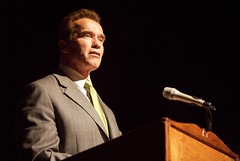
California Governor Arnold SchwarzeneggerImage by Thomas Hawk

"Voter approval of the May 19 measures is needed to complete implementation of the budget Mr. Schwarzenegger signed in February to close a then-$42 billion deficit through July 2010. The budget calls for steep spending cuts and new taxes. Among other things, the ballot measures would impose a spending cap on lawmakers, let the state borrow against future lottery revenue, and divert to the general fund some money voters had earmarked for mental-health and children's programs."

All I do know is that if these propositions fail on May 19th, which seems likely, the state may "borrow" local property taxes.

Cuts Loom in California if Propositions Fail

"The possibilities include cutting $3.6 billion from education, reducing the state's firefighting budget by 10%, and releasing 40,000 low-risk inmates to cut prison costs, Mr. Schwarzenegger said. The state also may have to borrow $2 billion from local governments, he said.

Some would be skeptical about "borrowing".

State proposal could borrow millions from cities

"The proposal would cost Concord about $2.24 million, said City Manager Dan Keen — money the city can ill afford to lose.

"It may be an effort to influence the election upcoming," Keen said. "But if the election fails, we are concerned that the state will have few options, and, given their record in the past, that they will try to come after cities."

Keen is skeptical about the state repaying any money it borrows.

"Their track record isn't very good. We're still waiting on repayment of some loans back in 1993 to redevelopment agencies," Keen said."

This move would cut 8% from local government spending. Many libraries are already facing severe budget cuts from the bad economy.

Library directors vote not to close branches - for now

"On a 6-3 vote, the Santa Cruz Public Libraries' Joint Powers Board on Tuesday asked acting Director Susan Elgin to return with variations on a theme -- how to trim about $1.3 million from the libraries' current $12.6 million budget without closing any of the system's 10 branches."

...

"The Santa Cruz Public Libraries' Joint Powers Board must by July 1 figure out how to balance its $11.4 million budget with an estimated $2.4 million less in sales and property tax revenues than at this time in 2008. The board oversees all libraries in the county except those in Watsonville."

Dwindling sales taxes and falling property values are impacting county and city systems. With the threat of the propositions failing and the state "borrowing" from local property taxes, that could be the nail in the coffin for many libraries.

It's sad to say that when the economy dips, essential services like public libraries get hit hardest. It's ironic that libraries are getting such heavy use, but can often be the first to receive the axe in a bad economy when they are often critical in helping provide workforce development and job training.

Local library awarded grant for job training

"A half dozen libraries across Tennessee are receiving grant funds administered through the Secretary of State’s office for programs that help job-seekers find work.

Libraries in Union City, Ardmore, Rogersville, Johnson City, Decatur and Franklin will each receive $7,500 to set up job training centers. These centers will provide materials and professional services to teach new skills to displaced workers, provide information about career choices and offer resumé writing and job application assistance.

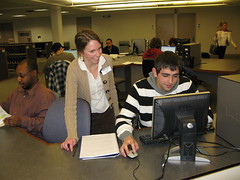
Image by NJLA: New Jersey Library Association via Flickr

Things are tough out there and librarians are very resilient. They are critical to our economic recovery. We will persevere and come out anew during these tough circumstances as always. There always seems to be doom and gloom these days, but libraries are still providing the critical services our public needs both now and for the future.


Friday, March 13, 2009

A New Job

I am happy to announce that I have accepted the position of Deputy County Librarian for Tulare County. My family and I will be moving to California in the next few weeks.

I am very excited about this opportunity and starting this new chapter of my life.