Thursday, December 03, 2009

Top Ten Things


Roy Tennant has a post about 10 things library administrators should know about technology. This was a precursor to an event that happened this Fall at the Digital Library Federation Forum. This post went around the circles with little comment other than re-posting. I didn't find this list very helpful as an administrator. The discussion in libraries shouldn't be "don't be afraid of technology", but "don't be afraid of change." The implementation of that change and the removal of that fear are the keys to success.

From my perspective, I don’t view these types of decisions that Roy brings up as technology decisions. I am sure there are some who say no to technology, but those administrators often say no to everything. Technology is just another tool to use and an administrator weighs whether he can use the tool or not. It's not an either or situation.

Using Tools to Make Connections
Library administration should keep up with current trends so that when staff members come up with ideas, they understand where those ideas are coming from. It will lead to a faster implementation, another way to accomplish the idea, or if the idea will work.

I enjoyed the re-post from the M Word, Marketing Libraries blog for five skills that drive innovation:
SNIP
Associating: The ability to connect seemingly unrelated questions, problems or ideas from different fields.

Questioning: Innovators constantly ask questions that challenge the common wisdom. They ask "why?", "why not?" and "what if?"

Observing: Discovery-driven executives scrutinize common phenomena, particularly the behavior of potential customers.

Experimenting: Innovative entrepreneurs actively try out new ideas by creating prototypes and launching pilots.

Networking: innovators go out of their way to meet people with different ideas and perspectives.

END SNIP

I always remember when I went in for a demo on a product. It was for Vocera. He was demonstrating the product and talking about the things it can do. I remember constantly scribbling in my notebook while he was speaking, even when he was not speaking. My staff asked me if we were supposed to take notes and what was I writing. Even the demonstrator asked. I told them that while he was speaking I was making connections to all the potential for this device. All the things we needed for our library beyond what he was talking about. I think most librarians should be doing this during a product demonstration, but then ferret out what would actually be needed from the product, or if the product is needed at all.

I am not sure Roy's list is very helpful, but for a few points. Technology is getting cheaper and easier, true. It’s relative though. If you have a tight budget and staff uncomfortable with using the tool, or even if the tool will be useful, those weigh into the decision. There is also the danger of having no direction for new services, technology or otherwise. Is this right for the community? I also enjoyed the feature creep discussion here and here. Having new services and technology without rhyme or reason is dangerous for budgets and for staff.

Don't Drown Your Horse
I see the entire list as a re-hash of concepts that have been used before and can be applied to a general view. Don’t be afraid of failure, don’t try to be perfect, are commonly used. However, some of the examples such as "technology gets easier over time" is fine, but the example of installing Unix seems a bit off. That isn't a good example if this article is directed at administrators.

Another piece would be staff buy-in. We can say "don’t be afraid of failure", but when it fails, staff can get pretty frustrated, even angry. Furthermore, without buy-in it just looks like you are shoving things down their throats. Drowning the horse in trying to make him drink.

I don't think administrators are saying no to projects because they involve technology. They say no to projects that they don't understand or aren't sure they have the resources for, staff or otherwise. Those trying to implement or attempting to convince others to implement must have a clear vision of what is to be accomplished and tell a compelling story.

Additional Thoughts
 
"...focus on risk mitigation, not risk elimination," Teri Takai, California State Chief Information Officer.

"In dealing with new ventures, particularly in dealing with technology, you should find ways to mitigate risk, but not eliminate it. New ideas and decisions involve risks, there is no way around it. Knowing what to do when things go wrong is more important than making something foolproof."

Know the organization well enough to understand the impact of the decision.
From Giuliani's Leadership:

"Knowing the small details of a large system leaves a leader open to charges of micromanaging. But understanding how something works is not only a leader's responsibility; it also makes him or her better able to let people do their jobs. If they don't have to explain the basics of what they need and why they need it every time they request more funds or different resources, then they are freer to pursue strategies beyond simply spending what they're given."


"Any sufficiently advanced technology is indistinguishable from magic". -Arthur C. Clarke

Don't abuse tech staff just because they know about technology. There is too much mythology behind those that can get things done. They work hard and love what they do, but they aren't magicians.

We need to move these conversations into conversations about change and not conversations about technology. Everything libraries do is about technology and what kind of service to roll-out is all tied together. It may put them on the cutting edge or the bleeding edge, it may put them on par with everyone else, or they can say it isn't right for them. The choice is made locally for that community. It shouldn't be implemented simply because someone else is doing it; it must be proven locally. Understanding the service to add or to change, knowing its impact on the library and staff, and understanding the return on investment are key pieces. A library needs to decide whether it is worth it to them.
Reblog this post [with Zemanta]

Tuesday, December 01, 2009

Success is determined locally


All politics is local -Tip O'Neil

HAPLR (Hennen's American Public Library Ratings) has ranked public libraries based on several factors for many years. Attempting to compare libraries, apples to apples, by counting books checked out, walk-in business, program attendance, computer usage, and budget allocation among many other factors. Library Journal has also gotten in the game and provided their own ranking system. My interpretation of the intent is to reward libraries for doing a good job and to encourage other libraries to emulate their success.

Every year, libraries across the country must report to their state library.  This data is then sent to the Federal Government and posted at the National Center for Education Statistics (http://nces.ed.gov/surveys/libraries/)

A problem with the numbers
A major problem with this statistical measure is the reporting. Every library in the United States must report on a number of indicators every year to their state government. Sometimes these numbers determine funding from the state, sometimes it doesn't. The survey system isn't very clear in what it is asking and information collected locally doesn't always mesh with what is being asked. Some of the questions are dated and do not reflect how current libraries operate. Number of internet terminals and number of computer users are only very recent additions. "Reference questions asked" has not changed either even though many librarians are answering much more than that, particularly with technology, yet the federal government does not want that tracked.

Antiquated and confusing questions can result in numbers being way too high, way too low, or not reported. As demonstrated in the Library Journal controversy, it wasn't logical that a library had 16 million computer users in a 12 month period. There is quite a bit of data that may seem illogical, but since this information isn't attached to anything financially and libraries don't benefit from this scoring system there is no incentive to take this report seriously. Why then is everyone ranking libraries based on this data?

Statistics or Success
With Hennen and now Library Journal began ranking libraries, it seems to push an agenda, focusing on excellence based on statistics rather than on factors that actually lead to success. Success based on statistics cannot be emulated. Furthermore, placing stars for these libraries doesn't help their budgets or success locally nor does it reflect why they are successful. The information used in the scoring system is also very dated. Information available to Hennen and Library Journal are typically two or even three years behind. So the scoring for the library doesn't reflect what the library is doing currently, but what it was doing years ago.

It was one thing for a marker such as HAPLR to record the scores, it's another thing to star the libraries. It makes libraries focus on the wrong things, statistical markers. It also does something else. I remember when this information was first distributed and one library colleague commented:


Is it really stating that libraries aren't doing their jobs well? That they aren't successful? I enjoyed the discussion on PUB-LIB with my favorite coming from James Casey:

"Susan's gut instinct to look behind the statistics is most assuredly useful for any of us pondering the HAPLR and LJ rating results.  That is clearly evident when HAPLR gives bouquets of praise to libraries serving upscale, suburban communities such as Cuyahoga County (Suburban Cleveland) earning a rating of 893 and Baltimore County at 794 while those excellent public libraries serving large and often underprivileged urban populations draw abysmal scores like 293 for Detroit Public Library, 285 for Chicago Public Library and 385 for Baltimore's Enoch Pratt Public Library.  One has to look behind the statistics to get at reality.

If one were to examine only statistical and output measures in rating the performance of Presidents of the United States (for example), Lincoln would have to be considered one of the most inept and unsuccessful of our Presidents instead of being one of the greatest.  The thousands of deaths, enormous destruction of property, military blunders, idiot generals hired, civil liberties curtailed, etc. have to be considered within the context of the overwhelming difficulties and challenges he had to overcome just to save the Union and bring Slavery to an end.  ---  The work of urban libraries in struggling against ignorance, crime, shrinking property tax bases, crumbling schools, ward politics, etc. is just as heroic and certainly not fairly represented by such dismal scores as 285 and 293. 
"

Some libraries will never be ranked at the top. In fact, in the last ten years, the top ten libraries have been trading spaces, but few have gone off the list and few new libraries have gotten onto the list. What are the real factors behind this? Statistics can never demonstrate that. There are many factors to this success, many however, may not have anything to do with the library's performance. It might be the affluency of the community, the percentage of college educated patrons, or simply the local culture of the area. The library's success can be tied to the community's success and that is very difficult to measure.

Libraries make a difference in their communities/
Librarians are rock stars

I would agree with this statement. I think when librarians or library administration are noticed prominently in the community and respected that it is a true sign of library success. When the local rotary or Kiwanis group calls several times wanting your library director to speak at their next function,  when they are chomping at the bit to provide funding for the library, that organizations and businesses want to be included and fund your projects because it makes them look good, and when the youth librarians get mobbed by little kids Beatles-style when they are out and about in the community- those are signs of success and of librarians being rock stars.

According to an OCLC report From Awareness to Funding, those numbers are not what is important (you can read my lengthy analysis here). I think these statistics are unhelpful and distracting and we certainly shouldn't be awarding stars based on this data. It doesn't really compare libraries and doesn't explain why a library is more successful. Library success is really dependent upon the perception and support of the community, not from a national ranking system. It may give a bit of heft in a performance review, but people in your community coming forth supporting the need is far more powerful.

Reblog this post [with Zemanta]

Thursday, October 01, 2009

Libraries receive stimulus grants, key to economic recovery

Barack Obama

The October 1st deadline for the first round of reporting for stimulus grants is upon us. I remember going to numerous webinars for the American Recovery and Re-investment Act (ARRA) training for these grants. Our library was the recipient of three of these grants. I did quite a bit of research before pursuing these grants as I knew that the reporting requirements were very extreme. I particpated in many a webinar and heavy research before proceeding.

If these webinars did anything, they drilled into your head that the Federal Government was serious about the reporting. Any lack of transparency or errors in reporting can kill your project immediately, result in the return of all funds, and have the agency blackballed from any future projects.You would think that Obama himself is going to show up himself to chastize you and take your money away.  It reminded me of an Art History class I took with my wife in college. Obama as the Pantocrator, a mild but stern, all-powerful judge of humanity.

Not enough for libraries
ALA has done a good job informing libraries about these opportunities. I wonder, however, how many libraries will receive these grants. I was very disappointed by the inability for libraries to get funding for fiber. Even though there have been various reports and studies produced to indicate the need and benefits, it hasn't been backed-up with funding. If there is one thing for sure, libraries will need increased bandwidth for future needs. Furthermore, anyone can tell that libraries are key to the economic recovery (there is an endless supply of stories), but is that backed up by stimulus grant funding? It seems to be lacking so far.

What kinds of grants
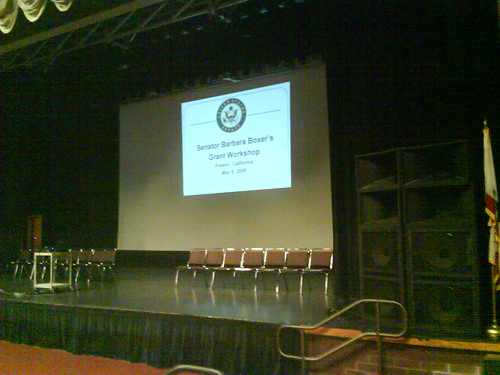
It was time to ramp up the detective-work to find those stimulus grants. I signed up for Grants.gov to receive alerts and began to research the process to get the grants. They were very elusive. Most of the library information about the grants was focused on fiber, most of the others focused on ways to partner with major agencies to receive funding. After attending a conference sponsored by Senator Boxer, I was able to track down several leads. What I did find was an opportunity to renovate some of our branch libraries. The reason why can provide a great explanation of the importance of libraries.

Libraries stimulate the economy
In the end we got the grants, three totalling $165,000. Altogether, we were one of three libraries in the country to receive a USDA stimulus grant and the only one in California. Knowing this about libraries, there should have been more funding to more libraries. I think I will know more about how much libraries received after the October deadline.

We received three stimulus grants from the USDA. The primary reason was that we provided the only public building in some of these areas where unemployment was 19%. In researching the grant, not only was there high rates of unemployment, but almost 80% of the population didn't attain a high school diploma. In rural areas, not only are resources scarce, they are non-existent. There are no buildings or services for the public. There is a school and after-school there is nothing without the library. It's the only public place, a safe place for someone to go where there is nowhere else to go. It's the only chance to get skills to be able to get a high school diploma, to get the skills needed for a job, to be a productive member of society. It starts with the library.

Reblog this post [with Zemanta]

Monday, September 28, 2009

Sony adds nothing new to Reader for libraries

I was disappointed that Sony's August 26th announcement didn't add more to libraries. In my previous post, I thought that Sony presenting at the New York Public Library would indicate improved performance and potential for new services at public libraries. That doesn't seem to be the case. Anything Sony has done for libraries has already been accomplished over a year ago. There's nothing new except one link.

A Link and Nothing More
If you go into the Sony Reader Ebook software, there is now a link to search public library ebooks. I entered my zip code and found the closest library that had Overdrive books. Thus, I was presented with two problems with this set-up. The site link goes to an Internet browser to the library instead of going inside the Sony E-book software. It's great promotion for libraries (that provide the service), but it isn't inside the e-book software to make the search and download process easier to use. It's just a link, nothing more. (photo by by inky (contact)   


Libraries have audiobooks, not as many e-books
The second part was that not that many libraries provide Overdrive, and of those, most provide audiobooks, not e-books. Which bring up this Teleread Post: E-books from public libraries? Not from MINE. Only audiobooks available

CLIP
"So, using the Sony library finder I went to the Somerset County library system. Bernardsville is in Somerset County, so I thought I had it made. Not! The Bernardsville Library, in Bernardsville, Somerset County, is not part of the Somerset County library system. That didn’t work. This week I guess I’ll try to go to a library that is part of the system and see if I can get a card. My own library tells me that I probably can’t. I called some of the other New Jersey libraries mentioned in the Finder but was told "residents only".
END CLIP

Why is this? Mostly because when those libraries began experimenting with services like Overdrive, they found that anyone could download an audiobook to any device. A cheapie from the corner drug store could suffice to open up a world of audiobooks. At first, Ipod users weren't able to, but in the last few months, they even have access. It's the best return on investment.

E-books have always been a tricky thing for Overdrive. At first, the only device the e-book would work on would be a windows Smartphone, but not much else. I lamented this fact in a Teleread post. Six months after I posted that, a Sony Reader upgrade enabled the device to download Overdrive E-books. It was great, I can get anything I wanted onto a device that is great for reading e-books. However, all the announcement from August 26th was a repeat of the fact that they could do that. It took a year for them to announce that? It was curious that they didn't push that after the upgrade. I still can't find much about it.

Just another locked service
So even though Sony is going far farther than others to provide the public with free reading material, they aren't going very far. They are late in the announcement of the compatbility with Overdrive. This affects libraries providing services. We wouldn't purchase and provide something there is no interest in. Often, we have to piggyback our marketing onto others so that we can promote what we provide. If Sony was pushing this, we would have received more demand, instead, we have a bunch of Sony Readers users wondering why more libraries don't provide e-books, but just audiobook downloads. Leading to further frustrate users, again from Teleread (Overdrive offers wireless download application) they announced that Overdrive was offering a downloadable software where you can download Overdrive titles right to your phone...except that it was only for audiobooks not for e-books, and just for windows, not iphone or symbian or android.

The Sony Reader is just as locked up as the Amazon Kindle. Of course, more format will go on the Sony Reader and allow library books, but no one else. It seems to be either an Adobe or an Overdrive issue. What allowed Overdrive books onto Sony Readers as a software upgrade to the Sony Reader itself, AND an upgrade from Adobe Digital Editions. If Adobe Digital Editions could allow the Sony Reader, why not an Iphone or ipod touch, a digital device more commonly used for e-reader (or really ANY e-reading device). Who is locking this down?


Save the Time of the Reader
From my librarian's perspective, what I would like to see is a way to provide free current reading material to the public. Libraries have traditionally provided this beyond any private or group of users. I have a budget to provide books to my community. I could pay for a subscription to something like Overdrive, provide free books online as I do inside our building.

What I would love to do is to be able to pay for a service for patrons to be able to download a program onto their device (cell phone, reader, whatever) and be able to download whatever they want right there. Overdrive seems to be developing it, but at an extremely slow pace. Any slower and they risk being irrelevant as a choice. I would even like to see Overdrive to be able to work inside the Stanza App for the Iphone/Ipod Touch. This is the kind of direction we should be going in. There are so many mobile devices out there, people should be able have access to reading materials that can stimulate, innovate, and please at their fingertips for free. We need to have the digital version of what libraries are already providing.

Reblog this post [with Zemanta]